Key Takeaways:Global Biopharmaceutical & Small Molecule Market Trends
The Biopharmaceutical Market is projected to experience robust annual growth exceeding the broader pharmaceutical industry because an aging global population, rising chronic disease incidence, and expanding wealth in emerging economies drive sustained demand for advanced therapeutics.
The Pipeline Balance between Small Molecules and Biologics is nearing a 50/50 split because the rapid success of GLP-1 agonists has renewed interest in small molecules, expanding their application beyond diabetes and obesity into broader chronic conditions.
Artificial Intelligence in Drug Discovery is rapidly scaling with over 160 clinical candidates developed using AI in 2024 (up from ~20 in 2023) because 60% of life science executives plan to increase AI investments to achieve cost savings of up to 12% of total revenue.
Biopharmaceutical R&D Strategy is shifting toward pipeline optimization and multi-indication candidates because drug pricing pressures, patent expirations, biosimilar competition, and declining R&D productivity force companies to favor lower-risk, high-probability candidates.
1 Global Biopharmaceutical Market
1.1 Growth in demand for all classes of biologic drugs is fueled by several factors. Increasing wealth in emerging economies is resulting in greater levels of diseases previously only observed in mature economies — such as heart disease and diabetes — and the ability to afford more advanced treatments. The global population is also aging, leading to greater incidence of chronic diseases best treated with biologic drugs. IQVIA estimates the total therapeutics market is growing at 2.1%.[1]
1.2 Biologics often offer greater target specificity, efficacy, and safety profiles; therefore the biopharma industry is growing faster than the overall therapeutics market. The growing acceptance of biosimilars as less expensive but as an equally effective and safe option is boosting the overall value of the market, even though it may be negatively impacting sales of originator drugs. Furthermore, in addition to developing novel biologics, branded drug manufacturers are also garnering approvals for additional indications for their existing products and engaging in various life cycle management approaches, in part to ward off biosimilar competition and extend IP coverage.[1]
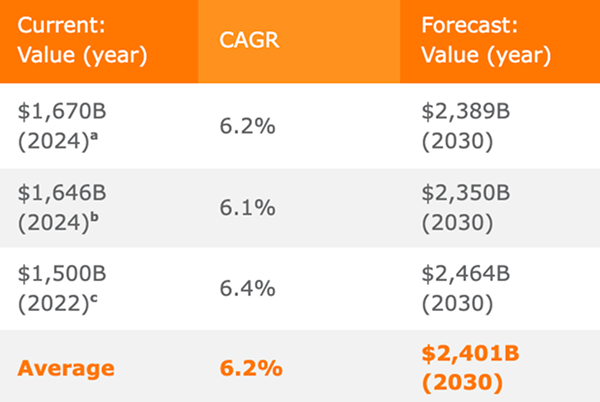
1.3 Although projections differ by source, there continues to be consensus that the biopharmaceutical market will experience robust annual growth over the near future at rates higher than projected for the pharmaceutical industry as a whole. As a consequence, biopharmaceuticals will continue to claim a greater share of the overall prescription drug market (Table 1).
Table 1. Market Forecasts: Global Biopharma
Forecasts as of Oct. 2025. Table References: a[2]; b[3]; c[4]
2 A Look Ahead: New Modalities
2.1. While emerging therapeutic modalities are unlikely to break into the top 10 best-selling drugs by 2030, they are gaining significant traction due to their ability to target novel disease mechanisms. Leading this wave of innovation are:
ADCs, which enhance precision cancer treatment
Multispecific antibodies, designed to engage multiple disease pathways
RNA-based therapies, expanding options in rare and genetic disorders
Gene and cell therapies, driving advancements in personalized medicine
Radiopharmaceuticals, offering targeted radiation delivery for oncology[5]
3 A Look Ahead: Upcoming Trends
3.1. The increasing adoption of these next-generation technologies is contributing to a fundamental market shift — bringing the industry closer to a 50/50 balance between small molecules and biologics.[5] This evolution underscores the growing emphasis on complex, high-value therapies that provide more targeted and durable treatment effects.
Beyond drug innovation, several macro trends are shaping the future of the pharmaceutical industry
AI in drug discovery and development, improving efficiency and decision-making
A deeper understanding of human biology and disease pathways, accelerating precision medicine
Mounting pricing pressures, driven by regulatory scrutiny and payer negotiations
Growing patient engagement, as consumers demand more control over their healthcare choices
Industry-wide volatility, stemming from cybersecurity risks, geopolitical tensions, supply chain disruptions, and economic uncertainties[6]
3.2. Taken together, these forces are pushing pharmaceutical companies to evolve — adopting new business models, streamlining operations, and investing in transformative technologies to remain competitive in an increasingly complex global market.
3.3. AI is emerging as a transformative force in drug discovery and development. While no approved drugs have been developed entirely through AI-driven discovery, its impact is expanding rapidly. In 2024, over 160 clinical candidates were developed using some level of AI, a significant increase from approximately 20 in 2023.[7]
3.4. A Deloitte Center for Health Solutions survey of 150 C-suite executives from pharmaceutical, biotechnology, biosimilar, and medical device companies across North America, Europe, and Asia found that 60% of respondents plan to increase AI investments across the value chain.[7] Deloitte also estimates that AI has the potential to generate up to an 11% increase in value relative to revenue while driving cost savings of up to 12% of total revenue over the next several years. These figures underscore AI’s growing role in accelerating drug discovery, optimizing clinical trial design, and enhancing manufacturing and supply chain efficiencies.
3.5. Despite these advancements, significant challenges remain. According to Deloitte’s survey, pricing and access to drugs and medical devices is the most pressing concern for the life sciences industry. More than one-third of executives also cited competition from generics and biosimilars as a major issue, alongside the impact of patent expirations.[8]
3.6. A decline in R&D productivity is another concern, with over half of surveyed biotech executives planning to reassess their R&D strategies in response to financial pressures and shifting market dynamics. Companies are increasingly focused on pipeline optimization, favoring high-probability candidates and therapies with multiple indications to mitigate risk.
3.7. Beyond pricing and competition, executives also pointed to regulatory uncertainty as a major factor shaping the industry’s future. Key areas of concern include potential regulatory changes in the United States and globally, particularly regarding drug pricing, accelerated approvals, and market exclusivity; the impact of U.S. political shifts, with a new administration and a Republican-controlled Congress likely to influence healthcare policy; persistent inflation and economic volatility, affecting both drug pricing and operational costs; and supply chain disruptions, exacerbated by geopolitical tensions, raw material shortages, and cybersecurity risks.
3.8. The implications of these trends are far-reaching. Speed to market — already a top priority since the COVID-19 pandemic — will become even more critical.[6] As pricing power continues to decline, companies must enhance cost-effectiveness, efficiency, and productivity to maintain profitability. While patient spending is projected to increase, regional disparities will require companies to adapt their pricing and access strategies to different healthcare systems and market conditions.
3.9. To stay competitive, nearly two-thirds of life science executives are prioritizing optimization of their operating models.[8] Over half are leveraging real-world evidence — including clinical, genomic, and patient-reported data — to improve decision-making and regulatory engagement. Nearly one-third of biopharma executives are emphasizing new technologies, such as CAR-T cell therapies and CRISPR-based gene editing, as key areas for investment. Additionally, the success of GLP-1 agonists has also reignited interest in small molecule drugs, expanding their applications beyond obesity and diabetes into other prevalent chronic conditions.
3.10. IQVIA’s assessment of the 2024 biopharma sector concluded that it “largely saw sideways movement at best,” reflecting the complexity of the healthcare system, macroeconomic uncertainty, and industry-specific challenges.[7] However, the overall outlook for 2025 remains positive.
3.11. According to Deloitte, three-quarters of life science executives surveyed are optimistic about the coming year.[8] More than half expect revenue growth and margin expansion, alongside breakthrough innovations and continued operational improvements. While challenges persist, the industry’s ability to adapt, integrate AI-driven efficiencies, and pursue high-value therapeutic opportunities suggests a resilient and evolving pharmaceutical landscape heading into 2025.
FAQs:
How does the growth of biopharmaceuticals compare to the overall pharmaceutical market?
The biopharmaceutical market is projected to grow faster than the overall therapeutics market. Driven by high target specificity, improved safety profiles, and increasing acceptance of biosimilars, biopharmaceuticals are continually taking a larger share of the overall prescription drug market.
What role are GLP-1 agonists playing in small molecule drug development?
The commercial success of GLP-1 agonists has reignited industry interest in small molecule drugs. This success is expanding small molecule applications beyond obesity and diabetes into other prevalent chronic conditions, contributing to a shift toward a 50/50 pipeline balance between small molecules and biologics.
How rapidly is artificial intelligence expanding in biopharmaceutical clinical development?
Artificial intelligence is expanding rapidly in clinical development. In 2024, over 160 clinical candidates were developed using AI, up from approximately 20 in 2023. Additionally, 60% of surveyed life science executives plan to increase AI investments across the value chain.
Why are biotech companies shifting toward multi-indication clinical candidates?
Biotech companies favor candidates with multiple indications to optimize pipelines and mitigate financial risk. Driven by declining R&D productivity, pricing pressures, and patent expirations, companies are prioritizing high-probability candidates that maximize commercial return across multiple therapeutic areas.
What are the main challenges facing life science executives according to industry surveys?
Life science executives cite drug pricing and market access as their most pressing concern. Other primary challenges include generic and biosimilar competition, patent expirations, regulatory uncertainty, persistent inflation, supply chain volatility, and declining R&D productivity.
How are manufacturers adapting to biosimilar competition and patent expirations?
Branded drug manufacturers ward off biosimilar competition by seeking regulatory approvals for additional indications of existing products. They also engage in lifecycle management strategies and optimize operational models to protect IP coverage and maintain profitability despite pricing pressure.

 Forecasts as of Oct. 2025. Table References: a[2]; b[3]; c[4]