Evolution of OSD Technologies: While wet and dry granulation remain industry standards, advanced methods like spray-drying and hot-melt extrusion (HME) are rapidly becoming essential for modern tablet and capsule formulation.
Enhancing Bioavailability: Strategic selection of granulation and oral solid dose manufacturing technologies can significantly improve a drug's bioavailability, potentially unlocking new therapeutic indications for small molecule candidates.
Impact on Therapeutic Outcomes: Small molecule drug developers must navigate the technical trade-offs of different OSD processes to fully optimize the therapeutic efficacy and commercial viability of their compounds.
Strategic Formulation Planning: Understanding the specific limitations and advantages of modern manufacturing technologies is critical for aligning drug delivery with clinical goals.
1 Dispensing
1.1. The first step in any oral solid dose manufacturing process is dispensing the raw materials. In this step, the API and excipient raw materials are weighed accurately and blended in a processing vessel. Some initial processing, such as milling, delumping, or screening, may be required to achieve homogeneous blending of the raw materials and proper particle size. Dust is often the major safety concern, and some materials require special isolator technologies.[1][2]
1.2. Granules, which are made of larger particles than powders, flow better than powders or other blends of ingredients and generally don’t stick to equipment. The ideal granules are spherical, and granular mixtures of APIs should have a narrow size distribution, preferably within 75–850 microns,[3] retain adequate moisture, and possess certain compression characteristics so they can be compressed without breaking and forming excessive dust during tabletting. Granulation can be done by two methods: wet or dry.[4]
2 Dry Granulation
2.1. Dry granulation is the process of compacting powders to larger particulates by applying mechanical stress. Compaction forces air out to create a stable compact, which is then milled to create the appropriate-sized granules.
2.2. Dry granulation is most commonly done by two methods: roller compaction or slugging. The most common method, roller compaction, compacts powders into a solid mass in the form of a ribbon or flakes between counter-rotating rolling pins and then passes the ribbon or flakes through a mesh. The granule size increases with pressure. Slugging, also called precompression or double compression, is a method where a conventional tablet press compresses powders into large tablets (25 mm diameter, 10–15 mm thickness) called slugs. The slugs are then milled and screened to create granules. Although this method is preferred for APIs that cannot handle moisture or the compaction forces required for roller compaction, solids with low density or small particles do not flow well into the die, so the slugs created can vary.[4]
2.3. Although dry granulation is cost-effective and preferred for moisture-sensitive APIs, compacted materials often undergo elastic recovery, and not all powders have physical properties that are amenable to dry granulation. In such instances, some method of wet granulation is often employed.
3 Wet Granulation
3.1. Wet granulation is the most common method of granulation and is a process of mixing the dry ingredients with a wet binder, such as water or solvent. After the API and excipients are milled, delumped, or screened, the blend of excipients and APIs are mixed with water or solvents. Depending on the equipment, especially the type of impeller used in mixing, the process can be high or low shear. Choppers or impellers are common, which generate high-shear forces. High-shear granulation excels in producing dense granules with diameters less than 2 mm.[5] If the viscosity and density of the liquids is similar, or if the solids readily dissolve, low-shear impellers can be employed. These hydrofoil impellers lack sharp edges, and the resulting flow-based mixing is more laminar and less turbulent.[6]
3.2. The resulting lumpy and sticky wet mass is conditioned by wet milling or otherwise conditioned so that particles of uniform size are fed into a fluidized bed dryer. Consistent granule size is critical in this step because excessively large granules will remain moist in the center, while inadequate granules will overdry and become too hard. Overdrying the bulk materials can lead to excessive production of fines (and aerated dust), which presents health hazards as well as waste. Wet milling also serves to enhance homogeneity and facilitate flow into the dryer. High-sheer granulation can be done in batch process or as a continuous process.[5][7]
3.3. When very low-dose API formulations are required, or when the flow properties of the blend aren’t suitable for mixing with an impeller, fluidized bed drying is commonly employed. In this process, the API and excipient blend is fluidized with air. The binder is then sprayed onto the powder to create granules. Fluidized bed drying can produce consistently sized granules and accommodate heat-sensitive compounds, but the process must be carefully optimized and controlled.[8]
3.4. The solvents used in all types of wet granulation methods must be nontoxic and volatile so that they evaporate during drying. Water, ethanol, and isopropanol are common solvents used either alone or in mixtures. Water can effectively bind particles together, but evaporation reduces the effect. To maintain the particle size upon drying, binders are often used.[7] Common water-based natural binders include glucose, sucrose, sorbitol, starch, and gelatin. Synthetic polymers are also used, particularly in solvents such as isopropyl alcohol. These include polyvinylpyrrolidone (PVP) and hydroxypropyl methylcellulose (HPMC).[9] The properly dried granules are then milled again to their final desired size.[3]
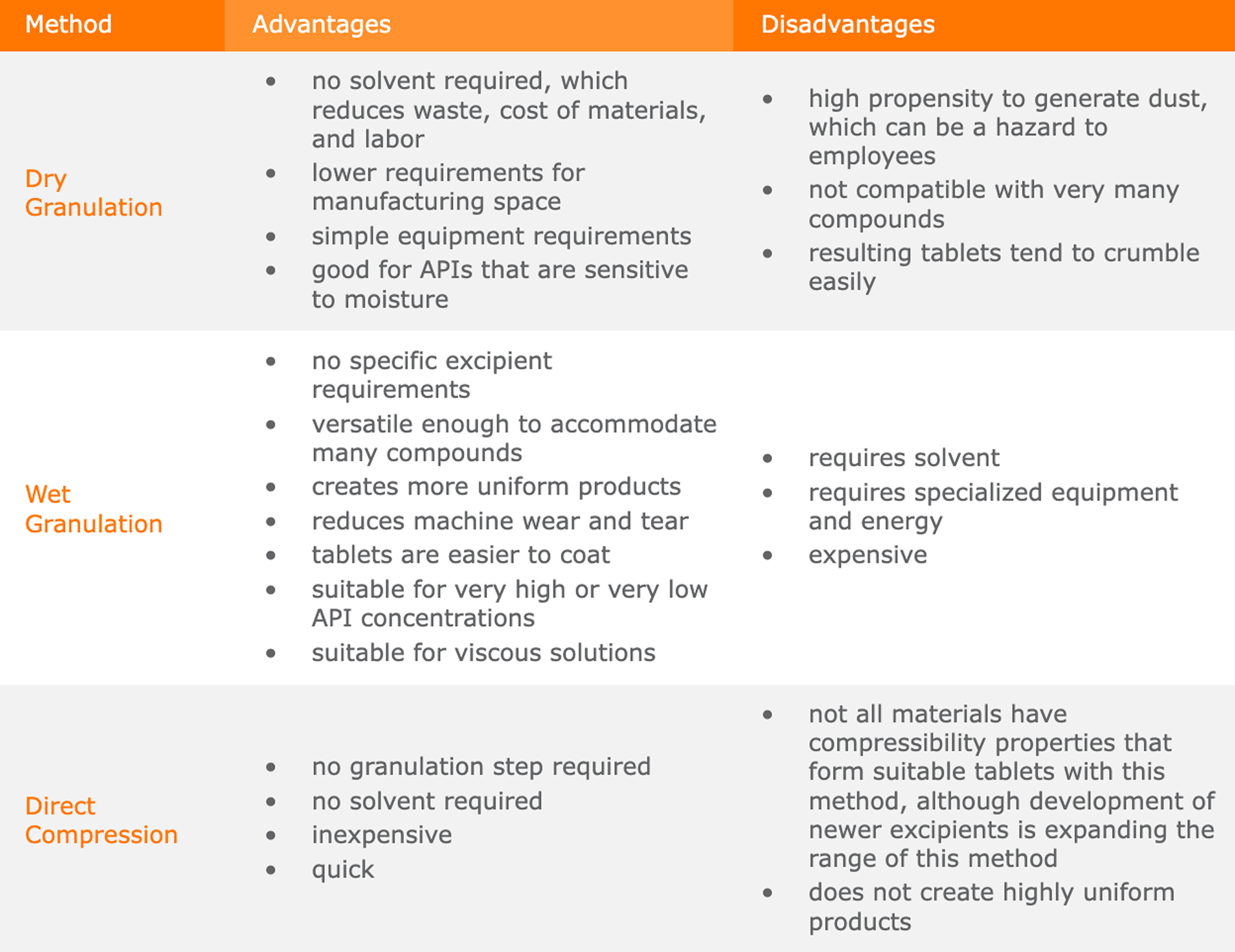
3.5. Table 1 presents a comparison of wet granulation, dry granulation, and direct compression methods.
Table 1. Comparison of Wet Granulation, Dry Granulation, and Direct Compression
Source: adapted from iPharMachine[10]
4 Spray-Drying
4.1. Spray-drying is a widely used technique for converting liquid formulations into dry powders through atomization and rapid solvent evaporation in a heated gas stream. Originally developed for food and dairy applications, spray-drying has become an essential process in pharmaceutical and biopharmaceutical formulation, particularly for producing powders with controlled particle properties, enhanced stability, and improved bioavailability.[11][12]
4.2. The process consists of atomizing a solution, suspension, or emulsion into fine droplets, which are immediately exposed to a high-temperature gas stream, resulting in rapid solvent evaporation and solid particle formation.[11] The dried particles are then separated from the gas stream via a cyclone or filter. Spray-drying is recognized for its scalability, consistency, and economic efficiency, particularly in manufacturing amorphous solid dispersions (ASDs) that enhance the solubility of poorly soluble small molecule drugs.[13][14] The technique is also increasingly applied to biopharmaceuticals, including proteins, peptides, and vaccines, as a means of improving stability, extending shelf life, and enabling novel drug delivery approaches, such as pulmonary and parenteral administration.[15]
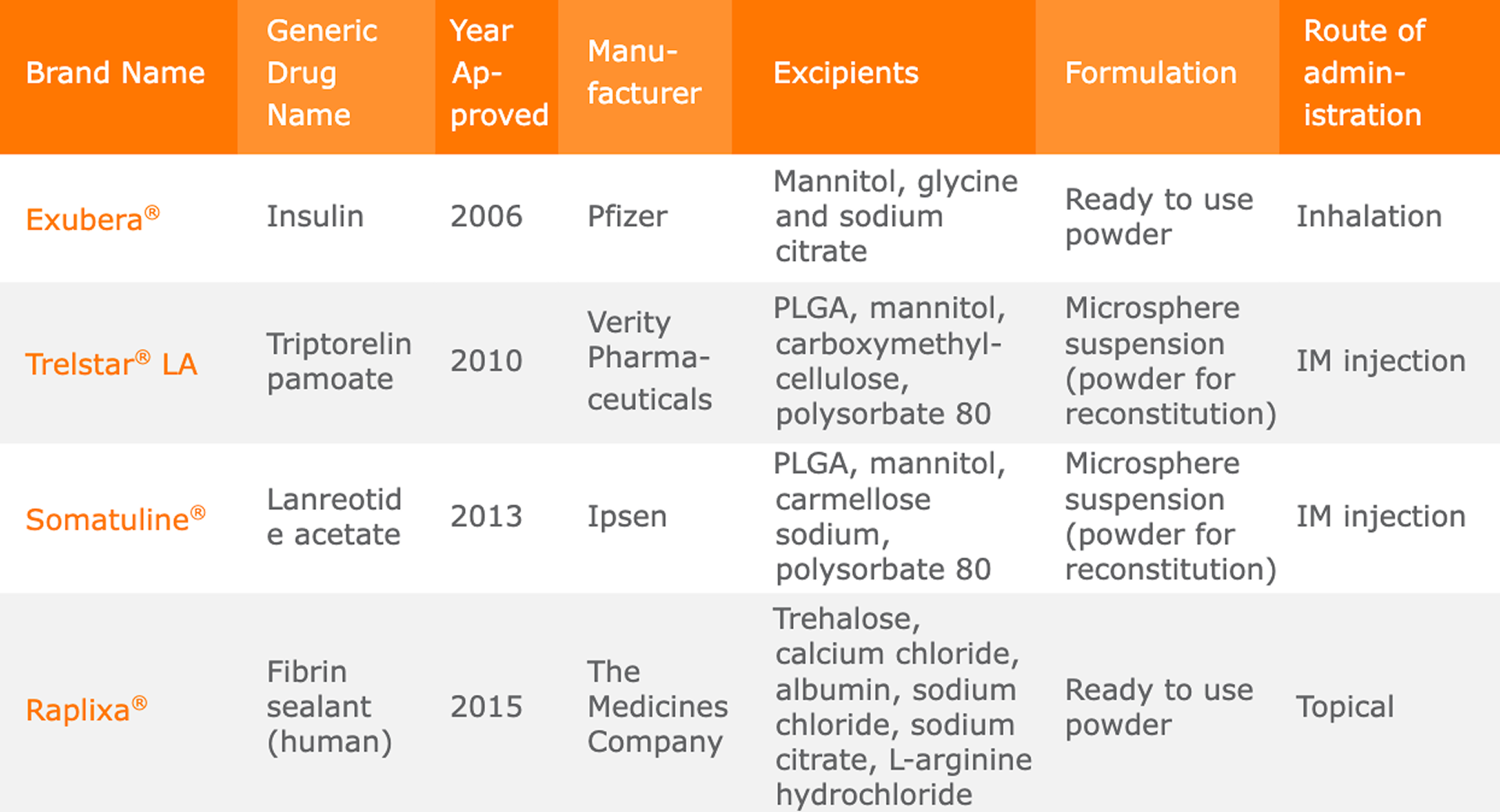
4.3. The critical process parameters in spray-drying include atomization, drying gas flow rate, feed composition, inlet/outlet temperature, and airflow pattern.[16][17] Atomization, achieved via rotary, pressure, pneumatic, or ultrasonic nozzles, determines the size, distribution, and morphology of the resulting particles, impacting flowability, dissolution rate, and aerodynamic properties for drug delivery.[18][19] Airflow patterns — co-current, countercurrent, or mixed flow — also influence temperature exposure and drying efficiency, with co-current flow being preferred for heat-sensitive materials. Additionally, feed solution properties, such as viscosity, solubility, and excipient composition, play crucial roles in stabilizing the API and preventing crystallization.[20] The ability to fine-tune these parameters allows manufacturers to tailor spray-dried formulations for specific therapeutic applications, making it a versatile and powerful tool in drug development. Some examples of approved drugs that are made by spray-drying are presented in Table 2.[21]
Table 2. Selected Examples of Drugs Made by Spray-Drying
Source: Pinto et al.[21]
5 Hot-Melt Extrusion
5.1. Hot-melt extrusion (HME) is a continuous manufacturing process for mixing materials using a rotating screw. Single-screw extruders (SSE), twin-screw extruders (TSEs), or multi-screw extruders (MSEs) are all employed within the pharmaceutical industry. Temperatures are maintained above the glass transition temperature (Tg) or even the melting temperature (Tm) of the materials involved. The technique has been gaining popularity since the 1970s because it enables efficient mixing of water-insoluble or poorly soluble active pharmaceutical ingredients (APIs) at low temperatures, with low shear forces, and with smaller requirements for solvents. Final dosage forms prepared with HME can also benefit from increased efficiency of drug delivery to the patient.[22]
5.2. The manufacturing process itself is readily amenable to scaling up, quality by design (QbD) development, and extensive use of process analytical technologies (PAT).
5.3. HME screws are made of surface-coated stainless steel to prevent friction and generation of heat. Single-screw extruders, as the name implies, contain one rotating screw. They are reliable, low-cost, and low-maintenance machines that generally provide high-quality mixing for simple projects. They are prone to overheating, however, and cannot sufficiently mix viscous components.[22]
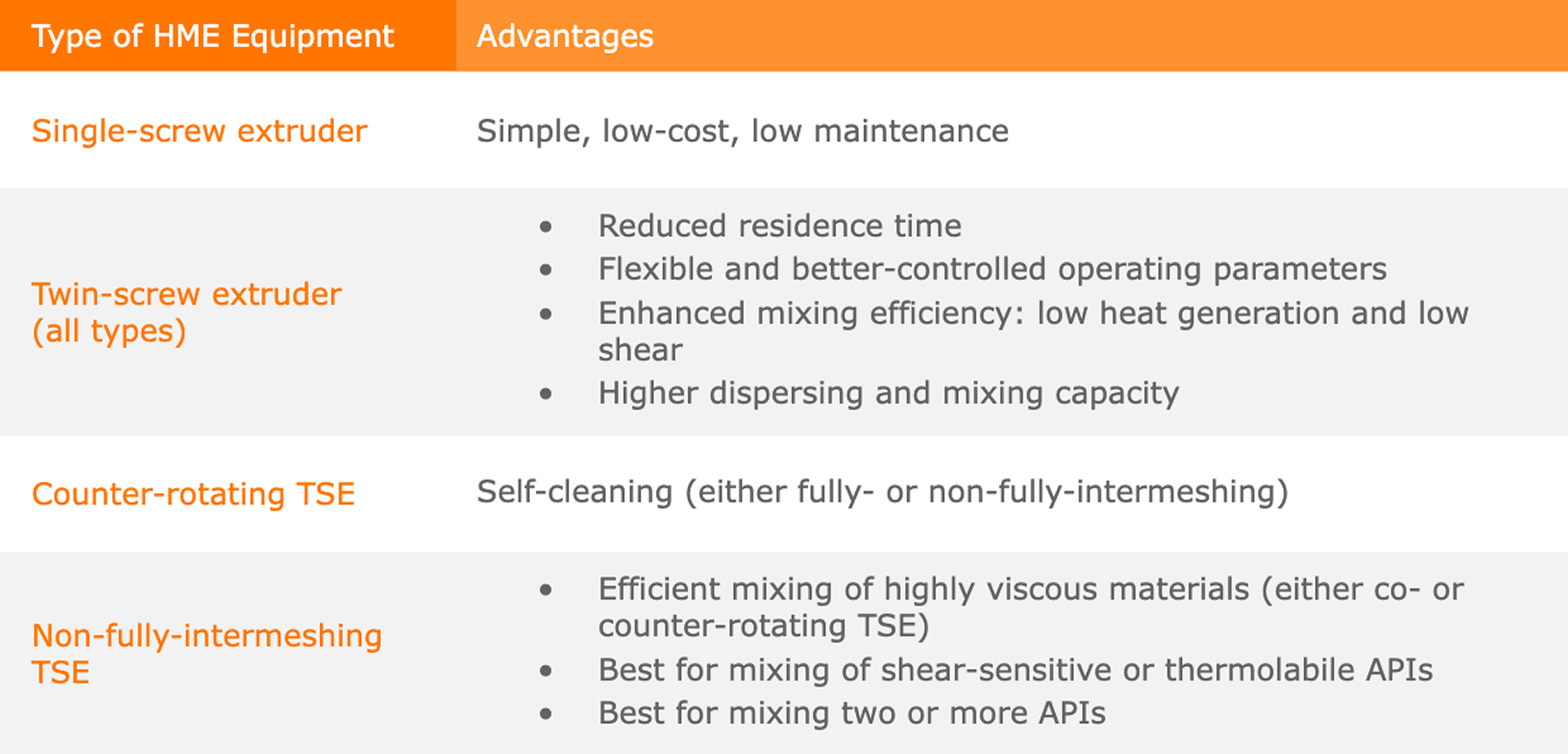
5.4. Twin-screw extruders (TSEs) are configured with parallel screws that rotate either in the same direction (co-rotating) or opposite each other (counter-rotating). In either configuration, the threads of the two screws can be fully intermeshing or non-intermeshing. Counter-rotating TSEs are useful in the pharmaceutical industry because they are self-cleaning. Non-intermeshing TSEs have the advantage of efficiently mixing viscous compounds with low shear and low heat generation. Some important advantages of different hot-melt configurations are given in Table 3.[22]
Table 3. Advantages of Different Hot-Melt Extrusion Configurations
Source: Patil, Tiwari, and Repka[22]
5.5. HME processes can range from 30 °C to 250 °C. Because only small amounts of the API are available during early development, HME at small scale is a common starting development point. A typical pilot-scale TSE will range from 18 mm to 30 mm, while a production scale TSE can range from 50 mm to 60 mm. Scale-up is straightforward, however, in that much of the scale-up involves longer continuous processing times rather than the resizing required for batch processing, such as the change in volumes and mixing speed conversions required for bioreactor scale-up.[22]
5.6. The screw is divided along its length into three equal sections as follows:
The feed section is where the stock ingredients are delivered directly from the hopper. The flights (threads) have a greater pitch in this region to allow the material to flow easily.
The compression section is the middle of the screw where the material begins to soften and melt. In this region, the temperature and mass flow rate are tightly controlled, and the components are mixed.
The metering section is at the end of the screw where the molten strand leaves the extruder die and the final shape is formed. The shaping methods can be calendaring, which creates a film, or pellet forming. Pellets are typically 3 mm to 20 mm.[22]
5.7. After it is extruded, the final material will experience die swell, in which the material expands before it cools and hardens into its final shape. The amount of die swell incurred during any process depends on the viscoelastic properties of the polymers involved. This step is a focus of heavy computer modeling in the industry.[22]
5.8. Broadly speaking, the components of an HME process are as follows:
API. The API used in these processes is typically a water-insoluble or poorly soluble small molecule. In their crystalline state, APIs have an ordered, lattice structure that is chemically stable and readily processed in HME. Crystalline-state APIs are mostly used in controlled-release preparations. Crystalline APIs are, however, even more poorly soluble than amorphous preparations of the same chemical entity. Amorphous preparations, while more soluble, are thermodynamically unstable. When using amorphous preparations, the glass transition temperature (Tg) must be carefully monitored, both on its own and as the API interacts with other ingredients.
Excipients. The key to formulating an API for an HME process is the excipient. Excipients can broadly be characterized as carriers, release-modifying agents, fillers, or stabilizing agents. All excipients must be meltable, of high quality, and thermostable. Meltable carriers include carnauba and ethyl cellulose, and polymers such as polyvinylpyrrolidone (PVP). Starch and starch derivatives have also been used in HME processes.
Plasticizers. Plasticizers are low-molecular-weight compounds that function to soften the other components of the HME formulation, thereby lowering the required processing temperature. They often alter the die swelling properties of the final dosage form. Commonly used plasticizers include citrate ester and D-alpha tocopheryl PEG 1000 succinate (a derivative of vitamin E).
5.9. HME is amendable to QbD principles and PAT. For example, near-infrared (NIR) spectroscopy has been applied to measure the API content in extruded films and co-crystal purity, while Raman spectroscopy has been used in-line to measure polymer–drug ratios.[22]
5.10. HME is finding use in reformulation of existing therapeutics, especially generic APIs. The new formulations often alter the drug delivery characteristics, which can have a number of benefits, including targeting to different organs, masking of bitter tastes, or metering the release over time in the patient. A few selected examples are presented in Table 4.[22]
Table 4. Selected Examples of HME Reformulations
Table compiled from Simões, Pinto, and Simões.[23]. Drug references: a[24], b[25], c[26], d[27], e[28], f[29]
6 Tablet Manufacturing
6.1. No matter the granulation method, granules with appropriate characteristics are processed into tablets. Small-scale tablet manufacturing can be done on a single punch machine, in which one tablet is compressed at a time. Commercial tablets are manufactured on rotary tablet presses, which operate continuously. Tablet presses are designed to apply precise, consistent pressure to form the pill. Such machines are efficient, capable of producing large quantities of tablets, and versatile enough to produce various shapes, sizes, and formulations. The ideal particle size for compression into tablets is 75–850 microns.[3]
6.2. The compression process can be divided into four stages.[30]
Filling. The top and bottom punch retract, creating a cavity in the die. Granulated API is delivered to the cavity.
Metering. The bottom punch moves upward to expel excess material from the die cavity.
Compression. The top punch is lowered and the bottom punch is delivered upward to compress the powder into the tablet.
Ejection. The top punch moves away from the compressed tablet and the bottom punch moves upward to push the tablet out of the die cavity.[30]
7 Capsule Manufacturing
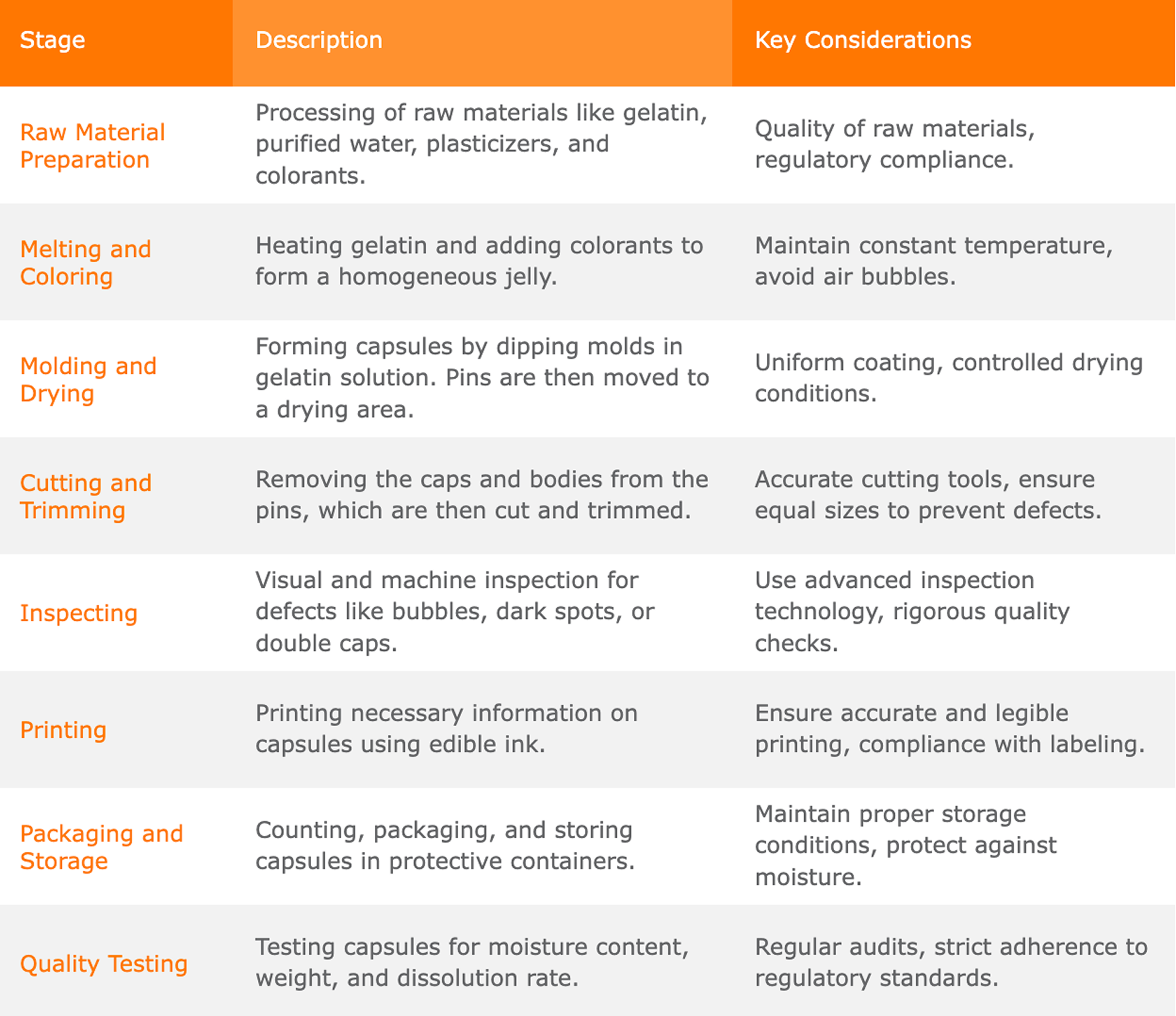
7.1. Hard capsules are manufactured as empty shells and subsequently filled with appropriate granule, powder, or pellets. Manufacturing of the empty hard capsules involves eight steps, which are summarized in Table 5. The final empty capsule must adhere to the same quality standards as the API itself. To ensure quality, final capsules are imaged to assess any bubbles, dark spots, or improper fit.[31] Small-scale equipment can fill 200–2,000 capsules per hour, whereas a commercial filling line can manufacture 42,000 capsules per hour.[32]
7.2. Softgel shells are made and filled in one step. Two ribbons of properly mixed gelatin and dyes are fed across roller dies. Where they meet, liquid API is injected into the die and the rollers compress to seal the capsule. The capsules are then dried for hours to days to allow them to harden completely.[33][34]
7.3. Filled capsules (hard or soft) are printed with drug or brand information using edible ink, and quality checks are again performed to ensure the printed information is legible and properly positioned. The capsules are then counted and packed into bottles, blister packs, or other packaging. The packaging must protect the capsules from light and moisture, among other environmental stresses.[31]
Table 5. Hard Capsule Manufacturing Process Steps
Source: reproduced from SED Pharma[31]
FAQs
What are the main differences between wet and dry granulation?
Wet granulation utilizes a liquid binder like water or ethanol to create a sticky mass that is subsequently dried and milled. In contrast, dry granulation creates larger particles by applying mechanical stress through roller compaction or slugging without moisture. While wet granulation is more versatile for various concentrations, dry granulation is preferred for moisture-sensitive APIs.
How does hot-melt extrusion (HME) improve drug bioavailability?
Hot-melt extrusion improves bioavailability by mixing poorly soluble APIs with thermoplastic polymers at temperatures above their glass transition state to form amorphous solid dispersions. This molecular-level blending breaks down crystalline lattice structures, allowing water-insoluble compounds to dissolve more readily in the gastrointestinal tract.
What is the role of spray-drying in pharmaceutical manufacturing?
Spray-drying converts liquid formulations into dry powders through atomization and rapid solvent evaporation in a heated gas stream. This process is essential for producing amorphous solid dispersions (ASDs) and heat-sensitive biopharmaceuticals. It allows for precise control over particle morphology, which is critical for specialized delivery routes like pulmonary or parenteral administration.
How are twin-screw extruders (TSE) used in hot-melt extrusion?
Twin-screw extruders utilize parallel rotating screws to provide high-intensity mixing with lower heat generation compared to single-screw models. These configurations are favored in OSD manufacturing for their self-cleaning properties and their ability to handle highly viscous materials or shear-sensitive APIs. Scaling up is generally straightforward by extending processing times.
What are the four stages of the tablet compression process?
Tablet compression on a rotary press consists of filling, metering, compression, and ejection. First, the die cavity is filled with granulated API; then, excess material is expelled to ensure precise dosage. High pressure is applied by top and bottom punches to form the tablet before the bottom punch expels the finished product.
What is the difference between hard and softgel capsule manufacturing?
Hard capsules are produced as two-piece empty shells that are subsequently filled with dry granules, powders, or pellets. Conversely, softgels are manufactured and filled in a single step where liquid API is injected between two gelatin ribbons and sealed by roller dies. Softgels require significant drying time to harden, while hard capsules focus on accurate shell fit and printing.
Gaspar, Filipe et al. Spray Drying: Scale-Up and Manufacturing. In: Shah, Navnit et al., eds. Amorphous Solid Dispersions: Theory and Practice. Springer; 2014:261–302.
Lefebvre, Arthur H., and Vincent G. McDonell. Atomization and Sprays. 2nd Ed. CRC Press; 2017.
 Source: adapted from iPharMachine[10]
 Source: Pinto et al.[21]
 Source: Patil, Tiwari, and Repka[22]
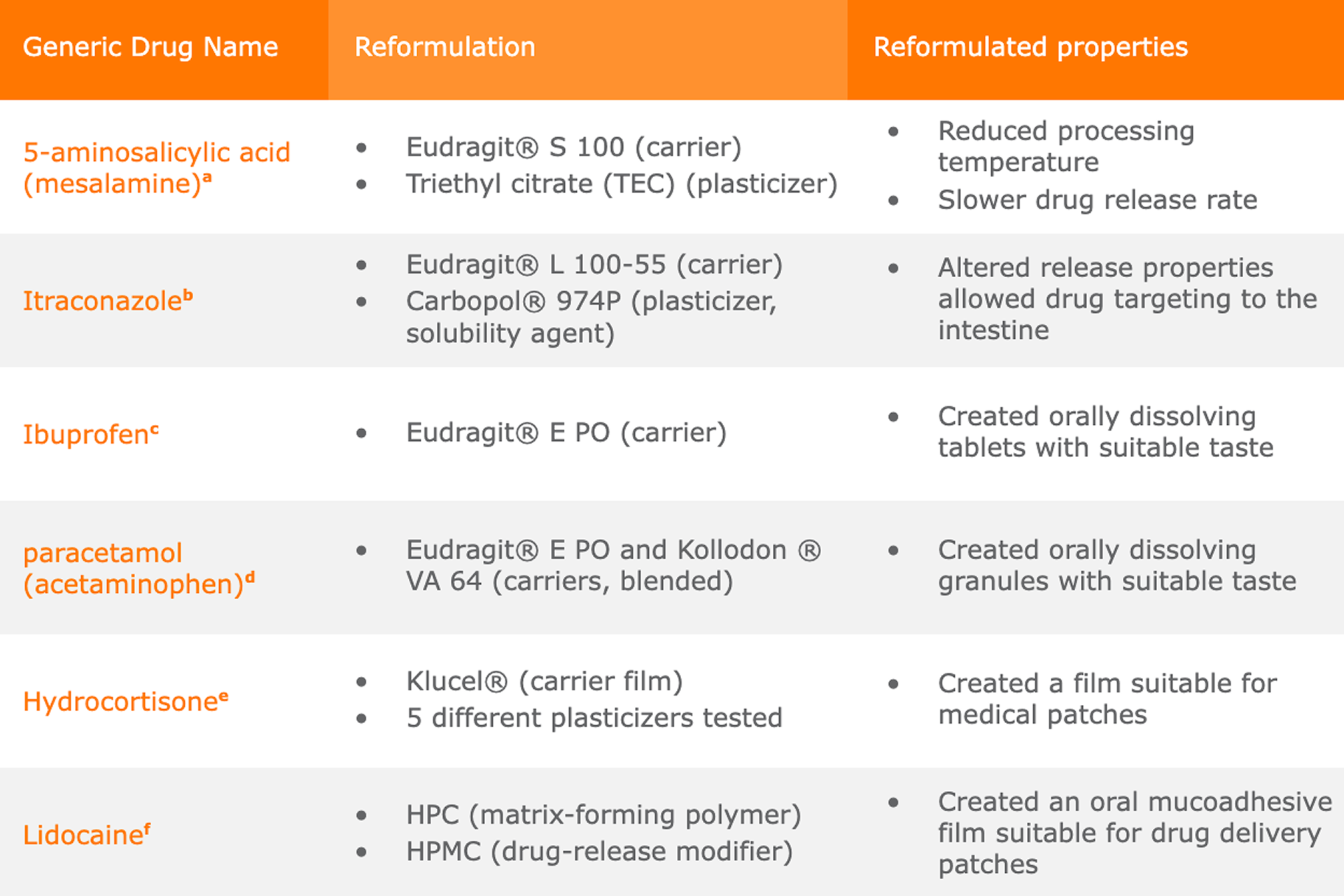 Table compiled from Simões, Pinto, and Simões.[23]. Drug references: a[24], b[25], c[26], d[27], e[28], f[29]
 Source: reproduced from SED Pharma[31]