Standardization of Single-Use Technology: Single-use systems (SUS) have become the industry standard across both upstream and downstream biomanufacturing, significantly reducing cross-contamination risks and turnaround times.
High-Throughput Process Development: The integration of advanced systems—such as ambr® microbioreactors and automated robocolumns—allows for rapid, data-driven optimization and more robust bioprocessing outcomes.
Operational Flexibility for CDMOs: Modern bioprocessing technologies enable Contract Development and Manufacturing Organizations (CDMOs) to pivot quickly between diverse client projects while maintaining strict quality standards and accelerated clinical timelines.
Enhanced Scalability and Efficiency: By leveraging automated, high-throughput tools, manufacturers can ensure a seamless transition from benchtop research to commercial-scale production without compromising process integrity.
1 Upstream Manufacturing Technologies
1.1 While techniques used to culture mammalian cells expressing recombinant protein products have not fundamentally changed over the past 30 years, there have been significant advances. The most significant of these, especially for mammalian cell culture, is the introduction and general acceptance of disposable single-use systems (SUS) that feature polymeric plastic product contact surfaces. In place of traditional stainless-steel bioreactors, processing vessels, hold tanks, and piping — which tend to be fixed and require cleaning between manufacturing batches using expensive clean steam and water — the industry has adopted SUS, which are generally more flexible and are disposed of after processing. This greatly reduces turnaround time between batches and increases facility throughput on a batch-per-year basis. It also eliminates the need to validate cleaning procedures.
1.2 In recent years, 2,000-L single-use bioreactors (SUBs) have become an accepted mammalian cell culture production platform, being well-sized for clinical manufacture of mAbs, fusion proteins, and many recombinant products. As product titers have increased (see above) the 2,000-L volumetric scale has also become increasingly appropriate for commercial manufacture and market supply for many products — especially those serving smaller markets. Scale-up is achieved horizontally by adding parallel systems and by configuring and operating manufacturing trains so that purification suites can serve multiple 2,000-L bioreactor trains. Bioreactor bags can be custom configured for specific processes or to fit specific facilities. The cost benefits of single-use bioreactors tend to diminish as total volumetric capacity requirements increase. As a result, larger-scale (5,000-L to 20,000-L) stainless-steel bioreactors remain widely utilized for high-volume products.
1.3 Single-use technologies (SUT) are seen as supporting flexible cGMP manufacturing operations and enabling efficient and rapid adjustment of production schedules and volumes and even system reconfigurations, combined with ease of process replication and relocation to other global sites or to contract manufacturers.[1] This flexibility is of particular importance to biopharmaceutical CDMOs dealing with multiproduct operations, different processes, and the often-changing commercial requirements and project timelines of third-party customers.
1.4 Disposable systems also facilitate the implementation of key regulatory initiatives, such as quality by design (QbD), the use of process analytical technology (PAT), and continuous bioprocessing.[1] For products that do not require large production volumes, the ability to use similar equipment configurations and the same materials across process development, clinical, and commercial scales simplifies scale-up and technology transfer, helping to accelerate time to market. Access to SUT is also in some cases enabling smaller biotechnology companies to pursue in-house process development and cGMP manufacturing rather than relying on outsourcing partners.[1]
1.5 Single-use systems do have some drawbacks. Validated studies are required to demonstrate that extractable and leachable components of the polymers used to manufacture the disposable bags, tubing, and other product contact surfaces are not present in the final product. There are also limitations to the size at which these systems can be operated — based both on physics and the need for human operators to install, operate, and move components. The 2,000-L scale has become the currently accepted norm, but companies such as ABEC (Custom Single Run [CSR®]) and Thermo Fisher Scientific (HyPerforma™) are now delivering larger-capacity SUS. ABEC currently offers single-use bioreactors to 6,000-L scale, fermenters to 1,000-L scale, and mixing vessels to 7,000-L scale. Concerns remain over the environmental impacts of both manufacturing and disposing of plastic components.
1.6 Primary suppliers of single-use components for bioprocessing include Cytiva (formerly GE Healthcare), Pall, Sartorius, Thermo Fisher Scientific, MilliporeSigma, and ABEC. A continuing concern among industry sources is the lack of standardization and inability of single-use components (for both upstream and downstream processing) from different manufacturers to be efficiently connected to one another. PAK BioSolutions is attempting to address process flow and control issues for SUS.
1.7 Many innovations in bioreactor design are being driven by the advanced cell and gene therapy space, where cell lines that need to be grown in adherent (vs. suspension) culture are more prevalent. Companies such as Cytiva (iCELLis™ platform) and Univercells (scale-X™ platform) are active in this space, while companies such as Cellares (Cell Shuttle™) are developing automated systems and “facility-in-a-box” offerings to support the manufacture of cellular therapies. In parallel, work continues to adapt such lines to suspension culture to facilitate scale-up and large-scale production where needed — for example, in the production of AAVs where 2,000-L scale production has become established.
1.8 Not directly involved in biomanufacturing but increasingly crucial to the rapid development of commercially viable upstream manufacturing processes are a number of microbioreactor systems that allow a wide range of process variables to be rapidly screened for their impact on cell growth, productivity, and product quality using statistical design of experiments (DoE) approaches. Sartorius’ Ambr® platform has rapidly gained market prominence in developing fed-batch processes, while Erbi Biosystems’ Breez™ system fills a similar role for perfusion processes and was acquired by MilliporeSigma in 2023.[2] Getinge’s Applikon MiniBio system bridges the gap to pilot-scale production.
1.9 Currently, upstream SUTs dominate precommercial (lab through clinical scale) biopharmaceutical manufacturing. BioPlan Associates, in its 2020 report and survey on biopharmaceutical manufacturing capacity and production, reported that nearly 85% of survey respondents use single-use bioreactors and estimated that more than 85% of precommercial product manufacturing now involves substantial use of SUS.[3]
1.10 Primary production fed-batch bioreactors do not function without an inoculum train of sequentially scaled smaller bioreactors that allow mammalian cells to be grown to sufficient cell density before progressing to a larger volumetric scale vessel. There has been significant recent investment in process intensification methods that allow cells to be quickly taken to very high densities at the N-1 stage of inoculum before seeding primary production bioreactors.
1.11 The culture of mammalian cells for production of biopharmaceuticals is not new, having been employed by companies such as Centocor (now Johnson & Johnson) in the 1990s. It is once again gaining prominence, driven by optimized feeding strategies and the ability to continuously harvest product using alternating tangential flow (ATF) cell separation, as pioneered by Repligen (XCell ATF®). Growth medium containing cells is continuously drawn from the production bioreactor, and clarified medium containing target-expressed protein (but no cells) is continuously removed using hollow fibers and a vacuum mechanism to be purified. Cells are returned to the production bioreactor for continued growth and expression. Sophisticated nutrient feeds and control strategies are used to replenish those lost with harvested medium. This approach theoretically allows cells to be maintained in the high growth and productivity phase for longer than is achievable in fed-batch culture. This technology is now being widely employed both to generate high-density feed streams for traditional batch culture (saving time and space by eliminating sequential bioreactors in the inoculum train) and for continuous harvest of primary production vessels.
1.12 Perfusion culture and large-scale batch culture require significant volumes of growth media and buffers for purification. Associated challenges in preparation and delivery are being addressed by use of single-use mixing systems and a range of novel high-speed, in-line mixing, dilution, and filtration technologies for both custom and off-the-shelf powdered chemically defined media components that simplify production and obviate some storage needs.
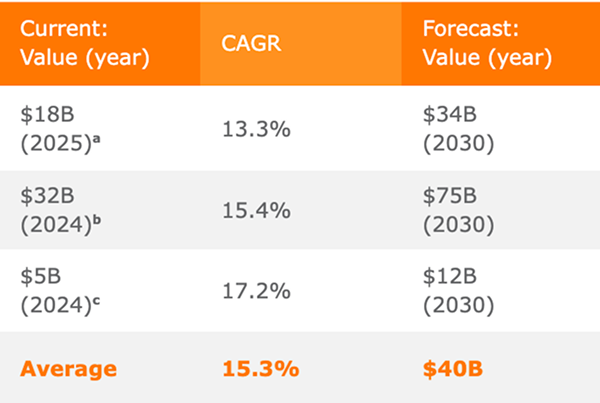
1.13 As demonstrated in Table 1, valuations for the single-use technology market can vary widely. The common factor, however, is that this portion of the global pharmaceutical market is among its fastest-growing segments.
Forecasts as of Oct. 2025. Table References: a[4]; b[5]; c[6]
2 Purification Technologies
2.1 Advances in expression systems and output from upstream processing have placed significant strain on purification facilities and stimulated a range of technology developments in downstream processing. These technologies were largely developed to increase processing speed without compromising product quality and purity. Efforts also persist to replace expensive chromatography resins — particularly protein A, which is the predominant affinity chromatography resin used for purification of mAbs and derivative products.
2.2 Here, too, single-use systems have become standard fare, especially for filtration cartridges and connectors but also via disposable, prepacked chromatography columns.
2.3 Filtration advances gaining recognition include single-pass tangential flow filtration (SPTFF), which employs long feed channel paths that allow conversion after a single pass based on longer membrane residence time.[7][8] Knock-on benefits include reduced hold-up volumes, elimination of holding tanks, and application in continuous processing.
2.4 Companies such as Natrix Separations (MilliporeSigma) have delivered improved capacity for membrane-based purification systems with faster exchange kinetics to deliver the potential for faster processing compared with traditional column chromatography techniques typically employing cellulosic or other bead matrices. The Natrix® Q membrane is a porous polyacrylamide hydrogel placed in a disposable cartridge format that delivers anion exchange. In addition to processing speed, potential benefits of this and similar approaches include reduced facility footprint, elimination of column packing and storage, and reduced buffer usage.
2.5 Cytiva is taking a parallel approach, employing cellulosic nanofibers manufactured by electrospinning techniques and using them in multiple short cycles as a chromatography matrix.[9] Fibers in disposable Fibro™ cartridges feature highly open structures, which facilitate mass transfer without diffusion and a high surface area. As a result, high binding capacities are achieved after seconds of residence time compared with the minutes typically required using traditional bead chromatography. This in turn delivers very rapid purification cycles and shortened processing times. Smaller columns can be cycled up to 200 times in a single batch, theoretically allowing the full lifetime of a protein A ligand/matrix at much smaller quantities than when used in bead chromatography.
2.6 In parallel with these novel approaches, efficiencies are being introduced for traditional column bead matrix chromatography approaches. Prepacked columns have been marketed for more than a decade. Disposable, single-use column systems are gaining in popularity and offer potential benefits by eliminating the need for column packing and resin or column storage. Examples include Repligen’s OPUS® platform and Cytiva’s ÄKTA ready™ system. Work continues on developing higher-capacity, faster-flowing, uniform bead matrices, such as Purolite’s Praesto™ Pure agarose bead matrix, for multiple chromatography applications.
2.7 Protein A affinity chromatography remains a highly effective means of separating mAbs and derivatives based on unique and specific binding characteristics. It is also well accepted by regulatory bodies and widely available. The price of protein A chromatography resins remains high, however, and typically represents a significant component in the cost of antibody manufacture. In addition, protein A ligands tend to be sensitive to column-cleaning methods, which can shorten useful life. Considerable effort has focused on improving the durability and efficiency of protein A chromatography and on identifying alternatives, though after more than a decade, no significant replacements have yet to be adopted. Companies such as Avitide now offer the development of custom, product-specific affinity chromatography ligands that promise to deliver improved performance and cost of goods. Despite some efforts, no commercial alternative to various chromatographic techniques has yet to achieve commercial success or regulatory approval.
2.8 Chromatography protocols featuring variable load rates, typically using short column lengths, have decreased processing times and improved efficiency by loading columns rapidly at the start of a cycle and decreasing flow rates as the capacity of the column is reached.
2.9 In a somewhat parallel approach, periodic countercurrent chromatography (PCC) techniques potentially eliminate product loss via breakthrough due to overloading. PCC also eliminates the long hold steps currently required for column cleaning and equilibration. The potential also exists for reduced facility footprint, reduced buffer requirements, and application in continuous processing. These techniques employ two or more (smaller than traditional) chromatography columns in sequence. The first column is deliberately loaded to beyond its dynamic breakthrough capacity, with the breakthrough product being captured by the next sequential column. Loading is continued on the second column while the first is eluted, cleaned, and re-equilibrated before being reconnected in series for further capture once column two is fully loaded. This cycle can theoretically be continued until the resin reaches the end of its useful life.
2.10 Employing a higher number of smaller columns in sequence potentially increases efficiency and allows more single-use columns to be employed. Because process parameters, including binding characteristics and column capacity, can change during chromatographic processing (and over the life cycle of a chromatography resin), this approach requires sophisticated monitoring and control strategies. Dynamic control algorithms allowing automated control are being developed. PCC also requires modified validation approaches for viral clearance (see below). Similar approaches are now being employed for polishing chromatography steps after primary capture.
2.11 Novasep is pioneering the reexamination of size-exclusion chromatography (SEC) as a powerful chromatographic method via isocratic multicolumn chromatography (I-MCC). SEC limitations at industrial scale, such as the need for long beds and high buffer consumption, are being addressed by employing several short columns in countercurrent mode.
2.12 There are considerable data now available to validate the PCC approach, and multiple companies — including Cytiva (ÄKTA), ChromaCon (CaptureSMB), Novasep, and Pall — are exploiting the concept to develop fully integrated chromatography skids from benchtop to industrial scale.[10]
2.13 The validated elimination of viruses remains a vital component of downstream processing for recombinant biotherapeutics. Here, various specialized filters now supplement viral clearance traditionally delivered via low pH hold (particularly for mAbs eluted from protein A under low pH conditions), solvent/detergent treatment, and clearance delivered during the performance of various column chromatography unit operations.[10]
2.14 Specialist manufacturers, such as Pall, employing sophisticated polyvinylidene fluoride and polyethersulfone membranes delivering small pore size (typically 0.2 µm) in cartridge format (Pegasus™, Ultipor™ VF), offer easy-to-use viral filtration solutions that typically deliver ≥4 logs of viral clearance for smaller, nonenveloped viruses and ≥6 logs for larger, enveloped viruses. Sartorius (Virosart®) provides viral filters with similar performance for filtration of chemically defined media before production.
2.15 Continuous, inline viral inactivation approaches are now being adopted.[11] These typically feature low-pH, packed-bed reactors.[12] Virus removal becomes particularly challenging, as might be expected, in situations where a virus is the target product, and in these cases preventative strategies become particularly important.
FAQs
What are the primary expression systems used in antibody manufacturing?
Mammalian cell lines, specifically Chinese Hamster Ovary (CHO) and HEK293, remain the dominant expression systems for manufacturing complex antibodies. These systems are preferred because they ensure human-like glycosylation patterns, which are critical for the drug's safety, efficacy, and pharmacokinetics in human patients.
How does downstream processing impact antibody purity?
Downstream processing ensures product purity by utilizing Protein A affinity chromatography as the initial "capture" step. This technology is vital because it selectively binds the Fc region of antibodies, removing over 95% of impurities in a single cycle before subsequent viral filtration and polishing.
What is the role of AI in antibody process development?
Artificial Intelligence (AI) and Machine Learning (ML) optimize antibody manufacturing by predicting protein stability and bioreactor behavior. These digital twins reduce the number of physical "wet lab" experiments required, allowing for rapid In Silico screening of high-titer cell lines and optimal media formulations.
Why is single-use technology preferred for clinical-scale manufacturing?
Single-use technology (SUT) is preferred for clinical-scale production due to its high operational flexibility and rapid "plug-and-play" setup. Because SUT components are pre-sterilized and disposable, they eliminate the need for costly Clean-in-Place (CIP) and Steam-in-Place (SIP) validation protocols, accelerating clinical trial timelines.
What are the emerging trends in bispecific antibody production?
The production of bispecific antibodies (bsAbs) focuses on overcoming "light chain mispairing" through Knob-into-Hole (KiH) technology. This engineering approach is critical for the assembly of asymmetric molecules, enabling therapies that simultaneously target two different antigens or epitopes for enhanced oncology outcomes.

 Forecasts as of Oct. 2025. Table References: a[4]; b[5]; c[6]