Biopharmaceutical manufacturing faces a persistent talent shortage because employers need workers with practical GMP manufacturing, cleanroom, production equipment, QA/QC, and documentation skills, while the existing education pipeline does not consistently provide job-ready training.
Entry-level biomanufacturing does not always require a four-year degree: only 42% of manufacturing associate job postings required a bachelor’s degree in the cited NIIMBL workforce research, expanding the potential labor pool beyond traditional life-science graduates.
Training is a major hidden cost of pharmaceutical manufacturing hiring because newly hired employees can require up to nine months of training before becoming self-sufficient, increasing payroll, trainer-time, and operational costs for pharmaceutical manufacturers and CDMOs.
Community colleges and vocational biotechnology programs can help close the skills gap by teaching practical competencies such as aseptic technique, GMP documentation, cleanroom operations, bioreactor operation, chromatography, regulatory affairs, and QA/QC.
Employer–education partnerships can create more direct pharmaceutical talent pipelines: programs such as Shoreline Community College and BioTC Oklahoma combine industry-designed curricula with internships, bootcamps, stackable credentials, and hands-on biomanufacturing training.
Global Talent Shortage
One of the ongoing challenges in the biomanufacturing industry is a serious labor shortage. The National Institute for Innovation in Manufacturing Biopharmaceuticals (NIIMBL) is a public–private partnership that was founded in 2017 to study, highlight, and address the challenges in the industry.[1] In 2022, NIIMBL published a study in which they surveyed manufacturers across the U.S. and found the talent shortage to be ubiquitous.[2] While the shortage is felt across all levels of biomanufacturing organizations, it is striking that only 42% of job postings for manufacturing associates require a bachelor’s degree.[2] Traditionally, firms across industries will pay relocation fees for high-level employees such as managers and above, but relocation support for entry-level employees without a college degree is rare. Companies are left, then, to recruit from local talent for entry-level manufacturing associates jobs while they simultaneously compete nationally (or even globally) for more educated talent.
When companies do hire talent, new employees with a college degree often haven’t been trained in the practical aspects of operating biomanufacturing and supporting analytical equipment, and even fewer are familiar with the basic concepts of GMP manufacturing, structure and function of cleanrooms, and GMP documentation. NIIMBL reported that nearly 20% of survey respondents rated it “very difficult” to hire for QA/QC positions, and 12% rated it “very difficult” to hire manufacturing and production positions. New employees at all levels, therefore, often need to undergo extensive training before they are self-sufficient in their roles. Such training can often take up to nine months, during which the company absorbs the cost of the new employee’s payroll, the trainers’ time, and the risk of having new or partially trained personnel work on “live” projects, even under supervision. In an ideal program, the personnel who are training new employees would themselves undergo a train-the-trainer program, which incurs additional cost to the employer.
As if these hurdles aren’t daunting enough, employers have a difficult time retaining the employees they spent so much time training. Because of the widespread shortage, all firms are looking to hire talent, and the preferred hires are those who have some experience in the industry. Even as biomanufacturing firms continue to announce capacity expansions that are feeding a 25% increase in employment, there are not enough new workers entering the workforce to keep up. Industry experts therefore expect the labor shortage to get much worse before it improves. The recent layoffs due to large pharma restructuring programs can temporarily alleviate these pain points, but it is certain to be a short-term respite in a very long uphill climb.
So where will new talent come from? The obvious place to look for the answer is in the academic field. There are, in fact, approximately 100 colleges across 40 states that offer a two-year degree program in biotechnology[2] in addition to the various four-year degrees in life sciences or chemistry offered by most universities. These programs, however, are having trouble filling the gap. In addition to the ever-increasing cost of college, graduates aren’t necessarily trained to do the job on day one of employment. A 2022 report by Harvard Business School found that only 25% of employers (across all industries) felt they were transparent in communicating their needs to educators.[3] A short list of some programs is presented in Table 1.
Even where the programs exist, they aren’t necessarily full. The average citizen is familiar with the roles of an electrician, cop, plumber, or nurse, but few have any real understanding how medicines are made, and most would be shocked to realize they could work in the field of biomanufacturing without a college degree. Jobs in the field typically pay above the median for the corresponding degree in their area and are generically cleaner and safer than the jobs listed above. When working in a cleanroom one would never encounter an attic crawling with spiders, never need to argue with a drunk person, and never encounter human feces.
Despite the attractive possibilities, the general lack of awareness keeps enrollment relatively low. This is particularly challenging because, while most hands-on courses are costly, biotechnology training is especially resource intensive. Not only must students have access to high-value equipment, but the reagents — such as media and resins — used in each lesson are also significantly more expensive than those used in a typical chemistry or biology class. Often the labs must be set up in specialized areas to keep the procedures sterile, which adds additional cost of building and maintaining the facility. In one example, Oklahoma City Community College (OCCC) had to suspend their hands-on, two-year biotechnology program in 2017 due to low enrollment, even though nearly every graduate was hired at one of the local biomanufacturing firms. An average of six students per semester was not enough to maintain the cost of the program.
Nevertheless, biotechnology training programs are an interesting source of innovation in their own right, both in terms of curriculum and funding. Two examples highlight diversity in how these programs are designed and implemented.
Shoreline Community College in Seattle has an internship program in which students apply to the local Big Pharma companies Bristol Myers Squibb and Seagen (now Pfizer). The industrial firms choose candidates and those accepted go through a 10-week training program for which the tuition (about $1,400) is paid by the firm. Graduates are then hired as paid interns for 10–12 weeks, earning about 25% above the local minimum wage. The program consists of four courses, which cover regulatory affairs, aseptic technique, QA/QC concepts, understanding of cleanrooms, and the basics of operating a bioreactor. The eight-credit-hour curriculum was designed by the industrial collaborators based on their specific needs. Students who do not wish to partake in the internship can pay their own tuition and take the certificate to further their career wherever they wish.
Students are typically adults who wish to retrain for a new skill, such as parents reentering the workforce, international students with a work visa but who have had trouble obtaining a job, veterans, or people recently laid off from one of the large local employers. Shoreline also has a program in which high school students can earn dual credit that will count toward either a four-year degree or fast-track them to an entry-level job upon graduation.
The Shoreline program was founded in 2021 and has seen enough success that it is already expanding. In May 2024, the college announced the grand opening of a new STEM building that houses biomanufacturing labs, complete with airlocks for students to practice gowning in.[4]
Another innovative example can be found in the BioTC Oklahoma program in Oklahoma City.[5] Founded in 2021 after a $35 million award from the U.S. Economic Development Administration (EDA), the program intends to partner with local high schools, local career technical schools, community colleges, and universities to provide stackable, practical training for all levels of biotech roles. The entry-level programs are concurrent with high school and demonstrate basic lab skills such as pipetting and use of bench-scale equipment. The next level up is a bootcamp-style program consisting of less than 120 hours of classroom work in which students spend nearly all their time learning the basics of operating production equipment, cleanroom function, and batch record concepts. They perform some basic operations such as thaw/inoculation of bioreactors, bioreactor harvesting, and running ion exchange chromatography. Additional instruction is stackable and intended for students who wish to continue focusing on their training, or can be paid for by firms who send employees to the short programs for intensive training on skills they need most in their facilities.
No matter the curriculum, location, school, or firm, the underlying issue is a lack of awareness that these jobs in biotech and pharma even exist. The popular conception of scientists is often in a hospital setting or a Ph.D. in the academy, which feels out of reach for young people entering the workforce or older workers who have borne the brunt of downsizing in a different industry.
Table 1. Selected Nontraditional Biotechnology Training Programs
Why is there a talent shortage in pharmaceutical manufacturing?
The pharmaceutical manufacturing talent shortage is driven by expanding manufacturing demand, limited awareness of biomanufacturing careers, and a shortage of workers with practical GMP skills. Employers need personnel who understand cleanrooms, aseptic operations, production equipment, batch records, quality assurance, and quality control, but traditional degree programs do not always provide this hands-on training.
Do pharmaceutical manufacturing jobs require a college degree?
Many entry-level pharmaceutical and biopharmaceutical manufacturing jobs do not require a four-year college degree. The NIIMBL workforce research cited in this article found that only 42% of manufacturing associate job postings required a bachelor’s degree, making manufacturing a potential career path for community-college graduates, vocational students, veterans, and workers transitioning from other industries.
What skills are needed for pharmaceutical manufacturing jobs?
Pharmaceutical manufacturing employees need practical GMP, process, equipment, and documentation skills in addition to scientific knowledge. Important competencies include Good Manufacturing Practice (GMP), cleanroom behavior, aseptic technique, batch records, bioreactor operation, chromatography, QA/QC, regulatory compliance, and analytical equipment operation, depending on whether an employee works in manufacturing, quality, process development, or testing.
How long does it take to train a new biopharmaceutical manufacturing employee?
Training a new biopharmaceutical manufacturing employee can take several months and, for some roles, up to nine months before the employee becomes self-sufficient. Training may include GMP documentation, cleanroom procedures, aseptic technique, equipment operation, quality systems, and site-specific procedures, creating significant payroll and trainer-time costs for pharmaceutical manufacturers and contract development and manufacturing organizations (CDMOs).
How can pharmaceutical companies address the manufacturing talent shortage?
Pharmaceutical companies can address the manufacturing talent shortage by building local, skills-based training pipelines with community colleges, technical schools, and workforce-development organizations. Employer-designed curricula, paid internships, apprenticeships, bootcamps, GMP training, and stackable credentials can prepare workers for specific manufacturing operations while reducing dependence on candidates who already have pharmaceutical industry experience.
What role do community colleges play in biomanufacturing workforce development?
Community colleges can create direct pathways into biomanufacturing by combining accessible education with hands-on, employer-aligned technical training. Programs can teach aseptic technique, cleanroom operations, bioreactor processing, chromatography, regulatory affairs, QA/QC, and GMP documentation, while partnerships with pharmaceutical companies can provide internships, tuition assistance, equipment access, and pathways from training directly into manufacturing employment.
Can vocational training help solve the biomanufacturing labor shortage?
Vocational and nontraditional training can expand the biomanufacturing workforce by treating manufacturing skills as practical technical competencies rather than requiring every worker to follow a four-year science-degree pathway. Bootcamps, certificates, apprenticeships, and stackable credentials can prepare workers for GMP manufacturing, upstream processing, downstream processing, cleanroom operations, and production support while accelerating entry into industry.
References
“About NIIMBL.” National Institute for Innovation in Manufacturing Biopharmaceuticals. Accessed 2 May 2024.

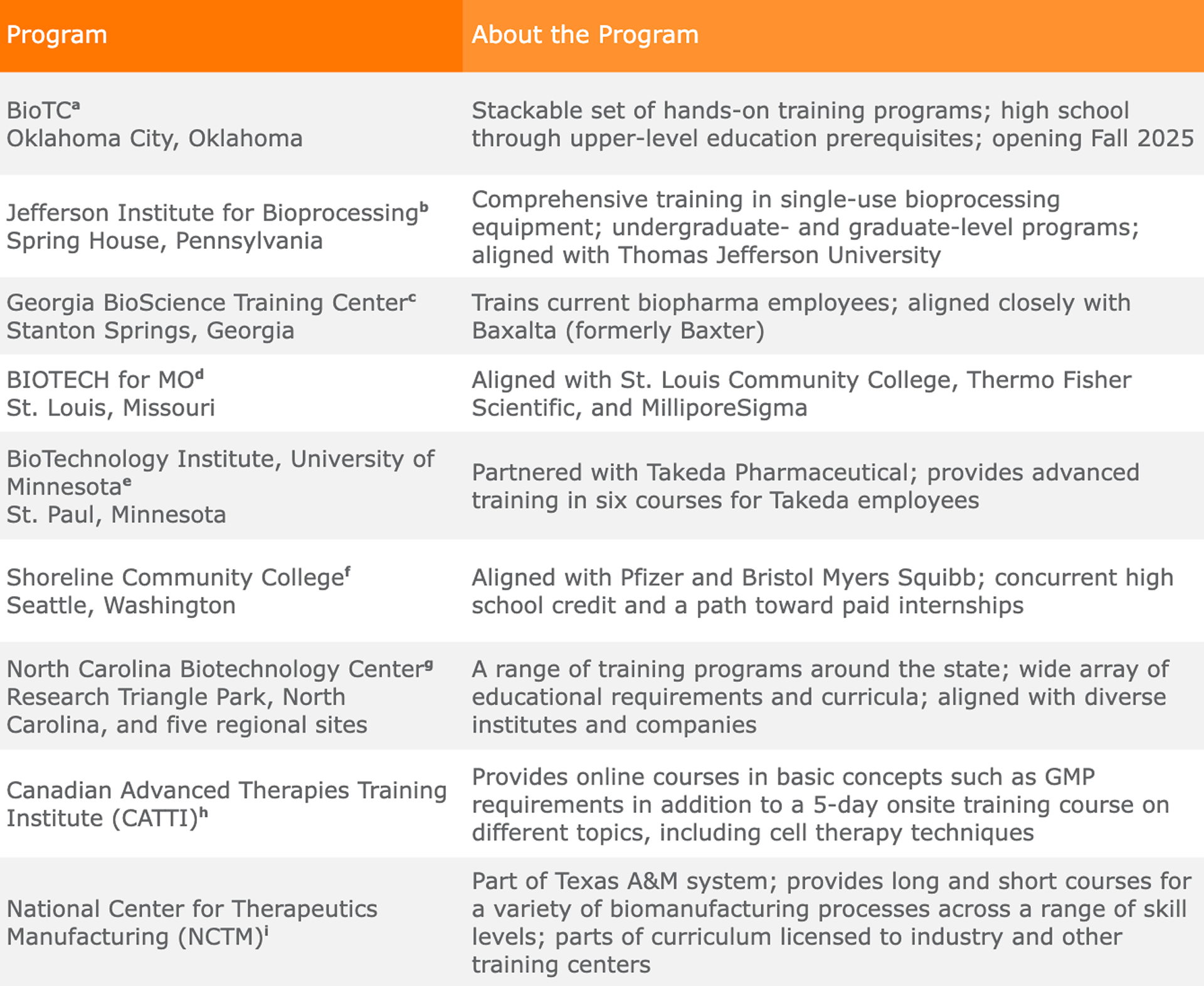 Table references: a[5], b[6],c[7], d[8], e[9], f[10], g[11], h[12], i[13]