Cell Therapy Analytical Testing must address four core regulatory pillars—Identity, Purity, Safety, and Potency—under 21 CFR 600.3 and 21 CFR 610, using established biomarkers and residual cell analysis for standard release.
Rapid Microbial Testing (RMT) technologies (e.g., ATP metabolism, CO2 metabolism, PCR, Raman spectroscopy) are required for cell product safety release because live therapies cannot undergo terminal sterilization and must meet tight clinical delivery windows.
Potency Assays remain the primary bottleneck causing FDA clinical holds, requiring developers to implement a multi-assay Assay Matrix as early as Phase I to account for complex biological mechanisms of action (MOA).
Autologous Stability Testing relies on Bracketing or Matrixing strategies rather than traditional master reference standards due to high donor material variance, which accounts for over 80% of total lot-to-lot variance
1 Analytical Considerations
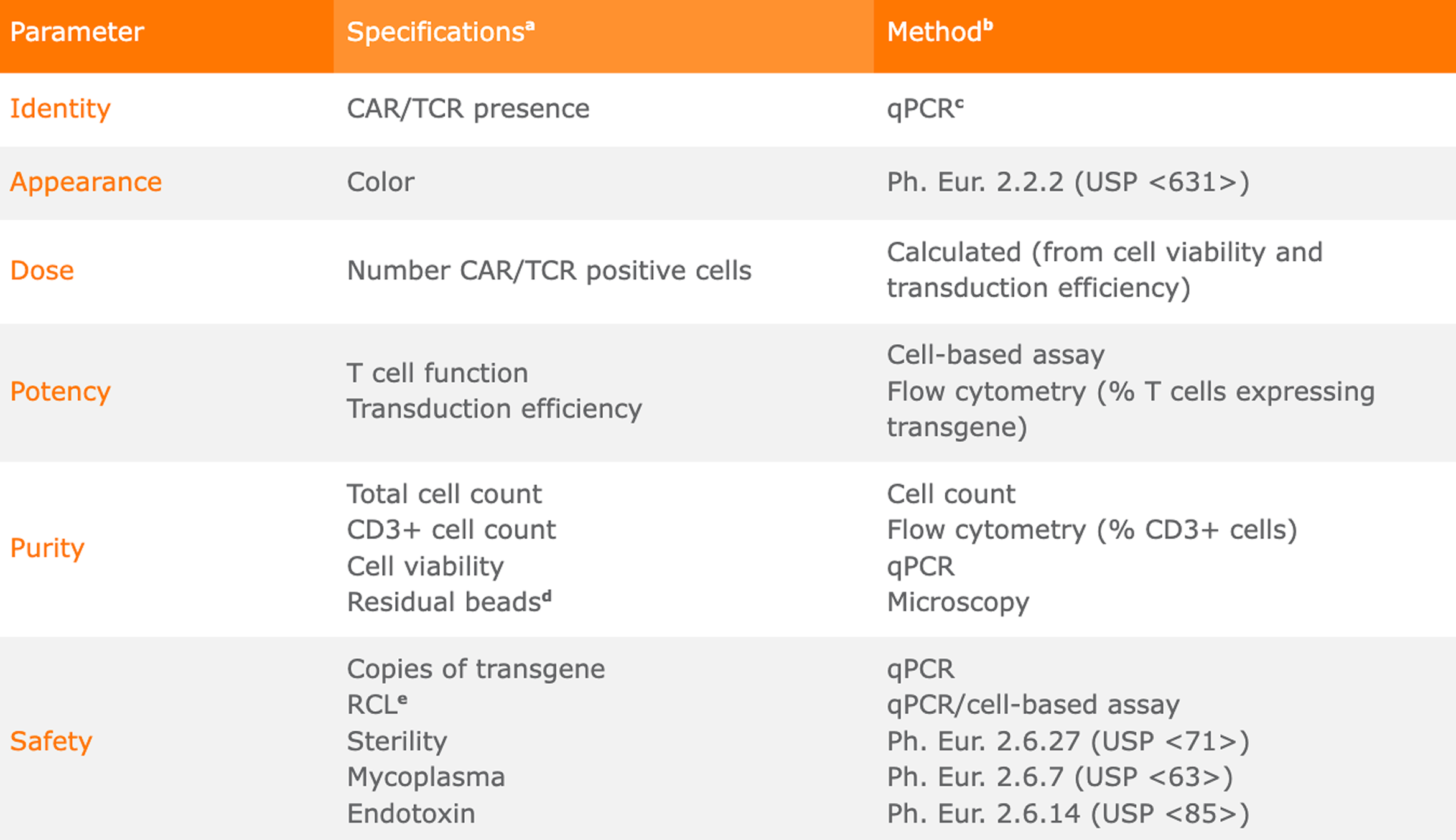
1.1. Like all therapeutics, a cell therapy analytical testing program must address identity, purity, safety, and potency, according to 21 CFR 600.3 and 21 CFR 610. Identity testing usually involves analysis of biomarkers by methods that are relatively well established. Tests for purity are often focused on analyzing the amount of residual cells or other materials in the product. These methods are also relatively well established.[1] An example of release specifications for a CAR-T product is given in Table 1.
2 Rapid Microbial Testing
2.1. A key milestone in the establishment of good safety testing was the development of rapid microbial testing (RMT). With traditional biologics, microbial testing for contaminating bacteria could take up to a month.[2] When the product must be released within a matter of days, traditional microbial testing methods become obsolete. Microbial testing is a critical release criterium because cell therapy products cannot be terminally sterilized.
2.2. In 2018, the U.S. Pharmacopeia (USP) highlighted the need for standardized rapid microbial identification methods,[3] specifically for use in regenerative medicines, and in 2020 the National Institute of Standards and Technology (NIST) announced a workshop to launch a consortium establishing methods for rapid analysis of microbial contamination in advanced therapies.[4]
2.3. In 2022, NIST published their report from the consortium and outlined four types of technologies based on the following: ATP metabolism, CO2 metabolism, PCR, and Raman spectroscopy.[5] Today there are several instruments available to perform this type of analysis and NIST continues to host annual workshops to advance the field.[6]
3 Potency Assays
3.1. Potency assays, however, have been a bigger challenge for the industry, and inadequate potency assays have led to clinical holds. At a 2022 meeting between regulators and developers, Dr. Peter Marks, former director of CBER, remarked, “I think there’s pretty uniform agreement that one of the key things that has delayed a fair number of approvals over the course of time has been issues related to potency.”[7] An early example of this challenge is demonstrated by the experience of Iovance Biotherapeutics, which encountered a clinical hold specifically due to an inadequate potency assay.[8][9][10]
3.2. The goal of any potency assay is to demonstrate in vitro the mechanism and therapeutic efficacy of the product. This is often difficult to do, especially for autologous cell therapies where the current state of the patient’s immune system cannot be modeled.[7] A cell therapy’s mode of action is also difficult to ascertain by a single assay because living cells often have multiple therapeutic activities that are, in some cases, poorly defined.[11] Cell therapy potency assays are often based on cell culture methods, which makes the analytical method more difficult to validate. Traditional cell-based assays also suffer from the same drawback already mentioned: they require a long time to perform.[8]
3.3. Currently, developers of advanced therapies often rely on multiple potency assays to demonstrate different but interconnected activities of the product. This assay matrix can consist of up to seven assays. Although the matrix approach is not mandated by the FDA, developers are reporting that, practically speaking, it is becoming the required approach. It is critical, however, that potency assays demonstrate similarity between lots before beginning a pivotal trial. With such short development programs, this means that developers need to begin developing high-quality potency assays, or a matrix of assays during phase I or even preclinical activities.[7]
4 Stability Testing
4.1. Although CAR-T cells are frozen and should be stable during cold storage and shipment, the high variation in donor starting material and therefore final drug product makes demonstrating stability of these and other autologous therapies difficult. In 2020, Bristol Myers Squibb (BMS) presented data that donor variance attributed 82% of the total variance between lots.[12] This, however, is only one of the reasons that stability testing of autologous therapies is particularly challenging.
4.2. Consider the differences between a biologic and a cell therapy with respect to the manufacturing and development programs. For phase I, fewer but larger GMP batches are produced of the biologic than the autologous cell therapy. This affords biologics developers the opportunity to compare activity of multiple identical samples over time, whereas the autologous cell therapy developers have only a few samples from many lots that will be highly variable.[12]
4.3. Two approaches were described by BMS to address this challenge. The first, bracketing, involves testing of many samples from a small number of batches, preferably the samples on the extremes of container size, etc. The matrixing approach, in contrast, involves spreading all of the testing time points over all of the batches. From each batch, only one or two samples are tested and “stability” is compared to the time zero sample for each batch, rather than a master reference standard.[12]
4.4. It is also important to consider that cell therapies are often evaluated in phase I trials and then skip to phase III, so the phase I stability testing is often used for the pivotal trial design.[12] Dark Horse Consulting illustrated one example of an issue with stability testing, in which an allogeneic product failed to elicit any signal in a phase III trial, despite success in the earlier trial. An investigation revealed that the working cell bank, which passed all specifications, including stability, was the source of the failure. The innovator had changed the process so that phase III patients received cells that had been previously frozen, whereas previous patients did not. The cells required a day of culture after the thaw before they were suitable for use as a therapeutic. This illustrates how rigorous application of current standards needs to be adapted for living cell therapies.[13]
Table 1. Example Specifications for T Cell Drug Product
aNote: not all specifications listed here may be performed for drug product release, and their categorization against the parameters listed may differ between drug products (cf. redacted Yescarta Biologics License Application)
bNote: acceptance criteria are dependent on the drug substance/product (unless pharmacopeial) and therefore not shown
dNote: when activation and expansion of T cells are stimulated by anti-CD3 and anti-CD28 antibodies covalently coupled to supramagnetic beads several microns in size
ereplication competent lentivirus (RCL) — capable of infecting non-target cells
Source: van der Walle et al.[14]
FAQs
What regulatory standards govern cell therapy analytical testing?
Cell therapy analytical testing is governed by 21 CFR 600.3 and 21 CFR 610 standards established by the U.S. FDA. These regulatory frameworks mandate strict testing protocols across four core quality attributes: Identity via specific biomarkers, Purity by quantifying residual process impurities, Safety via microbial controls, and biological Potency.
Why is rapid microbial testing essential for autologous cell therapies?
Rapid Microbial Testing (RMT) is critical for autologous cell therapies because living cell products cannot undergo terminal sterilization and feature short shelf-lives requiring release within days. Methods leveraging ATP metabolism, PCR, and Raman spectroscopy replace traditional 30-day culture methods to ensure patient safety prior to infusion.
How do developers overcome potency assay development delays?
Developers overcome potency assay challenges by establishing an Assay Matrix combining up to seven distinct analytical methods during Phase I or preclinical stages. Because single assays rarely capture multi-faceted biological mechanisms of action (MOA), matrix approaches satisfy regulatory expectations and prevent FDA clinical holds before pivotal trials.
What is the impact of donor variance on CAR-T cell therapy stability?
Donor material variance accounts for up to 82% of total lot-to-lot variance in autologous CAR-T cell therapies, making traditional master reference standards ineffective for stability testing. Developers manage this inherent variability by applying specialized statistical designs like Bracketing and Matrixing to demonstrate drug product stability across multi-lot manufacturing programs.
How does cryopreservation affect allogeneic cell therapy efficacy?
Cryopreservation can alter cell viability and therapeutic efficacy, occasionally causing clinical trial failures if post-thaw recovery is unmonitored. Process updates involving frozen cell storage often require a post-thaw culture recovery period to restore full cellular functionality and meet biological potency release criteria.

 aNote: not all specifications listed here may be performed for drug product release, and their categorization against the parameters listed may differ between drug products (cf. redacted Yescarta Biologics License Application)