
Key Takeaways
Stochastic conjugation attaches payloads to naturally occurring amino acids on the antibody, producing a heterogeneous mixture of ADC species with varying drug-to-antibody ratios (DARs).
Site-specific conjugation attaches payloads at predetermined locations on the antibody, generating a more uniform ADC population.
Stochastic methods benefit from extensive manufacturing experience and have enabled multiple commercially successful ADCs.
Site-specific approaches can improve control over DAR, pharmacokinetics, stability, and product consistency.
The choice between the two approaches involves balancing platform maturity, manufacturing complexity, product homogeneity, and desired therapeutic characteristics
Why This Comparison Matters Now
Antibody–drug conjugates have become one of the fastest-growing segments of oncology drug development. By combining the targeting specificity of monoclonal antibodies with the potency of cytotoxic payloads, ADCs aim to selectively deliver highly active drugs to tumor cells while minimizing systemic toxicity.
As the field has matured, developers have increasingly recognized that ADC performance depends not only on the antibody, linker, and payload, but also on how the payload is attached to the antibody. The conjugation strategy directly influences critical quality attributes such as drug loading, stability, pharmacokinetics, efficacy, and safety.
Many of the first-generation ADCs relied on stochastic conjugation methods that attach payloads to naturally occurring amino acids such as lysine or cysteine residues. These approaches proved commercially viable and established the foundation of the modern ADC industry. However, they also generate heterogeneous mixtures of ADC molecules with varying drug loads and conjugation sites.
To address these limitations, developers have invested heavily in site-specific conjugation technologies that allow payload attachment at precisely defined locations. Advances in protein engineering, enzymatic conjugation, and non-natural amino acid incorporation have enabled the production of increasingly homogeneous ADCs with tightly controlled drug loading profiles.
As ADC pipelines continue to expand and payload technologies become more sophisticated, the choice between stochastic and site-specific conjugation has become one of the most important platform decisions in ADC development.
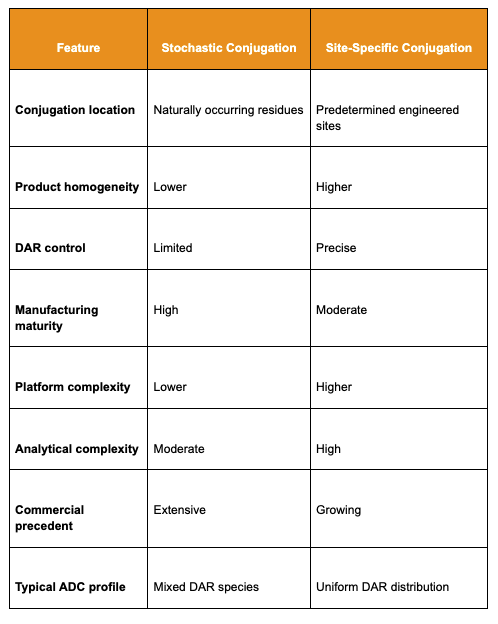 Mechanistic Differences
The primary distinction between stochastic and site-specific conjugation lies in how payload molecules are attached to the antibody.
Stochastic conjugation relies on naturally occurring reactive groups present on the antibody surface. Historically, lysine and cysteine residues have served as the most common conjugation sites. Because antibodies contain multiple accessible lysines and disulfide-linked cysteines, payload attachment can occur at numerous locations across the molecule.
As a result, stochastic conjugation generates a heterogeneous population of ADC molecules. Some antibodies may carry no payload molecules, while others may carry several. The exact attachment sites can also vary among individual molecules. This produces a distribution of species with different DARs and potentially different biological properties.
Site-specific conjugation takes a more controlled approach. Through protein engineering or enzymatic modification, specific locations are created or designated for payload attachment. The payload is then attached only at these predetermined sites, generating a more uniform product population.
Several site-specific strategies have emerged, including engineered cysteine residues, enzymatic conjugation systems, glycan-based approaches, and non-natural amino acid incorporation. Although these methods differ technically, they share the goal of producing ADCs with consistent payload placement and more predictable molecular behavior.
Manufacturing and Operational Considerations
Manufacturing considerations play a major role in the selection of conjugation strategy.
Stochastic conjugation offers important advantages from an operational perspective. The chemistry is relatively straightforward, manufacturing processes are well understood, and substantial regulatory precedent exists. Many commercially successful ADCs—including several first-generation products—were developed using stochastic approaches, providing developers with established development pathways and analytical frameworks.
However, the heterogeneity inherent to stochastic conjugation can create challenges during process development and characterization. Developers must carefully monitor DAR distributions and demonstrate consistent product quality despite the presence of multiple ADC species.
Site-specific conjugation introduces additional engineering and process complexity. The antibody itself may require modification to introduce specific conjugation sites, and the conjugation chemistry is often more specialized. Development programs may require additional analytical methods to characterize engineered features and confirm site occupancy.
Despite these complexities, site-specific conjugation can simplify certain aspects of product characterization by reducing molecular heterogeneity. More uniform DAR distributions may facilitate process control, comparability assessments, and manufacturing consistency.
As ADC development increasingly focuses on highly potent payloads and optimized therapeutic windows, many developers view this additional control as a worthwhile tradeoff.
Best Fit by Use Case
Stochastic conjugation is typically preferred when:
manufacturing simplicity and platform familiarity are priorities
established regulatory precedent is desired
rapid development timelines are important
the target product profile can tolerate DAR heterogeneity
Site-specific conjugation is typically preferred when:
precise DAR control is required
product homogeneity is a major development objective
highly potent payloads are being used
developers seek to optimize pharmacokinetics or therapeutic index
next-generation ADC platform differentiation is a strategic goal
Verdict
Stochastic conjugation established the modern ADC industry and remains a highly effective platform for many products. Its manufacturing maturity, regulatory familiarity, and extensive commercial track record make it an attractive option for developers seeking a proven path to the clinic and market.
Site-specific conjugation, however, addresses many of the limitations associated with ADC heterogeneity. By controlling payload placement and drug loading, developers can generate more consistent products with potentially improved pharmacological properties and manufacturing reproducibility.
Neither approach is universally superior. Stochastic conjugation remains a practical and commercially validated solution for many ADCs, while site-specific conjugation is increasingly becoming the preferred strategy for developers seeking greater molecular precision and next-generation ADC optimization.
As the field continues to evolve, the question may become less about replacing stochastic conjugation and more about determining when the additional control provided by site-specific approaches creates meaningful clinical and commercial value.