
Key Takeaways
Conventional peptide synthesis, especially solid-phase peptide synthesis (SPPS), builds peptides amino acid by amino acid and provides broad control over sequence, chemical modifications, and incorporation of non-natural amino acids.
Recombinant peptide production uses engineered biological hosts to express the desired peptide, often as a fusion protein that is subsequently processed and purified.
Chemical synthesis is generally most attractive for shorter and moderately sized peptides, but yield and impurity burden can become increasingly challenging as sequence length grows.
Recombinant systems can be advantageous for longer peptides, repetitive production at scale, and sequences composed primarily of genetically encoded amino acids, but they introduce fermentation, host-cell impurity, and downstream purification requirements.
Neither route is inherently more economical or sustainable: the best choice depends on peptide length, sequence complexity, required modifications, production scale, purity requirements, and process efficiency.
Why This Comparison Matters Now
Therapeutic peptides occupy an increasingly important space between conventional small molecules and larger biologics. Their ability to engage biological targets with high specificity while remaining smaller and often simpler than recombinant proteins has supported applications across metabolic disease, oncology, endocrinology, infectious disease, and other therapeutic areas. Recent growth in peptide therapeutics has placed new pressure on manufacturing strategies to deliver increasingly large quantities of high-purity material efficiently.
Historically, chemical synthesis has been the dominant method for producing many therapeutic peptides. Solid-phase peptide synthesis (SPPS) allows amino acids to be assembled sequentially on a solid resin, providing precise control over peptide sequence and substantial freedom to introduce non-natural amino acids, terminal modifications, lipidation, or other structural features used to improve potency, stability, or pharmacokinetics. SPPS has consequently become a highly versatile platform for both peptide discovery and commercial manufacturing.
But chemical synthesis has limitations. Each additional amino acid introduces another coupling and deprotection cycle, and less-than-complete reaction efficiency can compound across long sequences. Longer peptides can therefore become increasingly difficult to synthesize at high yield and purity. Large-scale SPPS may also require substantial quantities of solvents, reagents, and resin, creating cost, waste, and sustainability challenges.
Recombinant production offers an alternative. Instead of assembling a peptide chemically, the desired sequence is encoded genetically and expressed in a host such as Escherichia coli, yeast, or another expression system. The biological machinery of the host produces the peptide or a precursor that can subsequently be isolated and processed.
Recombinant production is well established for proteins, but its usefulness for peptides depends heavily on the molecule. Very short peptides may be degraded rapidly inside the host or may be toxic to the producing organism, necessitating fusion-protein strategies or specialized expression systems. Longer peptides may benefit much more substantially from recombinant production because biological synthesis avoids the cumulative coupling losses associated with chemical assembly.
As peptide pipelines expand and commercial demand grows, developers therefore face a fundamental manufacturing question: should the molecule be assembled chemically or produced biologically?
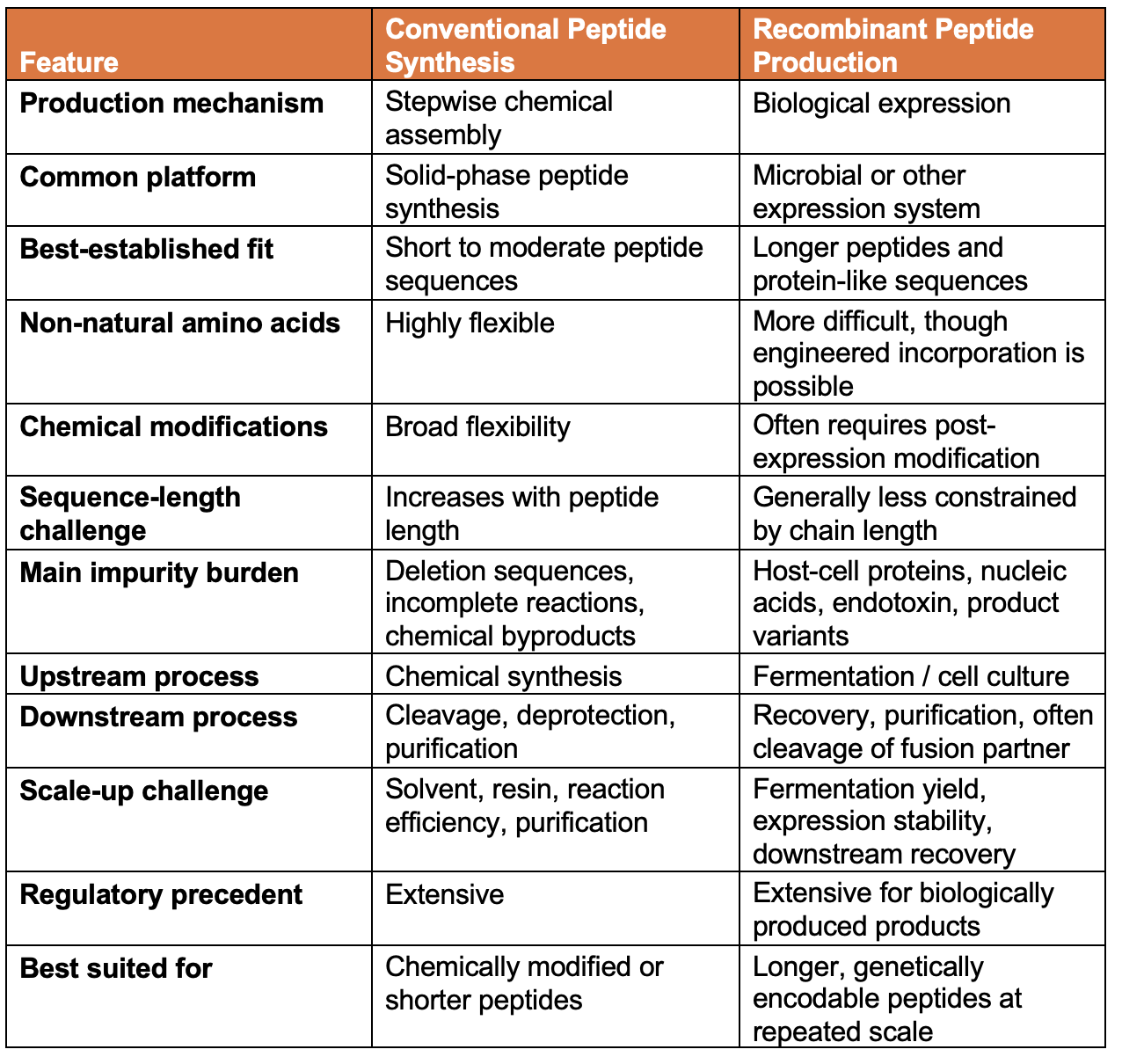 Mechanistic Differences
Conventional peptide synthesis most commonly relies on SPPS. The first amino acid is immobilized on a solid resin, after which subsequent amino acids are added sequentially through cycles of deprotection and coupling. Once the full sequence has been assembled, the peptide is cleaved from the resin, protecting groups are removed, and the crude material is purified.
This sequential chemistry gives developers exceptional structural freedom. ᴅ-amino acids, non-natural residues, modified side chains, lipid groups, and other chemical features can be deliberately introduced during synthesis. That flexibility is one reason chemical synthesis remains so important in therapeutic peptide design: many modern peptides are intentionally engineered beyond the structures that ribosomal biology naturally produces.
The weakness of the approach is cumulative efficiency. If each coupling step is slightly imperfect, those losses accumulate over a long sequence. Side reactions, incomplete coupling, racemization, deletion sequences, and other synthesis-related impurities may become increasingly difficult to separate from the desired product as complexity grows.
Recombinant production uses a fundamentally different mechanism. A DNA sequence encoding the desired peptide is introduced into an expression host, which uses its transcriptional and translational machinery to generate the peptide. Because biological translation assembles the full polypeptide using ribosomes rather than repeated chemical coupling reactions, increasing sequence length does not create the same cumulative synthetic challenge.
Short peptides can nevertheless be difficult to express directly. They may be susceptible to proteolytic degradation, poorly accumulated inside the host, or biologically active against the expression organism itself. Developers often address these limitations by expressing the peptide as part of a larger fusion protein that protects it during production. The fusion partner is subsequently cleaved and removed during downstream processing.
The distinction is therefore not merely chemistry versus biology. It is a choice between direct control over molecular construction and leveraging cellular machinery to perform that construction more efficiently.
Manufacturing and Operational Considerations
Chemical synthesis offers a comparatively direct manufacturing chain. Once the sequence, resin, protecting-group strategy, coupling chemistry, and purification process are established, production can be highly reproducible and does not require maintaining a biological production system.
This can be especially attractive for shorter peptides. The same manufacturing platform can also accommodate multiple products with relatively limited changes to infrastructure, making SPPS well suited to multiproduct peptide facilities.
Scale, however, can magnify its weaknesses. Commercial peptide synthesis may consume large volumes of organic solvents and excess amino acid reagents during repeated coupling and washing steps. Resin consumption and purification requirements add further material burden. As peptide demand increases, solvent recovery, waste treatment, cycle efficiency, and process intensification become increasingly important economic and environmental considerations. Recent reviews have therefore placed substantial emphasis on greener solvents, improved coupling chemistry, liquid-phase or hybrid approaches, and other strategies for reducing the environmental footprint of peptide synthesis.
Recombinant manufacturing shifts much of the burden upstream into fermentation or cell culture. Once a productive expression system is developed, biological amplification can generate substantial amounts of product using relatively inexpensive feedstocks. This can make recombinant approaches attractive for repeated large-scale production.
The challenge moves downstream. The desired peptide must be recovered from a complex biological matrix containing host-cell proteins, nucleic acids, cell debris, and other process-related impurities. If bacterial hosts are used, endotoxin control may also be important. Fusion proteins require additional cleavage and purification operations, potentially eroding some of the upstream economic advantage.
Expression yield is another critical variable. A theoretically inexpensive fermentation route becomes unattractive if the peptide expresses poorly, aggregates, is degraded, or requires extensive downstream processing to achieve suitable purity.
The economic comparison is consequently molecule specific. Chemical synthesis may have higher raw-material and solvent costs but a shorter and more direct process. Recombinant production may use inexpensive biological inputs but require substantially more process development and purification.
Molecular Design Considerations
The intended molecular structure can determine the manufacturing route before process economics are even considered.
Chemical synthesis offers particularly strong flexibility when a therapeutic peptide contains non-natural amino acids, backbone modifications, terminal modifications, lipid conjugates, or other structures not readily encoded by conventional translation. Modern medicinal chemistry frequently relies on these modifications to improve protease resistance, receptor selectivity, half-life, or membrane permeability.
Recombinant expression naturally favors peptides built from genetically encoded amino acids. Advances in synthetic biology can enable incorporation of non-canonical amino acids, but doing so generally requires more sophisticated host engineering and is not as straightforward as introducing the same residue through chemical synthesis.
Recombinant methods may become increasingly attractive as peptides begin to resemble small proteins in length and structural complexity. Long sequences, multiple disulfide bonds, or biologically derived architectures can make purely chemical production difficult, although successful manufacturing still depends on whether the chosen host can generate the required structure and folding pattern.
Hybrid strategies can also blur the boundary between the two platforms. A peptide or precursor may be produced recombinantly and then chemically modified, or different peptide fragments may be generated separately and joined using ligation techniques. The optimal manufacturing strategy therefore does not always require choosing exclusively between chemical and biological production.
Regulatory and Quality Implications
Both chemically synthesized and recombinantly produced peptides can support approved pharmaceutical products, but the manufacturing route creates different impurity profiles and therefore different characterization requirements.
Chemically synthesized peptides can contain sequence-related impurities arising from incomplete coupling, deletion or insertion sequences, stereochemical changes, protecting-group chemistry, or degradation. The FDA explicitly recognizes that peptide products can contain manufacturing- and degradation-related impurities regardless of whether the manufacturing route is synthetic or recombinant.
Recombinant products instead inherit many of the quality considerations associated with biologic manufacturing, including control of the expression system and biologically derived impurities. Depending on the host and process, developers may need to control host-cell proteins, host-cell DNA, endotoxin, process intermediates, cleavage products, and other product-related variants.
Importantly, manufacturing route can matter when comparing highly purified synthetic versions of peptides originally produced using recombinant DNA technology. The FDA has developed specific guidance addressing synthetic peptide products referencing certain recombinant peptide drugs, reflecting the need to understand whether process-specific impurities could alter immunogenicity or other clinically relevant properties.
European regulators have also formalized expectations specifically for synthetic peptide manufacturing, characterization, specifications, and analytical control, reflecting the growing maturity and commercial importance of chemically synthesized peptide active pharmaceutical ingredients.
The regulatory advantage therefore does not automatically belong to either platform. What matters is whether the manufacturer can thoroughly characterize the product and demonstrate consistent control over the impurities associated with the chosen route.
Best Fit by Use Case
Conventional peptide synthesis is typically preferred when:
the peptide is short to moderate in length
non-natural amino acids or extensive chemical modifications are required
precise control over terminal or side-chain modifications is important
the molecule is difficult to express efficiently in a biological system
flexible multiproduct manufacturing is valuable
chemical synthesis can achieve the required purity and yield at commercially viable scale
Recombinant peptide production is typically preferred when:
the peptide is longer or increasingly protein-like
the sequence consists largely of genetically encoded amino acids
chemical synthesis produces poor yield or an increasingly difficult impurity profile
repeated large-scale production may justify the upfront investment in an optimized expression system
biological production can achieve strong expression and straightforward downstream recovery
structural characteristics make biosynthetic assembly advantageous
Verdict
Conventional peptide synthesis remains the most versatile manufacturing strategy for many therapeutic peptides. Its greatest strength is molecular freedom: developers can construct precisely defined sequences and incorporate chemical features that biological expression systems cannot easily reproduce. For shorter and moderately sized therapeutic peptides, especially heavily modified molecules, chemical synthesis often remains the most practical route.
Recombinant production becomes increasingly compelling as peptide length and biological complexity increase. Instead of accumulating yield losses across dozens of chemical coupling reactions, an engineered cell can generate an entire genetically encoded peptide through a single biosynthetic process. When expression is efficient and downstream processing is manageable, that advantage can translate into attractive economics at larger production scales.
The dividing line is not a fixed number of amino acids. Sequence complexity, hydrophobicity, modifications, folding requirements, required dose, production volume, purification burden, and expression behavior can all shift the balance.
The strongest manufacturing decision therefore begins with the molecule rather than the platform. A short, extensively modified therapeutic peptide will usually favor chemical synthesis. A longer, largely natural peptide required at substantial scale may favor recombinant production. Between those extremes, developers should evaluate both routes—and potentially hybrid approaches—based on total process efficiency rather than assuming that either chemistry or biology is inherently superior.
As peptide therapeutics expand into larger indications and higher-volume markets, this manufacturing boundary is likely to become increasingly important. The winning platform will be the one that can deliver the required molecular structure, purity, scale, and cost while maintaining a robust and sustainable commercial process.