
Key Takeaways
Cleavable linkers are designed to release payloads in response to intracellular or tumor-associated triggers, such as low pH, proteases, or reducing conditions.
Non-cleavable linkers remain attached to the payload until the antibody is degraded inside the target cell.
Cleavable linkers may improve activity against heterogeneous tumors by enabling a bystander effect.
Non-cleavable linkers can improve systemic stability and reduce premature payload release.
The best linker strategy depends on payload properties, target biology, tumor heterogeneity, internalization rate, and desired safety profile.
Why This Comparison Matters Now
Linker design is one of the defining determinants of antibody–drug conjugate (ADC) performance. While the antibody directs the ADC toward tumor-associated antigens and the payload provides cytotoxic potency, the linker controls when, where, and how that payload is released. A linker that is too stable may prevent sufficient payload release inside tumor cells; a linker that is too labile may release drug prematurely in circulation, increasing systemic toxicity.
As the ADC field has matured, linker chemistry has become a major focus of platform differentiation. Early ADC failures often reflected challenges in balancing stability and payload release. More recent ADCs have benefited from improved linker designs that better coordinate circulation stability, intracellular release, and payload pharmacology.
The cleavable versus non-cleavable distinction captures one of the most important design choices in ADC development. Cleavable linkers are engineered to respond to biological triggers that are enriched in tumor cells or intracellular compartments. Non-cleavable linkers, by contrast, rely on degradation of the antibody itself after internalization, leaving a payload-linker-amino acid residue as the active cytotoxic species.
This comparison is especially important as ADCs move beyond highly expressed, rapidly internalizing targets and into more heterogeneous tumor settings. In those contexts, the ability of released payload to diffuse into neighboring cells—or remain confined to antigen-positive cells—can strongly influence both efficacy and safety.
 Mechanistic Differences
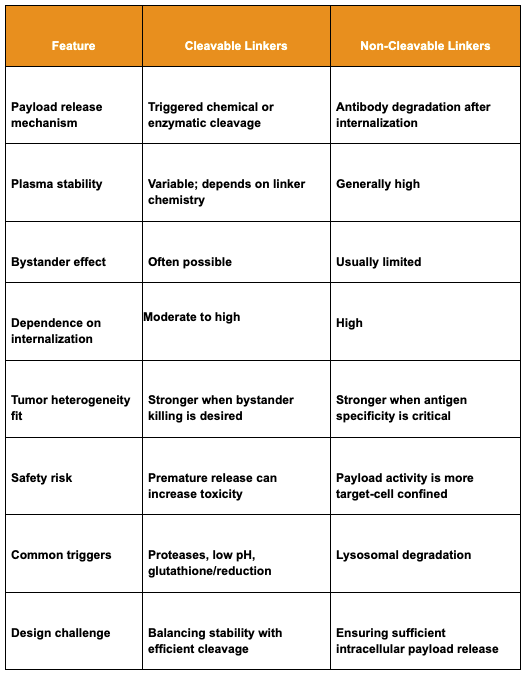
Cleavable linkers are designed to break under specific biological conditions. Some are sensitive to acidic environments, such as those found in endosomes and lysosomes. Others are cleaved by intracellular proteases or reduced by high intracellular concentrations of glutathione. Once the linker is cleaved, the cytotoxic payload is released in a form that can act on its intracellular target.
This release mechanism can be highly advantageous when the payload is membrane-permeable. After being released inside an antigen-positive tumor cell, the payload may diffuse into neighboring tumor cells that express lower levels of the target antigen. This bystander effect can improve activity against tumors with heterogeneous antigen expression.
Non-cleavable linkers operate differently. They are designed to remain stable throughout circulation and intracellular trafficking. After the ADC binds to its target antigen and is internalized, the antibody is degraded in the lysosome. The payload remains attached to a linker-amino acid residue derived from the antibody. This metabolite must retain cytotoxic activity to produce the desired antitumor effect.
Because non-cleavable linkers generally require full internalization and lysosomal degradation, they are especially dependent on target biology. The target antigen must be efficiently internalized, and the resulting payload metabolite must be active within the tumor cell.
Manufacturing and Operational Considerations
From a manufacturing perspective, both cleavable and non-cleavable linker strategies can be incorporated into established ADC conjugation workflows, but they create different development and analytical priorities.
Cleavable linkers require careful optimization of chemical stability. The linker must remain stable during manufacturing, storage, and circulation, but release payload efficiently once the ADC reaches the intended intracellular environment. This balance can be difficult to achieve, particularly for linkers sensitive to pH, enzymes, or reducing conditions that may vary across tissues and patients.
Non-cleavable linkers can offer advantages in systemic stability and product control. Because they are less likely to release payload before internalization, they may reduce off-target toxicity associated with free drug exposure. This stability can simplify some aspects of formulation and handling, although the final ADC still requires rigorous characterization of drug-to-antibody ratio, aggregation, free payload, and conjugation-related impurities.
The payload itself also strongly influences linker selection. Some payloads require release in an unmodified form to be active, making cleavable linkers more attractive. Others retain activity when attached to a linker-derived residue, making them compatible with non-cleavable designs.
Ultimately, linker selection cannot be separated from the full ADC architecture. The antibody, antigen, conjugation site, drug-to-antibody ratio, linker, and payload must be optimized as an integrated system.
Best Fit by Use Case
Cleavable linkers are typically preferred when:
tumor antigen expression is heterogeneous
a bystander effect is desirable
the payload must be released in a free or near-free form
intracellular tumor conditions provide a reliable release trigger
strong potency is needed across mixed tumor cell populations
Non-cleavable linkers are typically preferred when:
plasma stability and controlled payload release are top priorities
the target antigen internalizes efficiently
toxicity from premature payload release is a major concern
the payload remains active as a linker-associated metabolite
developers want payload activity largely confined to antigen-positive cells
Verdict
Cleavable linkers offer flexibility and potency advantages, particularly for tumors with heterogeneous antigen expression. By releasing membrane-permeable payloads inside target cells, they can enable bystander killing that extends activity beyond cells with high antigen expression. This can be valuable in solid tumors, where antigen distribution is often uneven.
Non-cleavable linkers offer a different advantage: control. Their stability in circulation can reduce premature payload release and may support a more predictable safety profile. They are especially attractive when the target antigen internalizes efficiently and when the payload remains active after lysosomal degradation of the antibody.
The best linker strategy is therefore not determined by linker class alone. It depends on the biology of the target, the permeability and potency of the payload, the desired degree of bystander killing, and the safety risks associated with systemic exposure. In modern ADC design, cleavable and non-cleavable linkers are best understood as complementary tools for shaping the therapeutic window.