
Key Takeaways
Traditional scale-up models rely on established engineering principles, scale-down studies, pilot-scale experiments, and empirical relationships such as power input, mixing time, oxygen transfer, and shear.
Digital twins create dynamic virtual representations of bioprocesses by combining process models with manufacturing and experimental data.
Digital twins can allow developers to explore scale-dependent behavior virtually before committing material, equipment time, and resources to physical runs.
Traditional models remain essential because biological processes are complex and any computational prediction must ultimately be grounded in representative experimental data.
The most effective strategy is generally model-informed rather than model-only scale-up, using digital twins to focus experiments and anticipate risk while retaining physical verification of process performance.
Why This Comparison Matters Now
Scale-up remains one of the most consequential transitions in biologics development. A process that performs consistently in a bench-scale bioreactor cannot simply be enlarged geometrically and expected to behave identically at commercial scale. Differences in mixing, oxygen transfer, carbon dioxide removal, shear, heat transfer, nutrient gradients, and other environmental conditions can affect cell growth, productivity, and ultimately product quality.
Traditional bioprocess scale-up therefore depends on a combination of engineering principles and experimental evidence. Developers identify parameters that should remain constant or within acceptable ranges as vessel size increases, construct representative scale-down models, perform experiments at progressively larger scales, and use those observations to establish an operating strategy for manufacturing.
That approach has enabled decades of successful biologics commercialization, but it can be expensive and iterative. Large-scale engineering runs consume significant quantities of material and facility time, and not every potential process condition can realistically be tested physically.
Digital twins are creating a complementary approach. Rather than relying only on extrapolation from experimental observations, a digital twin uses mathematical and computational models to represent the behavior of a physical process. Depending on the application, these models may incorporate computational fluid dynamics (CFD), mechanistic process models, multivariate statistical approaches, machine learning, and real-time or historical manufacturing data.
The objective is not merely to create a visualization of a bioreactor. A sufficiently developed digital twin can be used to ask predictive questions: What happens to mixing if agitation speed changes? Where might nutrient or dissolved oxygen gradients develop at commercial scale? How will a change in operating conditions influence cell metabolism or productivity? Which scale-up parameters are most likely to affect critical quality attributes?
As biologics manufacturers pursue faster development, greater process intensification, and more flexible facilities, the comparison between traditional scale-up and digital-twin-enabled development is becoming increasingly relevant.
 Mechanistic Differences
Traditional scale-up begins with engineering similarity. Developers identify process characteristics that influence biological performance and determine which should be maintained as equipment size changes. Depending on the process, these may include power input per unit volume, impeller tip speed, volumetric oxygen mass-transfer coefficient, gas flow, mixing time, or other parameters.
The difficulty is that these variables cannot all remain constant simultaneously. Increasing bioreactor size changes vessel geometry, fluid dynamics, gas distribution, and mixing behavior. Scale-up therefore becomes an exercise in identifying which parameters matter most for the process and finding operating conditions that preserve acceptable biological performance.
Scale-down models complement this work by deliberately reproducing large-scale stresses in smaller systems. Researchers may create oxygen, pH, nutrient, or mixing gradients that mimic those expected at manufacturing scale and examine whether cells and product quality remain robust under those conditions.
Digital twins retain these engineering concepts but add a predictive computational layer. CFD, for example, can model fluid movement inside a bioreactor and estimate local differences in shear, mixing, gas dispersion, and other physical conditions. Mechanistic biological models can describe cell growth, metabolism, substrate consumption, and product formation. Statistical or machine-learning models can identify relationships within large process datasets that may not be obvious from individual experiments.
A digital twin can combine several of these components into a representation that evolves with the physical process. The more closely the model is connected to real process data, the more it can potentially be updated as conditions change.
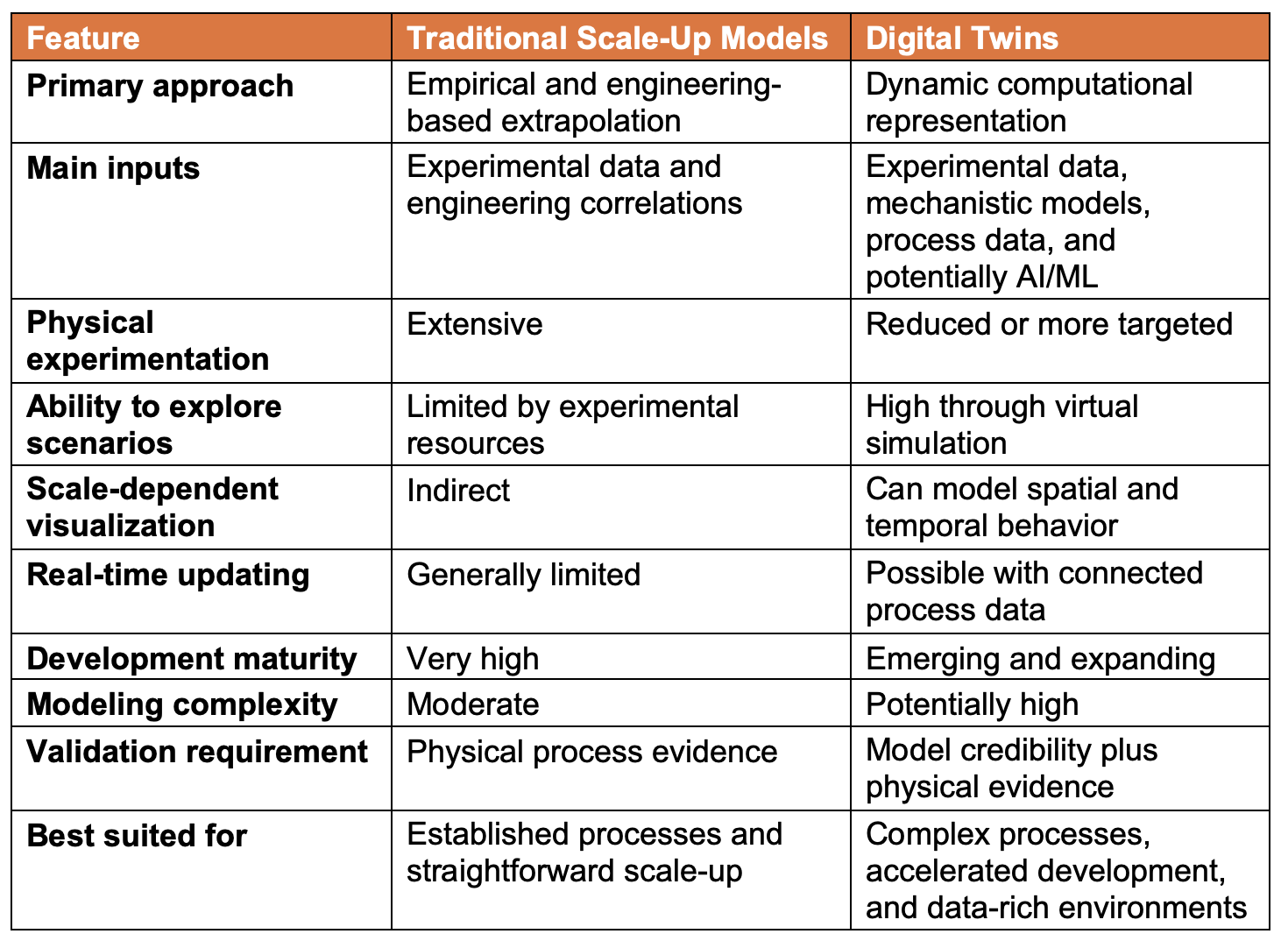
The distinction is therefore not that traditional approaches use no modeling. Bioprocess scale-up has always relied on models. The difference is the breadth, integration, and predictive ambition of the model. Traditional scale-up generally uses individual engineering relationships to guide physical experimentation; digital twins seek to represent multiple interacting dimensions of the process simultaneously.
Manufacturing and Operational Considerations
The potential operational advantage of digital twins is the ability to reduce unnecessary experimentation. Physical scale-up runs are expensive, particularly as programs move into pilot and commercial-scale equipment. They consume media, raw materials, facility capacity, personnel time, and potentially valuable drug substance.
A validated digital model allows developers to screen many operating scenarios virtually before deciding which conditions require physical confirmation. Rather than testing a broad experimental space at large scale, teams can use simulations to identify likely areas of risk and design more focused engineering studies.
Digital twins can also help developers investigate phenomena that are difficult to observe directly. A probe measures conditions at a specific location inside a bioreactor, but CFD can estimate spatial differences throughout the vessel. That can help identify local regions where oxygen depletion, excess shear, poor mixing, or other conditions could arise despite apparently acceptable bulk measurements.
The technology may be particularly useful when moving between facilities or bioreactor designs. Two vessels with the same nominal working volume may have different geometry, impellers, spargers, or mixing characteristics. A digital model can help evaluate whether a process transferred between them will experience equivalent physical conditions and where operating parameters may need adjustment.
Traditional scale-up retains important operational advantages of its own. It relies on well-established principles, familiar experimental workflows, and direct observations of the biological system. Experienced process-development teams often have substantial institutional knowledge about how their cell lines, media, bioreactors, and manufacturing platforms behave across scales.
Digital twins also require significant infrastructure. High-quality models depend on high-quality data, appropriate sensors, consistent data architecture, modeling expertise, computing resources, and careful lifecycle management. A sophisticated model built on incomplete or poorly characterized data can create false confidence rather than reduce risk.
The operational value of a digital twin therefore depends on whether its predictive power exceeds the effort required to build, validate, and maintain it.
Regulatory and Quality Implications
The expansion of digital modeling does not remove the regulatory requirement to demonstrate process understanding and manufacturing control. A computational model used to support important development or manufacturing decisions must be credible for its intended context of use.
That means understanding the assumptions underlying the model, the quality and representativeness of the data used to build it, the uncertainty associated with its predictions, and the conditions under which those predictions remain valid.
This is particularly important as digital twins incorporate machine learning or other data-driven methods. A model may predict process behavior accurately within the range of conditions represented by its training data while becoming less reliable when extrapolated outside that range.
Digital twins can nevertheless strengthen quality-by-design approaches by helping developers connect process parameters to potential manufacturing outcomes. They can support risk assessment, identify parameters that warrant closer experimental investigation, and improve understanding of interactions that would be difficult to characterize using one-factor-at-a-time studies.
Regulatory agencies are increasingly examining advanced manufacturing technologies and the use of digital models in pharmaceutical development. The direction of travel favors greater use of modeling, simulation, and advanced process control, but model credibility and physical evidence remain central.
For developers, the regulatory goal should therefore not be to replace experimental data with simulation. It should be to demonstrate how a credible model contributes additional process understanding and helps generate better experimental and manufacturing decisions.
Best Fit by Use Case
Traditional scale-up models are typically preferred when:
the manufacturing process and equipment platform are already well understood
extensive historical scale-up knowledge is available
the process behaves predictably across scales
data infrastructure is insufficient to support a sophisticated digital model
program economics do not justify developing and maintaining a digital twin
direct experimentation can answer the relevant scale-up questions efficiently
Digital twins are typically preferred when:
scale-dependent behavior is complex or difficult to observe experimentally
large-scale engineering runs are costly or capacity constrained
multiple equipment configurations or manufacturing sites must be evaluated
the organization has substantial historical and real-time process data
CFD, mechanistic modeling, or multivariate analysis can illuminate important process interactions
accelerated scale-up and technology transfer are strategic priorities
the same model can generate value across development, manufacturing, and continued process verification
Verdict
Traditional scale-up remains the foundation of successful bioprocess development. Engineering principles, scale-down experiments, and physical manufacturing data provide the empirical evidence required to understand whether a process will remain robust as equipment size and operating conditions change.
Digital twins can substantially extend that capability. By integrating computational fluid dynamics, mechanistic modeling, historical process information, and potentially real-time manufacturing data, they allow developers to explore a much larger process space than physical experimentation alone can economically support.
Their greatest value is therefore not replacing traditional scale-up but making traditional scale-up more targeted and predictive. A digital twin can help determine which risks deserve experiments, which operating conditions are most promising, and where scale-dependent differences are likely to emerge before those differences appear in an expensive manufacturing run.
For straightforward processes with extensive platform history, conventional scale-up methods may provide all the information needed. For complex processes, novel equipment configurations, aggressive timelines, or data-rich manufacturing networks, digital twins can provide a meaningful additional layer of process understanding.
The strongest strategy is consequently a hybrid one: simulate broadly, experiment intelligently, and verify physically. Traditional models provide the scientific and empirical foundation; digital twins make it possible to extract more predictive value from that foundation and continuously refine it as new process data become available.