
Key Takeaways
Micronization is generally the simplest of the three approaches, increasing API surface area while preserving the crystalline drug form.
Nanomilling extends particle-size reduction into the nanoscale, producing much greater surface area and potentially increasing both dissolution rate and saturation solubility.
Amorphous solid dispersions (ASDs) take a fundamentally different approach by disrupting the drug’s crystalline structure and stabilizing the higher-energy amorphous API within a polymer matrix.
Micronization is often the logical first strategy when dissolution rate rather than equilibrium solubility is limiting absorption.
Nanomilling can provide a larger dissolution enhancement while maintaining high drug loading, but requires careful control of particle aggregation, crystal growth, and physical stability.
ASDs can produce the largest exposure improvement for compounds with very low crystalline solubility but introduce greater formulation complexity and risks related to recrystallization, precipitation, moisture, and polymer loading.
The strongest development strategy is generally problem-first rather than technology-first: determine whether particle size, dissolution rate, or the crystalline solubility ceiling is actually limiting exposure before selecting a formulation platform.
Why This Comparison Matters Now
Poor aqueous solubility remains one of the most common obstacles in small molecule drug development. A compound may bind its therapeutic target with high potency and cross biological membranes effectively but still achieve inadequate systemic exposure because insufficient drug dissolves in gastrointestinal fluids.
The problem is particularly important for Biopharmaceutics Classification System (BCS) class II compounds, which have relatively high permeability but low aqueous solubility. For these molecules, formulation development often becomes an exercise in determining how to place more dissolved drug at the absorptive surface for long enough to achieve the desired exposure.
Micronization, nanomilling, and amorphous solid dispersions represent three of the most established strategies for accomplishing that goal, but they do not solve the same physicochemical problem.
Micronization and nanomilling both reduce particle size. By increasing the surface area of crystalline active pharmaceutical ingredient (API) exposed to gastrointestinal fluids, they accelerate dissolution. Nanomilling takes this principle much further by reducing particles into the nanometer range, where extremely high specific surface area — and, at sufficiently small particle dimensions, changes in saturation solubility — can produce a more substantial effect.
Amorphous solid dispersions (ASDs) intervene at a deeper thermodynamic level. Instead of simply making crystals smaller, they remove or substantially reduce crystalline order. The API is stabilized in a higher-energy amorphous state, commonly within a polymer matrix, allowing concentrations above the equilibrium solubility of the crystalline drug to be generated after administration.
This creates a useful formulation-development hierarchy. If the drug is sufficiently soluble but dissolves too slowly, conventional micronization may be enough. If greater dissolution enhancement is needed, nanomilling may provide it without abandoning the crystalline form. If the crystal lattice itself imposes a solubility ceiling too low to achieve adequate exposure, an amorphous formulation may be required.
The critical question is therefore not simply, which technology produces the greatest solubility enhancement? It is, how much enhancement the molecule actually needs — and which formulation can provide it while remaining stable, manufacturable, and clinically practical.
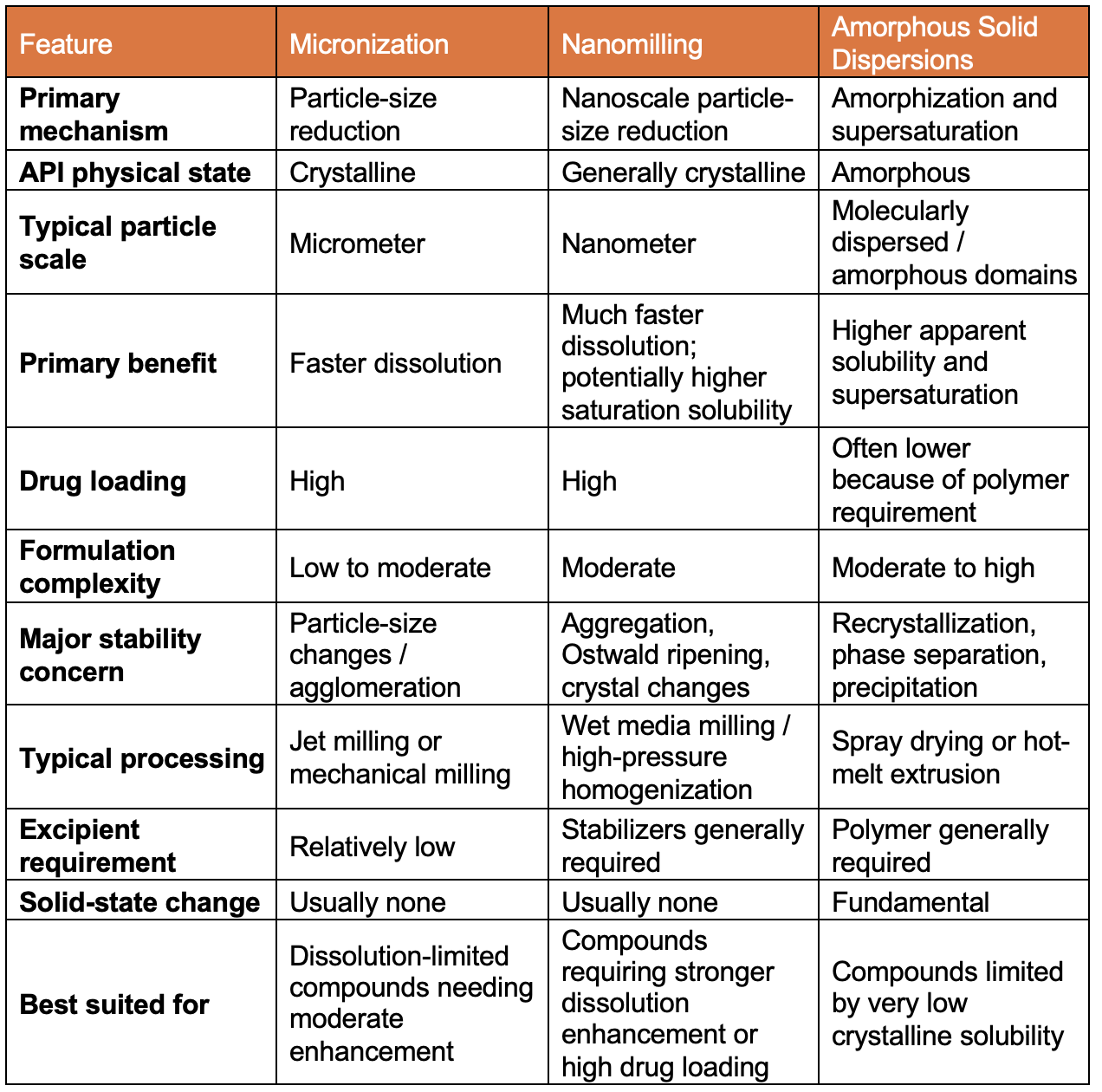 Mechanistic Differences
The three approaches can be understood as progressively more aggressive interventions in the physical barriers preventing a drug from entering solution.
Micronization
Micronization reduces the size of crystalline API particles, commonly using jet milling or related mechanical processes. Smaller particles provide greater surface area per unit mass, allowing more drug to contact the dissolution medium simultaneously.
The basic relationship is described by the Noyes–Whitney framework: increasing the available surface area can increase dissolution rate when other variables remain favorable.
Micronization does not, however, fundamentally eliminate the thermodynamic solubility limit imposed by the crystal lattice. Once the gastrointestinal fluid becomes saturated with the crystalline drug, simply providing additional surface area cannot necessarily produce substantially higher dissolved concentrations.
That distinction makes micronization highly useful but places a natural limit on what it can accomplish.
Nanomilling
Nanomilling extends the same principle into a much smaller particle-size range. Wet media milling, high-pressure homogenization, and related techniques can reduce crystalline drug particles to hundreds of nanometers or below.
The resulting increase in surface area can dramatically accelerate dissolution. At sufficiently small particle sizes, increased surface curvature and surface energy can also produce an increase in saturation solubility relative to larger crystals.
Nanocrystals therefore occupy an important middle ground. They can provide more substantial enhancement than conventional micronization while preserving the crystalline state of the API.
Their high surface energy also creates instability. Nanoparticles naturally tend to reduce their surface area through aggregation or crystal growth. Polymeric or surfactant stabilizers are therefore commonly required to prevent particles from agglomerating or undergoing Ostwald ripening during manufacturing and storage.
Amorphous Solid Dispersions
ASDs take a fundamentally different approach.
A crystalline API is organized into a stable lattice. Before the molecule can dissolve, energy must be expended to overcome those intermolecular interactions. For strongly crystalline compounds, that lattice energy can impose a severe limit on aqueous solubility.
An ASD removes that ordered crystal structure. The drug is trapped in an amorphous state, generally within a polymeric carrier, using processes such as spray drying or hot-melt extrusion.
Because amorphous drug has higher free energy than its crystalline counterpart, it can generate concentrations above the equilibrium solubility of the crystalline form. The polymer then plays an additional role by helping inhibit nucleation, crystal growth, and precipitation.
ASDs can therefore create a “spring-and-parachute” effect: the amorphous drug produces a rapid increase in dissolved concentration, while the formulation attempts to maintain that supersaturated state long enough for absorption.
That ability to exceed the crystalline solubility ceiling distinguishes ASDs most clearly from particle-size-reduction approaches.
Manufacturing and Operational Considerations
Micronization has a major practical advantage: simplicity.
Jet milling and other established particle-size-reduction technologies are widely available, scalable, and relatively straightforward to incorporate into conventional oral solid-dose manufacturing. Because the formulation may require comparatively few additional excipients, drug loading can remain high.
The principal challenge is achieving and maintaining the required particle-size distribution without damaging the material or creating undesirable downstream properties. Very fine powders may exhibit poor flow, electrostatic behavior, agglomeration, or altered compression characteristics. Milling can also introduce amorphous regions or other solid-state changes that require characterization.
Nanomilling adds another level of process complexity. Wet media milling requires optimization of milling media, energy input, solids concentration, temperature, stabilizer selection, and milling duration. Developers must achieve the desired particle size while preventing contamination, degradation, or unwanted solid-state changes.
Once nanosized particles have been generated, their dimensions must also survive downstream processing. A nanosuspension may be administered directly in some applications, but oral solid-dose products generally require conversion into a dry intermediate through spray drying, freeze-drying, granulation, or another process.
The nanoparticles must then redisperse appropriately when the dosage form encounters gastrointestinal fluid. A nanocrystal formulation that irreversibly aggregates during drying may lose much of the dissolution advantage created during milling.
ASDs shift the manufacturing challenge from particle-size control to solid-state control.
Spray-dried dispersions require appropriate API–polymer compatibility and a solvent system capable of producing the desired dispersion. Developers must optimize feed concentration, atomization, drying conditions, residual solvent, particle morphology, and downstream handling.
Hot-melt extrusion avoids organic solvent but requires the API and polymer to tolerate elevated processing temperatures and shear.
In either case, polymer loading can become a significant constraint. If one gram of API requires several grams of polymer to maintain a stable amorphous dispersion, high-dose drugs may generate tablets or capsules that are too large for practical administration.
Manufacturing feasibility therefore becomes part of formulation selection very early in development.
Drug Loading and Dose Considerations
Dose can substantially change which technology is most attractive.
Micronization generally preserves the highest formulation efficiency because the dosage form can contain a large proportion of API. That makes it attractive when relatively high doses are required and only a moderate dissolution improvement is necessary.
Nanocrystals can similarly support high drug loading. Stabilizers are required, but the formulation does not necessarily need the large polymer-to-drug ratios associated with some ASDs. This can make nanosizing particularly attractive when a high-dose compound requires greater dissolution enhancement than micronization can provide.
ASDs can become challenging as dose increases. Polymer is not merely a processing aid; it is often essential for maintaining the amorphous state and inhibiting precipitation. Reducing polymer content simply to shrink the dosage form may compromise physical stability or in vivo performance.
Conversely, highly potent drugs requiring relatively small doses may tolerate substantial polymer loading without creating an impractically large tablet or capsule.
Dose should therefore be considered alongside solubility from the beginning. The formulation that produces the greatest dissolution enhancement in laboratory testing may not be the one capable of delivering the required clinical dose in a viable dosage form.
Stability Considerations
Each technology creates a different physical-stability problem.
For micronized API, developers must ensure that particles do not agglomerate or otherwise lose the surface-area advantage created during milling. Moisture, storage conditions, and downstream processing can all influence particle behavior.
Nanocrystals present an amplified version of that challenge. Their high surface energy creates a thermodynamic incentive for particles to aggregate or for smaller particles to dissolve and redeposit onto larger crystals through Ostwald ripening. Stabilizer selection and control of storage conditions therefore become critical.
ASDs face perhaps the most fundamental stability challenge because the amorphous drug is intentionally maintained in a thermodynamically unfavorable state.
Over time, molecular mobility can allow drug molecules to reorganize into a crystal lattice. Moisture can plasticize the polymer matrix and increase that mobility, potentially accelerating recrystallization. Developers must therefore understand glass-transition behavior, drug–polymer interactions, humidity sensitivity, storage temperature, and packaging requirements.
The same issue occurs after administration. Generating supersaturation is not enough; the formulation must prevent precipitation for long enough to permit absorption.
The stability question consequently mirrors the mechanism of each technology: micronized particles must remain small, nanocrystals must remain nanosized, and amorphous drug must remain amorphous or at least supersaturated long enough to perform its intended function.
Regulatory and Development Considerations
All three technologies have substantial pharmaceutical precedent, but each creates different critical material attributes and control requirements.
For micronized products, particle size and particle-size distribution can directly influence dissolution and bioavailability. Milling conditions, solid form, surface properties, and agglomeration therefore require appropriate characterization and control.
Nanocrystal products require even tighter understanding of particle-size distribution and physical stability. Developers must demonstrate that manufacturing, storage, and downstream processing do not materially alter the nanoscale properties responsible for product performance.
For ASDs, the regulatory and analytical emphasis shifts toward solid-state characterization. Developers need to understand amorphous content, residual crystallinity, API–polymer interactions, moisture uptake, glass transition, physical stability, dissolution behavior, and the potential for recrystallization during storage.
These formulation attributes ultimately need to connect back to clinical performance. The objective is not merely to demonstrate that a formulation is micronized, nanosized, or amorphous, but to establish that the properties created by the manufacturing process are controlled sufficiently to deliver reproducible drug exposure.
Best Fit by Use Case
Micronization is typically preferred when:
dissolution rate is the principal barrier to absorption
the API’s equilibrium solubility is sufficient to support the required exposure
only a moderate improvement in dissolution is needed
maintaining the crystalline form is desirable
high drug loading is important
developers want the simplest viable formulation and manufacturing process
Nanomilling is typically preferred when:
micronization does not provide sufficient dissolution enhancement
high surface area is needed while retaining crystalline API
high drug loading remains important
the API cannot be formulated into a sufficiently stable ASD
a nanosuspension or nanoparticle-based solid dosage form fits the target product profile
aggregation and particle-size stability can be effectively controlled
Amorphous solid dispersions are typically preferred when:
very low crystalline solubility — not simply slow dissolution — is limiting exposure
overcoming the crystalline solubility ceiling is necessary
the API can be stabilized successfully in an amorphous polymer matrix
supersaturation produces a meaningful improvement in absorption
polymer loading is compatible with the required clinical dose
the additional formulation and manufacturing complexity is justified by the exposure benefit
Verdict
Micronization, nanomilling, and amorphous solid dispersions form a useful escalation ladder for poorly soluble drugs, but the most sophisticated technology should not automatically be the first choice.
Micronization should generally be considered when the problem is predominantly kinetic. If the drug has sufficient intrinsic solubility to support the desired exposure but simply dissolves too slowly, increasing crystalline surface area may solve the problem with relatively little formulation complexity.
Nanomilling becomes attractive when greater dissolution enhancement is required but preserving the crystalline drug and high API loading remain valuable. Moving from micron-scale to nanoscale particles can produce a much larger surface-area effect and may modestly increase saturation solubility, but that advantage comes with a greater requirement to stabilize the particle population.
Amorphous solid dispersions become most compelling when the limitation is fundamentally thermodynamic. If the equilibrium solubility of the crystalline API is too low to generate adequate exposure regardless of how rapidly the crystals dissolve, particle-size reduction may eventually reach its practical limit. An ASD can move beyond that limit by eliminating the crystal lattice and generating a supersaturated drug concentration.
The decision can therefore be framed as three increasingly consequential questions:
Does the drug simply need to dissolve faster?
Micronization may be sufficient.
Does it need substantially more dissolution performance while maintaining a high-loading crystalline formulation?
Nanomilling may offer the better balance.
Is crystalline solubility itself too low to achieve the required exposure?
An amorphous solid dispersion may be necessary.
That hierarchy should not replace experimental screening. Some compounds respond unexpectedly to particle-size reduction, others prove difficult to stabilize as nanocrystals, and still others resist formation of a physically stable amorphous dispersion.
The most efficient development strategy is therefore to identify the minimum formulation intervention capable of achieving the target exposure. A simple micronized product that meets the clinical requirement is preferable to a needlessly complex ASD. Conversely, repeatedly optimizing particle size is unlikely to rescue a molecule whose fundamental limitation is its crystalline solubility.
For poorly soluble compounds, the winning technology is not the one that changes the API most dramatically. It is the one that provides enough biopharmaceutical improvement to meet the target product profile while preserving the strongest possible combination of stability, drug loading, manufacturability, scalability, and patient usability.