

Key Takeaways
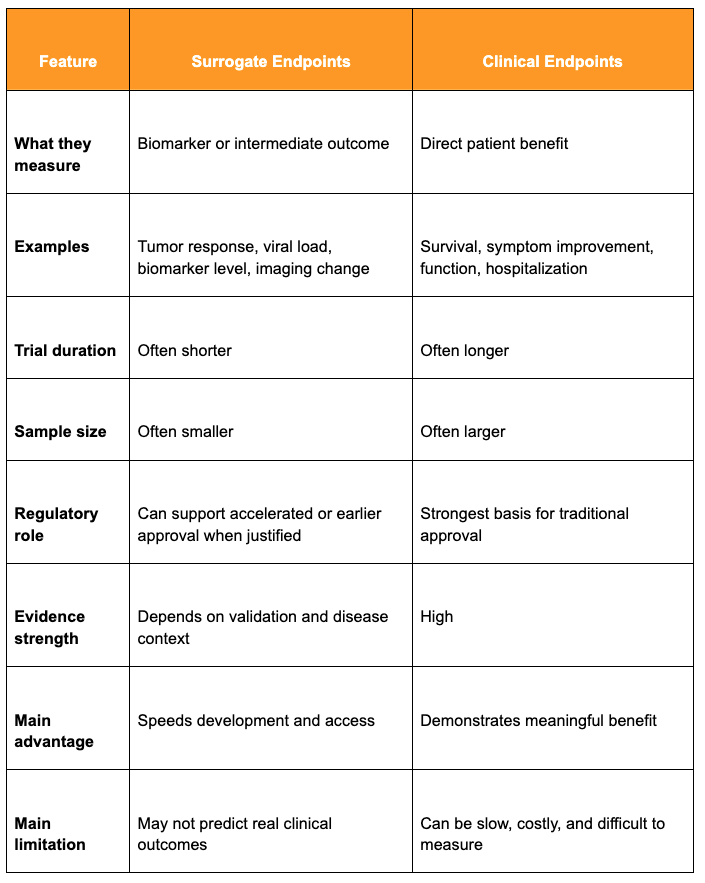
Clinical endpoints directly measure patient outcomes, such as survival, symptom improvement, functional status, hospitalization, or disease progression.
Surrogate endpoints use biomarkers, laboratory values, imaging findings, or intermediate measures expected to predict clinical benefit.
Surrogate endpoints can support faster development and earlier regulatory decisions, especially in serious diseases with long timelines or limited treatment options.
Clinical endpoints provide stronger evidence of real-world therapeutic value but often require larger, longer, and more expensive trials.
The best evidence strategy depends on disease biology, endpoint validation, unmet need, available therapies, and regulatory pathway.
Why This Comparison Matters Now
Endpoint selection is one of the most consequential decisions in clinical development. The endpoint determines what the trial is designed to prove, how many patients must be enrolled, how long the study must run, and how regulators, payers, physicians, and patients will interpret the result.
Traditionally, drug development has prioritized clinical endpoints that directly reflect patient benefit. These may include overall survival in oncology, reduction in major cardiovascular events, improved mobility in neuromuscular disease, fewer hospitalizations in chronic disease, or meaningful symptom relief in psychiatric and inflammatory conditions. Clinical endpoints are powerful because they answer the central question of medicine: does the therapy improve outcomes that matter to patients?
However, many diseases progress slowly, affect small populations, or require years of follow-up before clinical benefit can be measured directly. In those settings, relying exclusively on clinical endpoints can make development slow, costly, or impractical. Surrogate endpoints emerged to address this challenge by allowing developers to measure an earlier biological or intermediate marker that is expected to predict eventual clinical benefit.
Surrogate endpoints have become especially important in oncology, rare diseases, infectious disease, cardiovascular medicine, and accelerated approval pathways. Measures such as tumor response, viral load reduction, biomarker normalization, or imaging changes can allow promising therapies to reach patients earlier when waiting for definitive clinical outcomes would delay access.
At the same time, surrogate endpoints carry risk. Not every biomarker that changes in response to treatment translates into meaningful patient benefit. As regulatory agencies, payers, and clinicians continue to scrutinize accelerated approvals and confirmatory trial requirements, the distinction between surrogate and clinical endpoints has become central to modern drug development strategy.
 Mechanistic Differences
Clinical endpoints measure outcomes that are intrinsically meaningful to patients. In oncology, overall survival is a clinical endpoint because it measures whether patients live longer. In chronic disease, endpoints such as fewer exacerbations, reduced hospitalizations, improved walking distance, or improved daily functioning directly reflect how a patient feels, functions, or survives.
Surrogate endpoints are different. They are not themselves the ultimate clinical outcome, but they are used because they are expected to predict it. A surrogate endpoint may be a laboratory value, molecular biomarker, imaging result, virologic measure, or pathological finding that sits along the causal pathway between disease biology and patient outcome.
For example, reduction in viral load can serve as a surrogate endpoint in infectious disease because viral replication is closely tied to disease activity and transmission. In oncology, tumor shrinkage or progression-free survival may be used as surrogate or intermediate endpoints, particularly when waiting for overall survival data would take years or be confounded by subsequent therapies.
The strength of a surrogate endpoint depends on how well it has been validated. A strong surrogate is biologically plausible, consistently associated with clinical outcomes, and shown across studies to predict treatment benefit. A weak surrogate may reflect drug activity without reliably predicting whether patients will live longer, feel better, or function better.
Manufacturing and Operational Considerations
Although endpoint selection is primarily a clinical and regulatory decision, it has major operational consequences for drug development.
Trials using surrogate endpoints can often be shorter and smaller than trials requiring definitive clinical outcomes. This can reduce cost, accelerate decision-making, and allow developers to evaluate therapies in diseases where long-term outcomes would be impractical to measure within a reasonable timeframe. For small companies or rare disease programs, this can be the difference between a feasible and infeasible development plan.
Surrogate endpoints can also support adaptive development strategies. Early biomarker or imaging signals may help sponsors refine dosing, enrich patient populations, or decide whether to continue development. In precision medicine, surrogate or intermediate endpoints can be especially valuable when a therapy is designed to correct a specific molecular defect.
Clinical endpoint trials, by contrast, often require larger patient populations, longer follow-up, and more complex site operations. They may also require robust patient-reported outcome instruments, adjudication committees, long-term safety monitoring, and strategies to minimize missing data. These requirements increase cost and complexity but also strengthen the credibility of the evidence package.
For sponsors, the operational question is not simply whether a surrogate endpoint is faster. It is whether the endpoint is strong enough to support the intended regulatory, clinical, and commercial claims. A fast endpoint that fails to convince regulators, payers, or physicians can create downstream problems even if it accelerates early development.
Regulatory and Clinical Implications
Regulatory agencies accept surrogate endpoints when the scientific rationale is strong and the context justifies earlier decision-making. In some cases, surrogate endpoints can support full approval if they are well validated. In other cases, they may support accelerated approval, with confirmatory studies required to verify clinical benefit after approval.
This distinction is especially important. A surrogate endpoint may be adequate to show that a therapy is biologically active, but regulators may still require evidence that the observed biological effect translates into meaningful benefit for patients. Confirmatory trials are therefore central to maintaining confidence in approvals based on surrogate measures.
Clinical endpoints generally provide the strongest evidence for traditional approval because they directly establish patient benefit. They are also often more persuasive to payers and clinicians, particularly when the clinical effect is clear, durable, and meaningful. However, clinical endpoints may not always be realistic early in development or in diseases with very slow progression.
The clinical implications are equally important. A therapy that improves a surrogate endpoint but fails to improve clinical outcomes may expose patients to cost, inconvenience, and toxicity without delivering meaningful benefit. Conversely, requiring long-term clinical endpoints in every setting could delay access to effective therapies for patients with serious or life-threatening diseases.
The challenge is therefore to match endpoint strategy to the disease context and the strength of the available evidence linking the surrogate to clinical benefit.
Best Fit by Use Case
Surrogate endpoints are typically preferred when:
disease progression is slow or clinical outcomes take years to measure
the disease is serious or life-threatening and unmet need is high
the surrogate is biologically plausible and well validated
early access pathways or accelerated approval may be appropriate
patient populations are small and traditional outcome trials are difficult
Clinical endpoints are typically preferred when:
direct patient benefit can be measured within a feasible trial timeframe
the relationship between biomarker change and patient outcome is uncertain
the therapy carries meaningful safety risks that require strong benefit evidence
payers and clinicians will require clear demonstration of functional or survival benefit
traditional approval or broad clinical adoption is the goal
Verdict
Clinical endpoints remain the clearest and most persuasive way to demonstrate therapeutic value because they directly measure outcomes that matter to patients. When feasible, they provide the strongest foundation for regulatory approval, payer acceptance, physician confidence, and patient trust.
Surrogate endpoints, however, are essential tools in modern drug development. They can accelerate clinical programs, enable earlier access to promising therapies, and make trials feasible in diseases where waiting for definitive outcomes would be impractical or unethical. Their value depends on the strength of the evidence linking the surrogate measure to real clinical benefit.
The best endpoint strategy is not simply a choice between speed and certainty. It is a balance between biological plausibility, validation, unmet need, and the consequences of uncertainty. Surrogate endpoints are most powerful when they are used transparently, supported by strong evidence, and followed by confirmatory studies that establish meaningful benefit. Clinical endpoints remain indispensable when the field needs definitive proof that a therapy changes patients’ lives.