
Key Takeaways
Solid-phase peptide synthesis (SPPS) assembles a peptide while it remains attached to an insoluble resin, allowing rapid cycles of coupling, deprotection, and washing.
Liquid-phase peptide synthesis (LPPS) performs peptide assembly in solution, often isolating or purifying intermediates between synthetic steps or using soluble-support strategies.
SPPS dominates modern pharmaceutical peptide manufacturing because it is highly automatable, adaptable, and effective for longer or more complex sequences.
LPPS can offer advantages in raw-material efficiency, solvent consumption, scale, and intermediate purification, particularly for shorter peptides or highly optimized commercial processes.
Increasing demand for peptide APIs is renewing interest in hybrid and next-generation LPPS approaches that seek to combine SPPS-like convenience with improved process efficiency.
The best route depends on sequence length, complexity, target scale, impurity profile, sustainability goals, and the economics of the complete synthesis and purification process.
Why This Comparison Matters Now
Peptide manufacturing has moved rapidly from a specialized pharmaceutical capability toward industrial-scale production. Expanding use of peptide therapeutics across metabolic disease, endocrinology, oncology, and other indications — and especially unprecedented demand for incretin-based medicines — has placed pressure not only on synthesis capacity but also on amino acid supply, purification, solvent handling, lyophilization, and waste-management infrastructure. Pharma’s Almanac has previously highlighted that the current peptide capacity challenge extends well beyond the number of available synthesizers.
Solid-phase peptide synthesis (SPPS) has become the dominant synthetic technology behind much of this growth. Its operational elegance is compelling: the growing peptide remains bound to an insoluble support while reagents are added, reactions proceed, and excess material and reaction byproducts are removed simply by washing the resin. Repeating these cycles allows relatively long and structurally sophisticated peptides to be produced without isolating every intermediate.
That efficiency transformed peptide research and manufacturing. SPPS is readily automated, accommodates a broad range of protected and non-natural amino acids, and allows developers to move from sequence design to physical material relatively quickly. It remains the preferred method for many pharmaceutical peptide applications.
Its convenience, however, comes at a cost. SPPS typically uses excess amino acid derivatives and coupling reagents to drive reactions toward completion, together with repeated solvent-intensive wash steps. The polymeric resin itself represents an additional raw material that ultimately becomes waste. As peptide volumes rise dramatically, these inefficiencies become increasingly significant economically and environmentally.
Liquid-phase peptide synthesis (LPPS) takes a different approach. Peptide fragments or complete chains are assembled in solution without an insoluble resin. Conventional LPPS may require isolation and purification of intermediates between reactions, making it operationally more cumbersome than SPPS. However, solution chemistry can operate at higher effective concentrations and may consume substantially less resin, reagent, and solvent.
Newer LPPS technologies are also challenging the historical distinction between the two platforms. Soluble supports, tags, membrane separations, and other process innovations seek to preserve the convenient iterative synthesis associated with SPPS while capturing the material efficiency and scalability of solution-phase chemistry.
The question is therefore becoming increasingly relevant: does the operational simplicity of SPPS still outweigh its material intensity at commercial scale, or can modern liquid-phase approaches provide a more efficient route for selected peptides?
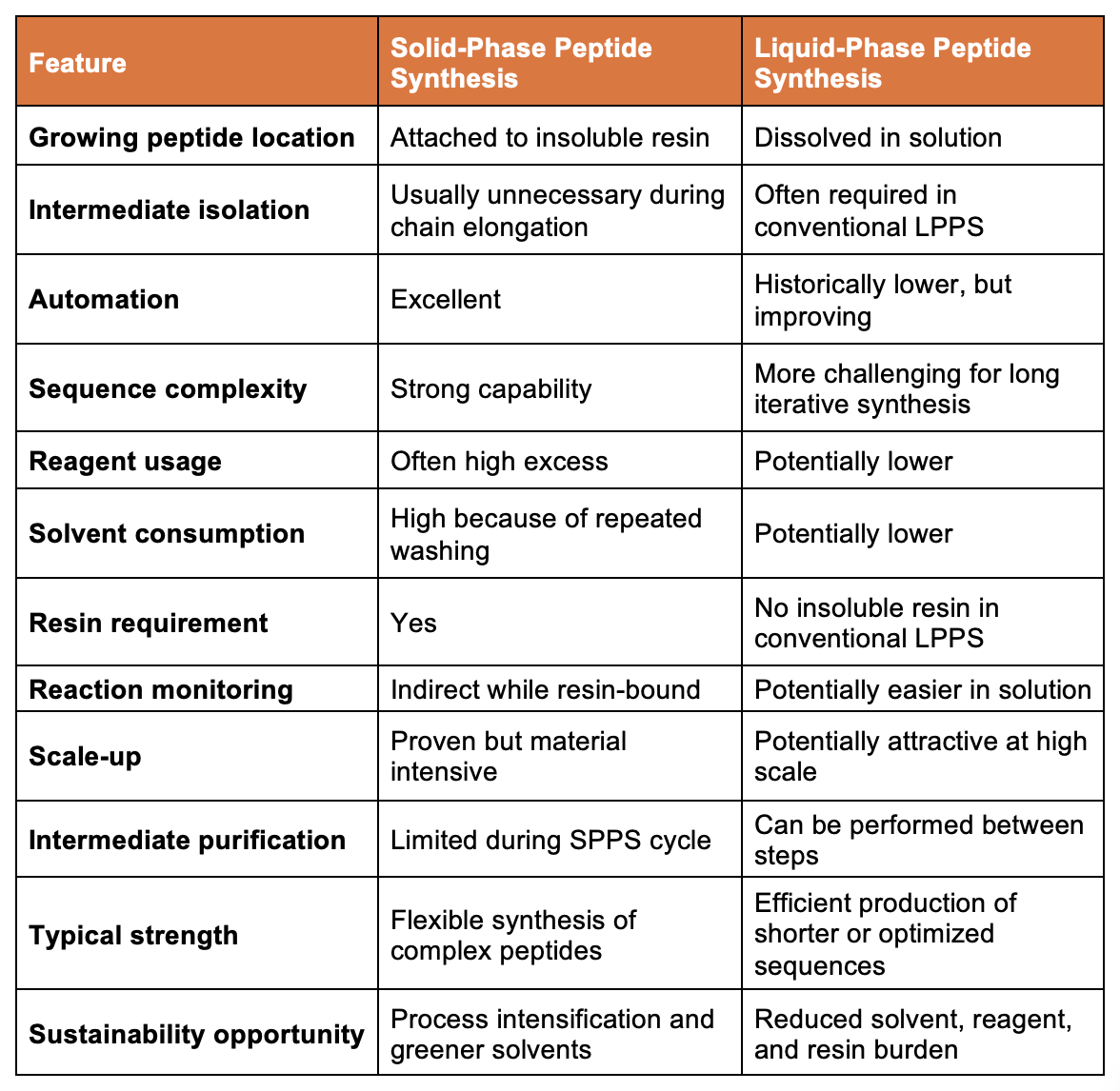 Mechanistic Differences
In SPPS, the first protected amino acid is attached to an insoluble polymeric resin. Its temporary protecting group is removed, exposing a reactive amine that can be coupled to the next protected amino acid. Once that reaction is complete, excess reagent and soluble reaction products are washed away while the peptide remains immobilized on the resin.
This cycle of deprotection, coupling, and washing is repeated until the desired sequence has been assembled. The completed peptide is then cleaved from the resin and its remaining protecting groups removed before downstream purification.
Immobilization provides the central operational advantage of SPPS. Because the desired product does not have to be isolated after each coupling reaction, developers can use excess reagents to drive reactions toward completion and then remove those reagents by simple filtration and washing. Automated synthesizers can perform dozens of these cycles with relatively little intervention.
The same feature creates SPPS’s central efficiency problem. Every cycle typically requires fresh solvent for reaction and washing, and substantial excesses of protected amino acids and activating agents may be needed to achieve high coupling efficiency. The U.S. FDA has specifically noted that SPPS is a complex manufacturing process involving numerous reaction and purification steps capable of influencing peptide identity, purity, and quality.
Conventional LPPS removes the solid support. Coupling reactions take place in homogeneous solution, and the growing peptide or peptide fragment must generally be separated from unreacted starting materials, reagents, and reaction products before the next stage.
That requirement can slow iterative synthesis because isolation becomes an active unit operation rather than a wash step. It also creates an advantage: intermediates can be characterized and purified during synthesis, potentially preventing impurities generated early in the process from propagating through the remainder of the sequence.
Modern LPPS technologies increasingly blur this distinction. Soluble polymers, molecular tags, precipitation strategies, membrane separations, and related approaches can allow a growing peptide to remain associated with a recoverable support while still reacting under solution-phase conditions. These approaches aim to achieve the high reaction efficiency of solution chemistry without requiring traditional chromatography or crystallization after every coupling.
Manufacturing and Operational Considerations
SPPS is attractive operationally because it has become highly standardized and automated. Commercial peptide manufacturers can use established synthesizer platforms to execute complex multistep sequences with tight process control. Changing products may involve changing the amino acid sequence and process parameters rather than redesigning an entire manufacturing platform.
This flexibility is particularly valuable in multiproduct facilities and during development, when sequences may still change. Automation also reduces the handling burden associated with dozens of sequential reaction steps.
At commercial scale, however, the amount of material moving through an SPPS process can become enormous relative to the amount of active pharmaceutical ingredient (API) ultimately produced. Resin occupies substantial reactor volume, while each coupling and deprotection cycle generates solvent and reagent waste. For long peptides, dozens of cycles may be required.
Scale can therefore expose a distinction between synthetic yield and process mass efficiency. A process may deliver an acceptable yield of high-quality peptide while still consuming very large quantities of solvents, protected amino acids, coupling reagents, and resin per kilogram of API.
LPPS can shift that equation. Solution-phase reactions can often be run at relatively high concentrations, and developers may use closer-to-stoichiometric quantities of starting materials. Eliminating an insoluble resin also removes one significant raw-material and waste stream. Modern LPPS has consequently attracted renewed interest as peptide manufacturing moves toward larger commercial volumes.
However, LPPS introduces operational complexity of its own. The product cannot simply be retained in a reactor while everything else is washed away. Intermediate isolation may require extraction, precipitation, crystallization, membrane separation, or chromatography. Every such operation must achieve sufficient recovery while controlling impurity propagation.
For long peptides, repeatedly performing those separations can become cumbersome enough that SPPS regains its advantage. The economics therefore depend on the entire process rather than reaction efficiency alone.
Sequence Length, Complexity, and Purification
Sequence complexity is one of the strongest factors influencing platform choice.
SPPS became transformative precisely because it made longer peptide assembly manageable. Repetitive coupling chemistry can proceed on a single solid support without the need to isolate increasingly complex intermediates after each step. This makes SPPS especially valuable for sequences with numerous residues, unusual amino acids, or modifications requiring precise positioning.
Long sequences still create problems. Even very high individual coupling efficiencies compound over dozens of reactions. Deletion sequences, incomplete reactions, racemization, and other closely related impurities can accumulate, increasing the burden on preparative chromatography.
LPPS is often more attractive for shorter sequences, peptide fragments, or manufacturing routes in which highly efficient intermediate purification can be incorporated deliberately. Bachem, for example, describes LPPS as particularly applicable to shorter peptides and notes its potential advantages in scalability and reduced reagent and solvent consumption, while SPPS remains preferred for many pharmaceutical applications.
Fragment-based strategies can also combine the strengths of both approaches. Separate peptide fragments can be synthesized under conditions best suited to each sequence and then joined in solution. Such hybrid routes can become attractive when full-length SPPS becomes inefficient but fully iterative LPPS would be operationally cumbersome.
Consequently, the relevant question is not simply how many amino acids a peptide contains. Difficult residues, hydrophobic sequences, aggregation during synthesis, post-translational mimics, chemical modifications, and the nature of likely impurities can all influence which route performs better.
Sustainability and Process Efficiency
Sustainability has become one of the most important reasons to reconsider the conventional SPPS paradigm.
The repeated washing cycles central to SPPS can consume substantial quantities of organic solvent. Coupling chemistry often requires excess protected amino acids and activating reagents, while spent resin creates another waste stream. These issues become increasingly significant as therapeutic peptides move into indications requiring production at unprecedented scale.
LPPS potentially addresses several of these issues by eliminating insoluble resin, operating at higher concentrations, and reducing the excess of reagents required for each reaction. Reviews of modern LPPS explicitly identify reduced reagent and solvent consumption and improved compatibility with green-chemistry principles as key attractions of the approach.
But “liquid phase” does not automatically mean sustainable. Intermediate purification may itself require large quantities of solvent, energy, and processing resources. Poor yields during precipitation or extraction could offset advantages gained during the coupling reaction.
Similarly, SPPS is not static. Manufacturers are pursuing greener solvent systems, improved coupling reagents, higher-loading resins, reduced wash volumes, continuous processing, solvent recycling, and other forms of process intensification.
The meaningful sustainability comparison is therefore the complete process mass intensity and environmental footprint per unit of acceptable peptide API, not simply whether the synthesis uses a solid support.
Regulatory and Quality Implications
Regulators do not prescribe SPPS or LPPS as the preferred synthetic route. The quality requirement is that the manufacturer understands and controls the process and the resulting impurity profile.
That issue is particularly important for peptides because closely related sequence variants can be difficult to remove and may have biological consequences. The FDA has emphasized that peptide-related impurities arising during synthesis can affect the safety or effectiveness of peptide products.
SPPS can generate deletion sequences, incomplete coupling products, stereochemical variants, protecting-group-related impurities, and degradation products. LPPS may generate many of the same chemically related species, but intermediate isolation creates opportunities to purge impurities before subsequent synthetic steps.
The manufacturing route consequently shapes the impurity-control strategy. Developers must understand how impurities arise, whether they persist or amplify through later reactions, how downstream purification removes them, and how analytical methods distinguish them from the desired peptide.
This regulatory focus has become increasingly formalized. The EMA’s guideline on the development and manufacture of synthetic peptides, effective from June 2026, specifically addresses manufacturing processes, characterization, specifications, and analytical control for synthetic peptide APIs.
The emergence of dedicated guidance reflects the increasing industrial maturity of synthetic peptide manufacturing rather than a preference for one synthesis platform over another.
Best Fit by Use Case
Solid-phase peptide synthesis is typically preferred when:
the peptide is moderate or long in sequence
substantial sequence complexity or unusual amino acids must be accommodated
rapid development and flexible sequence changes are important
highly automated synthesis is desirable
avoiding isolation of intermediates after every coupling provides a significant operational advantage
manufacturing scale remains compatible with resin, reagent, solvent, and purification requirements
Liquid-phase peptide synthesis is typically preferred when:
the peptide or peptide fragment is relatively short
the synthetic route can be optimized around a limited number of highly efficient reactions
manufacturing occurs at sufficiently large scale for resin and solvent consumption to become major economic constraints
intermediates can be isolated or purified efficiently
reducing excess reagents and process mass intensity is a major development objective
solution-phase conditions provide superior reaction kinetics or impurity control
Hybrid approaches are particularly attractive when:
different sections of a complex peptide favor different synthesis strategies
fragments can be produced efficiently and then ligated
full-length SPPS creates excessive impurity or material burden
purely iterative LPPS would require too many isolation steps
the manufacturer is optimizing the overall process rather than defending a single synthesis platform
Verdict
SPPS remains the workhorse of modern therapeutic peptide manufacturing for good reason. Its combination of automation, flexibility, sequence capability, and straightforward removal of excess reagents transformed peptide synthesis and continues to make it the most practical option for many complex pharmaceutical peptides.
Its greatest advantage — using an immobilized peptide to simplify repeated synthetic cycles — is also the source of its greatest limitation. Large quantities of resin, amino acid derivatives, coupling reagents, and solvent can be consumed to manufacture comparatively small amounts of final API. As peptide demand increases from kilograms toward substantially larger commercial volumes, that material intensity matters much more.
Liquid-phase peptide synthesis can provide a compelling alternative when the chemistry and sequence are suitable. Higher reaction concentrations, reduced reagent excess, elimination of insoluble resin, and the ability to purify intermediates can create important advantages for large-scale manufacture. Modern soluble-support and tagged LPPS technologies are further reducing the historical operational gap between solution- and solid-phase synthesis.
But LPPS does not displace SPPS simply because it can be more material efficient. The need to isolate intermediates can make long iterative syntheses cumbersome, and complex sequences can quickly restore SPPS’s operational advantage.
The practical dividing line is therefore not solid versus liquid so much as synthetic complexity versus process efficiency. SPPS generally wins when sequence complexity and operational flexibility dominate the decision. LPPS becomes increasingly attractive when scale, raw-material efficiency, and sustainability outweigh the convenience of resin-bound synthesis.
For many future high-volume peptide products, the strongest answer may ultimately be neither platform alone. Hybrid processes that combine solid-phase synthesis, solution-phase fragment manufacture, ligation, and newer soluble-support technologies offer developers another option: use each chemistry only where it creates genuine process value.