
Key Takeaways
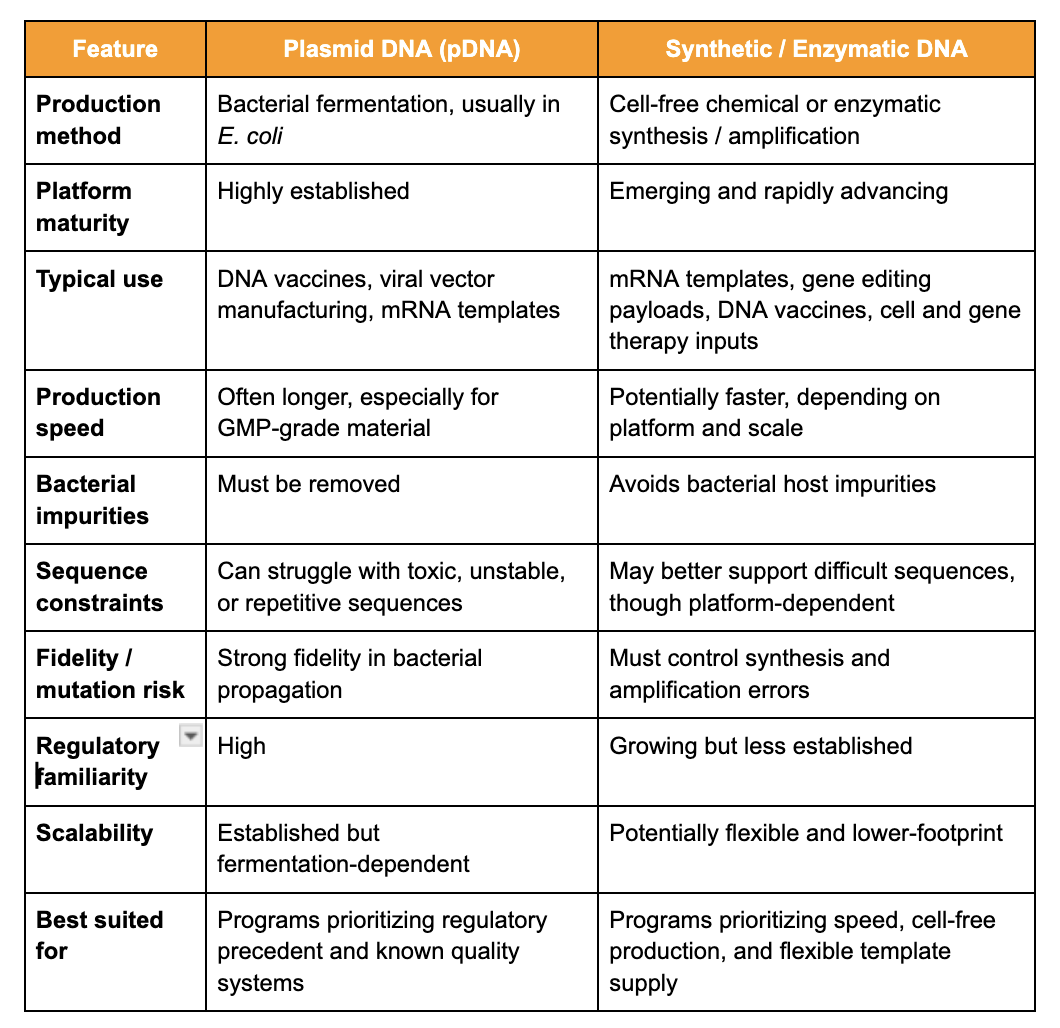
Plasmid DNA (pDNA) is produced through bacterial fermentation, most commonly in E. coli, and remains a familiar, regulatorily established platform for DNA vaccines, viral vector production, and mRNA template generation.
Synthetic/enzymatic DNA platforms use cell-free methods to generate DNA without bacterial propagation, potentially reducing endotoxin, host-cell DNA, and antibiotic-resistance-gene concerns.
pDNA manufacturing benefits from high fidelity and deep process familiarity, but can face long lead times, bacterial-sequence constraints, and scale limitations.
Enzymatic DNA approaches can shorten production timelines and support rapid iteration, but the field is still newer and must address questions around product format, sequence fidelity, impurity profiles, and regulatory comparability.
The best choice depends on whether the program prioritizes regulatory precedent and established quality systems or speed, cell-free production, and flexible template manufacturing.
Why This Comparison Matters Now
DNA is a foundational input for modern genetic medicines. Plasmid DNA is used directly in some DNA vaccines and gene therapy applications, and indirectly as a critical manufacturing material for viral vectors, mRNA therapeutics, and engineered cell therapies. As demand for genetic medicines expands, DNA supply has become a strategic manufacturing constraint rather than a routine upstream input.
Historically, plasmid DNA has been the default platform. It is typically manufactured by inserting the desired sequence into a plasmid, propagating that plasmid in bacterial cells, and then purifying the final DNA product. This approach is well understood, scalable within established limits, and supported by decades of process experience.
However, bacterial fermentation introduces constraints. Some sequences are difficult to propagate in bacteria, particularly unstable or repetitive sequences. Plasmid production can also require removal of bacterial impurities, including host-cell DNA, RNA, endotoxin, and process-related contaminants. In addition, plasmids may contain bacterial backbone elements, such as origins of replication and selection markers, that are necessary for production but not therapeutically useful.
Synthetic and enzymatic DNA platforms are emerging as alternatives designed to bypass some of these limitations. These technologies produce DNA outside living cells using chemical or enzymatic workflows, including approaches based on rolling-circle amplification and cell-free enzymatic synthesis. Several companies are positioning these systems as faster, cleaner, and more flexible alternatives to conventional plasmid manufacturing, particularly for mRNA template production, gene editing payloads, and cell and gene therapy applications.
The comparison matters because DNA manufacturing is becoming a rate-limiting step for many advanced therapies. As developers seek faster development cycles, smaller manufacturing footprints, and more flexible supply chains, the choice between pDNA and synthetic or enzymatic DNA may increasingly shape timelines, cost of goods, and regulatory strategy. Cell-free DNA approaches are advancing rapidly, but recent work also highlights that in vitro DNA production can introduce mutation-related quality concerns that must be managed carefully.
 Mechanistic Differences
Plasmid DNA manufacturing is a biologically mediated process. Developers design a circular DNA plasmid that includes the sequence of interest and production elements needed for bacterial propagation. The plasmid is introduced into E. coli, amplified through fermentation, and then recovered through cell harvest, lysis, clarification, purification, and polishing steps.
This process is powerful because bacteria are efficient DNA replication systems. It also provides a familiar route to large quantities of DNA. However, the final product must be separated from bacterial host impurities, and the plasmid architecture may include non-therapeutic backbone sequences. These elements are useful during manufacturing but can create regulatory and product-design considerations, particularly when the DNA is intended as a therapeutic product rather than only as a process intermediate.
Synthetic and enzymatic DNA production takes a different approach. Instead of relying on bacterial growth, these methods assemble or amplify DNA in vitro. Some systems use enzymatic synthesis to generate DNA from sequence information and then amplify it through rolling-circle amplification or related cell-free processes. Others use synthetic gene assembly followed by enzymatic amplification to produce linear, circular, or concatemeric DNA formats.
The major conceptual advantage is that DNA can be produced without bacterial fermentation. That can simplify certain impurity concerns and may allow faster movement from digital sequence to physical DNA. However, because these systems rely on synthesis and amplification reactions rather than cellular replication, they must demonstrate strong control over sequence fidelity, product heterogeneity, and process-related impurities. One 2024 study found that DNA synthesized in vitro by polymerase chain reaction or rolling-circle amplification had higher mutation rates than DNA produced in E. coli, underscoring the need for robust quality controls as cell-free systems mature.
Manufacturing and Operational Considerations
From an operational standpoint, plasmid DNA has the advantage of familiarity. Many suppliers, contract development and manufacturing organizations, and therapy developers already understand the unit operations, analytical requirements, and quality systems needed to produce GMP-grade pDNA. That maturity makes pDNA a lower-risk default for programs where regulatory precedent and established supply chains matter.
The downside is that plasmid production can be slow and capacity-constrained. Developing a plasmid production process involves cloning, bacterial cell banking, fermentation optimization, purification, and analytical release testing. For fast-moving modalities such as mRNA vaccines or personalized genetic medicines, these timelines can become limiting. Bacterial systems may also struggle with sequences that are toxic, unstable, repetitive, or otherwise difficult to maintain during propagation.
Synthetic and enzymatic DNA platforms promise a different manufacturing profile. By eliminating bacterial fermentation, they may reduce the need for cell banking, fermentation scale-up, and removal of bacterial impurities. Cell-free production can also be more compact and modular, potentially supporting faster development cycles and more flexible manufacturing models. Industry developers of enzymatic DNA platforms describe timelines measured in weeks or even days for certain workflows, compared with longer conventional plasmid timelines, although specific timelines vary by provider, scale, product format, and GMP requirements.
That said, synthetic and enzymatic DNA manufacturing introduces its own operational questions. Developers must define the final DNA format, control sequence-related impurities, characterize amplification byproducts, and ensure that the material performs consistently in downstream applications such as in vitro transcription, transfection, or vaccine delivery. For therapeutic use, regulators will expect a clear understanding of product identity, purity, potency, and comparability to conventional materials where relevant.
Regulatory and Quality Implications
Regulatory familiarity remains one of pDNA’s strongest advantages. Plasmid DNA has been used across DNA vaccines, viral vector manufacturing, and mRNA template workflows, giving regulators and manufacturers a shared understanding of expected quality attributes and impurity controls. These include supercoiled content, residual host-cell proteins, host-cell DNA, RNA, endotoxin, residual antibiotics or selection-related concerns, and residual process reagents.
Synthetic and enzymatic DNA may simplify some of those issues by removing bacterial host-cell impurities from the process. Avoiding bacterial propagation can reduce concerns related to endotoxin, residual host-cell DNA, and antibiotic resistance markers. That is a compelling quality argument, particularly for products where the DNA itself is administered or where template purity affects downstream RNA quality.
However, newer platforms also require their own regulatory story. The quality attributes of enzymatically produced DNA may not map perfectly onto conventional plasmid specifications. Depending on the format, developers may need to explain how linear, minimal, doggybone, minicircle, concatemeric, or other nonstandard DNA structures behave in the intended application. They must also demonstrate that sequence integrity and impurity profiles are controlled at clinically appropriate levels.
The regulatory question is therefore not whether synthetic or enzymatic DNA is acceptable in principle. It is whether the sponsor can characterize the material fully, control the manufacturing process, and show that the DNA performs consistently for the intended use.
Best Fit by Use Case
Plasmid DNA is typically preferred when:
regulatory precedent and platform familiarity are top priorities
the sequence is stable and straightforward to propagate in bacteria
the DNA is being used in established workflows for viral vector or mRNA manufacturing
existing suppliers and release methods are already qualified
the program values a conservative manufacturing path over speed or novelty
Synthetic/enzymatic DNA is typically preferred when:
rapid sequence-to-DNA timelines are strategically important
bacterial propagation is difficult because of unstable, repetitive, toxic, or complex sequences
minimizing bacterial impurities is a major quality objective
a smaller manufacturing footprint or cell-free process is desirable
the DNA is being used as a template for RNA production or as a flexible input for genetic medicine development
Verdict
Plasmid DNA remains the established workhorse for genetic medicine manufacturing. It benefits from decades of use, broad supplier networks, known analytical expectations, and regulatory familiarity. For many programs, especially those with stable sequences and conventional manufacturing needs, pDNA remains the most straightforward and lowest-risk choice.
Synthetic and enzymatic DNA platforms are becoming increasingly important because they address several pain points associated with bacterial plasmid production. Their potential advantages include faster production, cell-free manufacturing, reduced bacterial impurity burden, and improved flexibility for challenging sequences or fast-moving development programs. These strengths are particularly relevant as mRNA therapeutics, gene editing, and personalized genetic medicines increase demand for rapid, high-quality DNA templates.
The practical answer is that pDNA and synthetic/enzymatic DNA are likely to coexist for some time. pDNA will remain the default where regulatory precedent and established quality systems matter most. Synthetic and enzymatic DNA will gain ground where speed, flexibility, difficult sequence manufacturing, and cell-free production offer a clear advantage.
For developers, the decision should begin with the intended use of the DNA: therapeutic product, viral vector input, mRNA template, gene editing payload, or research-stage material. From there, the best platform is the one that can deliver the required sequence, quality profile, timeline, and regulatory confidence for that specific application.