
Key Takeaways
Spray-drying converts a drug–polymer solution or suspension into dry particles through atomization and rapid solvent evaporation.
Hot-melt extrusion (HME) uses heat and mechanical shear to mix drug and polymer into an amorphous or molecularly dispersed solid form.
Spray-drying is generally better suited for thermally sensitive molecules, because solvent evaporation can occur quickly at controlled outlet temperatures.
HME avoids organic solvents and aligns well with continuous manufacturing, but it requires drug and excipient stability under elevated heat and shear.
The best choice depends on drug properties, polymer compatibility, thermal stability, solvent constraints, target dose, and manufacturing strategy.
Why This Comparison Matters Now
Poor aqueous solubility remains one of the most common barriers in small-molecule drug development. Many promising compounds show strong potency in discovery but fail to translate efficiently because they cannot dissolve well enough to achieve adequate exposure in vivo. As a result, enabling formulations have become central to modern drug development.
Spray-drying and hot-melt extrusion are two of the most important technologies for producing amorphous solid dispersions, which can improve apparent solubility and dissolution by stabilizing the drug in a higher-energy amorphous state within a polymer matrix.
The comparison matters because both platforms can solve similar formulation problems but impose very different constraints. Spray-drying offers flexibility in solvent systems and can be useful for heat-sensitive compounds, while hot-melt extrusion offers a solvent-free, continuous process that may be attractive for scalable manufacturing.
For developers, this is not simply a technical equipment choice. It shapes excipient selection, process development, stability strategy, environmental controls, and eventual commercial manufacturing design.
 Mechanistic Differences
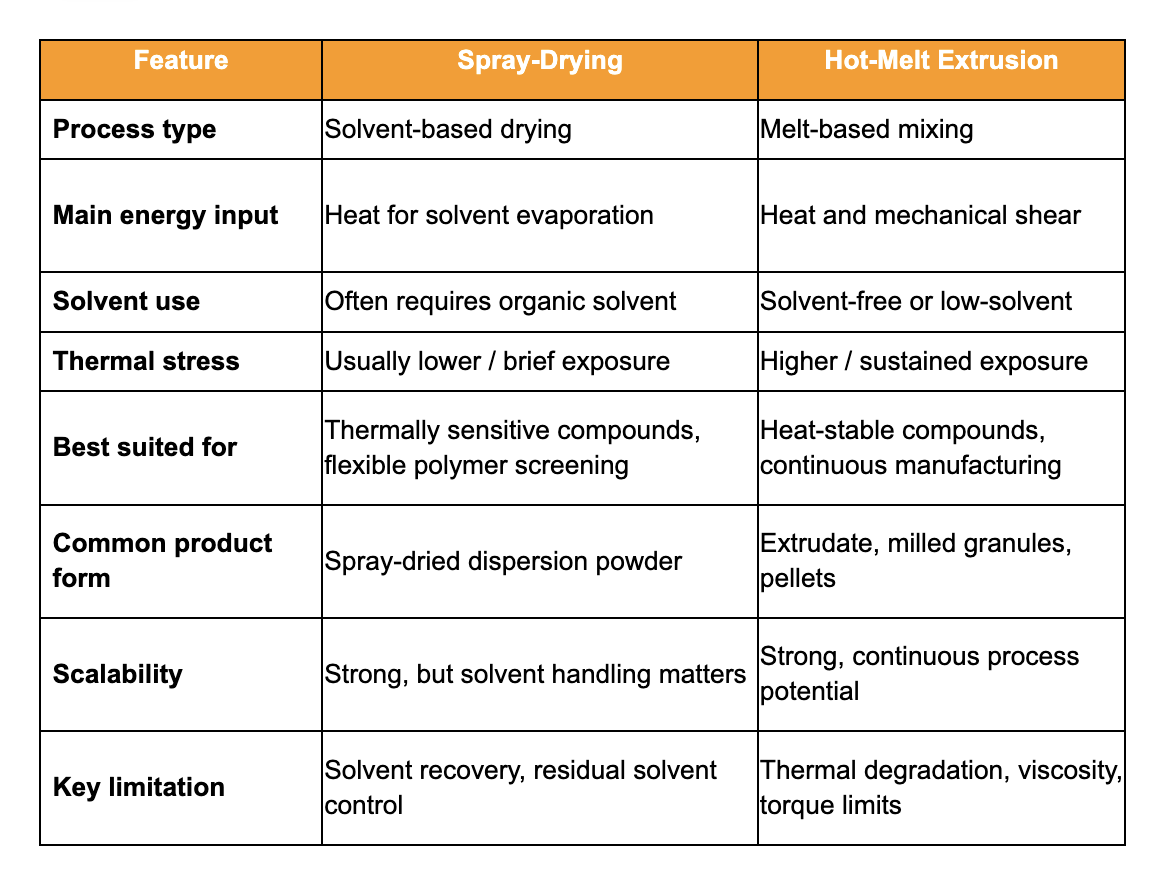
Spray-drying begins with a solution or suspension containing the drug, polymer, and often other excipients dissolved or dispersed in a volatile solvent system. The feed is atomized into fine droplets, which rapidly dry in a stream of heated gas. As the solvent evaporates, the drug and polymer solidify into particles, often forming an amorphous solid dispersion.
The short drying time is one of spray-drying’s main advantages. Even though heated gas is used, the evaporative cooling effect and relatively brief exposure can reduce thermal stress compared with melt-based processing. This can make spray-drying attractive for compounds that degrade under prolonged heat.
Hot-melt extrusion works differently. Drug and polymer are fed into an extruder, where rotating screws apply heat and shear to mix the materials in a molten or softened state. The drug may dissolve into the polymer matrix, creating a molecular dispersion. The extrudate is then cooled, milled, and processed into a final dosage form.
Because HME does not require a solvent-based feed, it avoids many solvent-handling issues. However, the drug and polymer must tolerate elevated temperature and mechanical stress, and the formulation must have suitable melt viscosity for extrusion.
Manufacturing and Operational Considerations
Spray-drying offers strong formulation flexibility, especially during early development. Developers can screen multiple polymers and solvent systems to identify combinations that stabilize the amorphous drug form and support rapid dissolution. The resulting powder can often be blended, encapsulated, compressed, or further processed into oral solid dosage forms.
The main operational burden is solvent management. Many spray-dried dispersion processes rely on organic solvents, requiring controls for flammability, worker safety, emissions, residual solvents, and solvent recovery. These issues become increasingly important at commercial scale.
Hot-melt extrusion has a different operational profile. Because it is inherently continuous and often solvent-free, it can fit well into modern manufacturing strategies focused on process intensification and reduced solvent burden. HME can also be highly scalable when the formulation is well understood.
The trade-off is that process development can be constrained by thermal stability, polymer glass transition temperature, melt viscosity, screw design, torque, residence time, and downstream milling behavior. For compounds with narrow thermal windows, HME may be difficult or impossible without plasticizers or other formulation modifications.
Best Fit by Use Case
Spray-drying is typically preferred when:
the drug is thermally sensitive
the formulation requires flexible polymer and solvent screening
rapid amorphous solid dispersion development is needed
the target product can tolerate solvent-based processing
Hot-melt extrusion is typically preferred when:
the drug and excipients are thermally stable
solvent avoidance is a priority
a continuous manufacturing process is desired
the formulation has suitable melt viscosity and processability
Verdict
Spray-drying and hot-melt extrusion are not interchangeable technologies, even though both are widely used for solubility enhancement and amorphous solid dispersion development. Spray-drying is often the more flexible option for thermally sensitive compounds and early-stage formulation screening, but it introduces solvent-handling and residual-solvent considerations.
Hot-melt extrusion is attractive when the drug–polymer system can tolerate heat and shear, particularly for companies seeking solvent-free, continuous manufacturing. Its strengths are process efficiency and industrial scalability, but those advantages depend on having a formulation with the right thermal and rheological properties.
For many poorly soluble compounds, the best platform is determined early by the molecule itself: if thermal stability is limited, spray-drying often has the edge; if solvent avoidance and continuous processing are priorities and the molecule is heat-stable, hot-melt extrusion may be the stronger path.