
Key Takeaways
Lyophilization (freeze-drying) stabilizes sensitive biologics by removing water.
Liquid formulations are easier to administer and avoid reconstitution steps.
Many monoclonal antibodies and vaccines are formulated as liquids when stability allows.
Lyophilized products are often preferred for temperature-sensitive biologics.
Formulation strategy must balance stability, manufacturability, and patient convenience.
Why This Comparison Matters Now
Drug formulation plays a critical role in ensuring that biopharmaceutical products remain stable, safe, and effective throughout their shelf life.
Many biologics are inherently unstable in aqueous environments and may degrade through aggregation, oxidation, or hydrolysis. Lyophilization removes water from the product, significantly improving stability.
However, lyophilized products require reconstitution before administration, which can introduce dosing errors or inconvenience in clinical settings. As a result, developers must carefully evaluate whether a liquid formulation is feasible.
 Mechanistic Differences
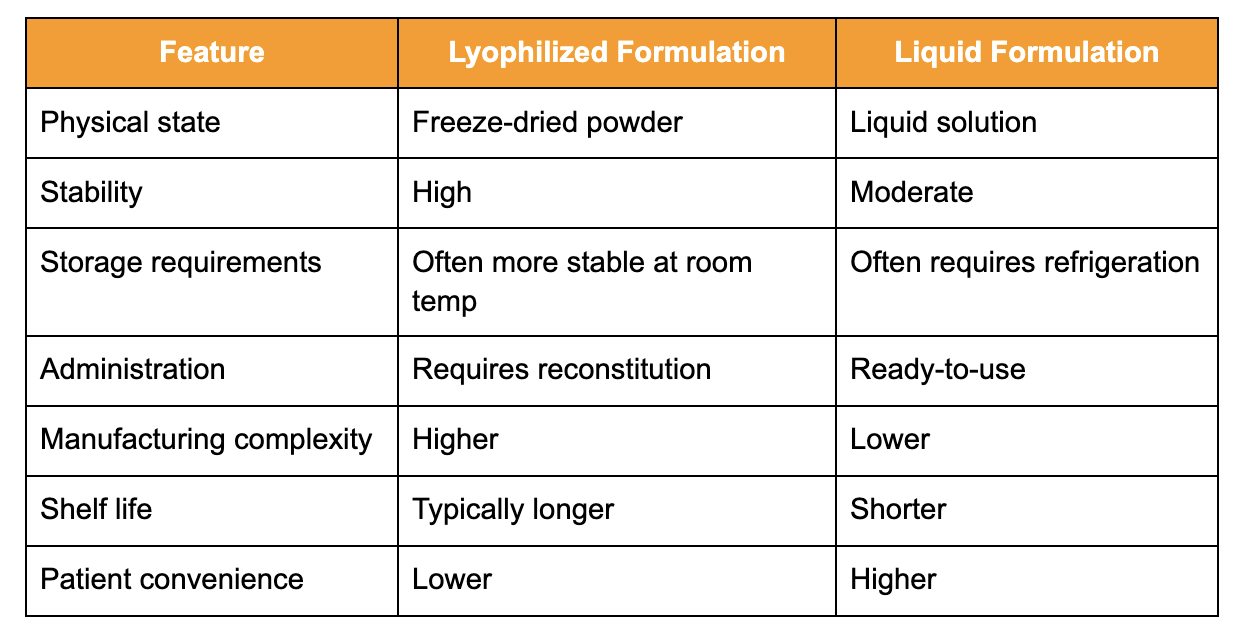
Lyophilization stabilizes drug molecules by removing water through freezing and sublimation processes. Without water, many degradation pathways are slowed dramatically.
Liquid formulations keep the drug dissolved in solution, which makes administration easier but exposes the molecule to potential chemical and physical instability.
Manufacturing and Operational Considerations
Lyophilization requires specialized equipment and longer production timelines. Freeze-drying cycles must be carefully optimized to prevent structural damage to the drug product.
Liquid formulations simplify manufacturing but may require cold-chain storage and transport.
Best Fit by Use Case
Lyophilized formulations are typically preferred when:
the drug molecule is unstable in aqueous solution
long-term storage is required
cold-chain limitations exist
Liquid formulations are preferred when:
the molecule remains stable in solution
patient convenience is a priority
rapid administration is needed
Verdict
Liquid formulations are ideal for patient convenience and ease of administration, but lyophilized formulations remain essential for stabilizing many sensitive biologics.