
Key Takeaways
Terminal sterilization provides the highest sterility assurance because the final sealed product is sterilized.
Sterile filtration with aseptic processing is necessary for temperature-sensitive products such as biologics.
Regulatory guidance strongly prefers terminal sterilization when the product formulation can tolerate it.
Many advanced therapies and protein drugs must rely on sterile filtration because heat or radiation would damage the product.
Sterility strategy must balance product stability with contamination control requirements.
Why This Comparison Matters Now
Sterility assurance is one of the most critical aspects of pharmaceutical manufacturing, particularly for injectable drugs and biologics.
Two primary strategies dominate sterile drug product manufacturing:
Terminal sterilization, in which the final sealed container is sterilized using heat, radiation, or other sterilizing methods.
Sterile filtration followed by aseptic processing, where the drug product is filtered to remove microorganisms and then filled into sterile containers under aseptic conditions.
Regulatory guidance consistently identifies terminal sterilization as the preferred approach because it sterilizes the finished product in its final container. However, many biologics and advanced therapies cannot tolerate the high temperatures or radiation required for terminal sterilization.
As biologics and cell-based therapies continue to grow, developers must determine which sterility assurance strategy best balances product stability with contamination risk.
 Mechanistic Differences
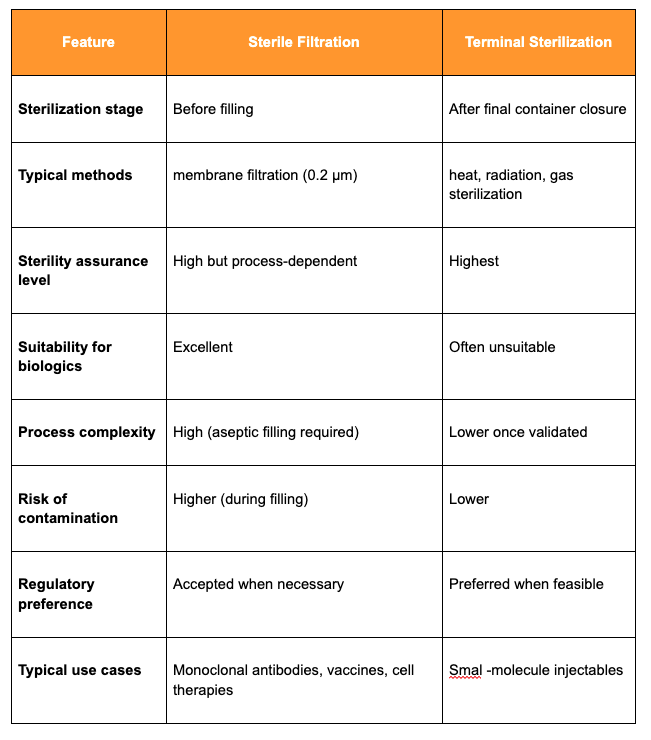
Sterile filtration removes microorganisms by passing the drug solution through a membrane filter with pore sizes typically around 0.2 microns. This filtration step eliminates bacteria but does not destroy microorganisms.
Terminal sterilization, by contrast, destroys microorganisms after the drug has been sealed in its final container. Methods such as steam sterilization or radiation ensure that any contaminating organisms are inactivated.
Because the product is sterilized after filling, terminal sterilization offers stronger assurance that contamination cannot occur during manufacturing.
Manufacturing and Operational Considerations
Aseptic processing using sterile filtration requires highly controlled manufacturing environments, including cleanrooms, isolators, or restricted access barrier systems. The process must be carefully validated to prevent microbial contamination during filling operations.
Terminal sterilization simplifies the sterility strategy because the product is sterilized after the container is sealed. However, it requires that the drug formulation and packaging materials withstand sterilization conditions.
Regulatory and Quality Implications
Regulatory guidance consistently states that terminal sterilization should be used whenever the product formulation allows. This preference reflects the stronger sterility assurance provided by sterilizing the final product container.
However, for many modern biologics and advanced therapies, sterile filtration followed by aseptic processing is the only viable option.
In those cases, manufacturers must implement robust contamination control strategies, including environmental monitoring, validated filtration processes, and strict aseptic processing controls.
Best Fit by Use Case
Terminal sterilization is generally preferred when:
the drug product can tolerate heat or radiation
small-molecule injectable drugs are being produced
maximum sterility assurance is required
Sterile filtration is preferred when:
the drug product is heat-sensitive
biologics or protein therapeutics are involved
cell or gene therapy products are being manufactured
Verdict: Which Should You Choose?
Terminal sterilization remains the gold standard for sterility assurance when the drug product can tolerate sterilization conditions.
However, sterile filtration with aseptic processing is essential for many biologics and advanced therapies, where product stability prevents the use of terminal sterilization methods.
The correct strategy ultimately depends on the stability of the drug product and the ability to maintain sterility throughout the manufacturing process.