
Key Takeaways
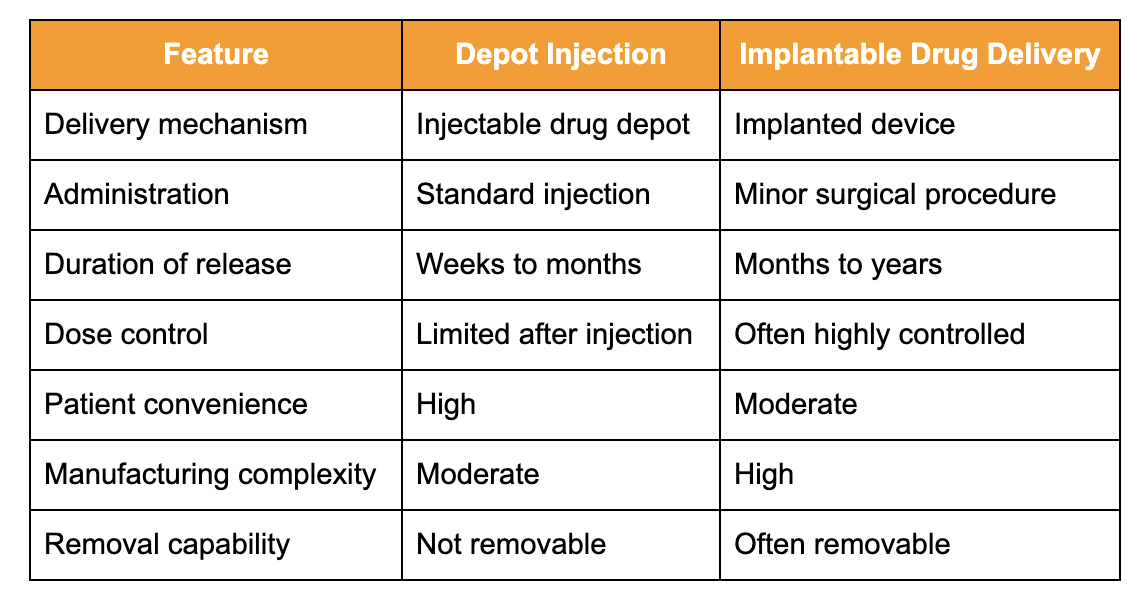
Depot injections use biodegradable formulations or depots that slowly release drug over weeks or months following a single injection.
Implantable delivery systems can provide highly controlled drug release over months or even years.
Depot systems are generally simpler to administer and scale clinically, as they rely on standard injection procedures.
Implantable systems offer greater control over release kinetics and may support ultra-long duration therapies.
The choice between these approaches often depends on treatment duration, drug properties, patient convenience, and safety considerations.
Why This Comparison Matters Now
Long-acting drug delivery technologies are receiving increasing attention as developers seek to improve treatment adherence and therapeutic outcomes for chronic diseases. Many therapies for conditions such as diabetes, schizophrenia, opioid use disorder, and hormonal disorders require frequent dosing, which can create substantial burdens for both patients and healthcare systems.
In response, pharmaceutical developers are increasingly exploring delivery strategies that maintain therapeutic drug levels for extended periods following a single administration. Long-acting injectables and implantable delivery systems represent two of the most widely pursued approaches to achieving this goal.
Depot injections have become particularly prominent in recent decades. These systems typically involve biodegradable polymers or other matrices that form a depot at the injection site, gradually releasing the active drug over time. Many commercially successful long-acting formulations—such as those used in psychiatry or hormone therapy—rely on this principle.
Implantable drug delivery devices represent a different approach. These systems involve the placement of a small implant beneath the skin that continuously releases drug over extended periods. Some implants rely on biodegradable materials that slowly dissolve, while others are designed to remain in place and be replaced after a defined treatment interval.
As pharmaceutical companies continue to develop therapies for chronic conditions requiring long-term treatment, choosing the optimal delivery strategy has become a critical part of therapeutic design. Depot injections and implantable systems each offer unique advantages and trade-offs that must be carefully evaluated.
 Mechanistic Differences
Depot injection systems rely on formulations that create a localized drug reservoir after administration. These depots often consist of biodegradable polymer matrices, lipid-based carriers, or in situ forming gels that solidify after injection. As the material slowly degrades or releases drug through diffusion, the active compound enters systemic circulation over an extended period.
The release kinetics of depot formulations depend on several factors, including polymer composition, drug solubility, and particle size. Developers often tune these parameters to achieve specific release profiles ranging from several weeks to multiple months.
Implantable drug delivery systems operate through different mechanisms depending on the design of the device. Some implants consist of biodegradable rods or pellets that gradually dissolve as drug is released. Others are non-biodegradable devices containing drug reservoirs that release drug through diffusion or controlled mechanical mechanisms.
Because implants are physically placed within the body, they can be engineered to deliver drugs at highly controlled rates. In some cases, implants can even support programmable or adjustable drug delivery profiles.
Manufacturing and Operational Considerations
From a manufacturing perspective, depot injections are generally easier to produce and scale compared with implantable delivery devices. Many depot formulations rely on established pharmaceutical manufacturing techniques such as spray drying, polymer microparticle fabrication, or lipid-based formulation technologies.
Depot products also integrate smoothly into existing clinical workflows because they can be administered through standard injection procedures. This allows physicians or nurses to deliver therapy during routine clinical visits without requiring specialized surgical expertise.
Implantable drug delivery systems introduce additional complexities. These products often combine pharmaceutical and medical device components, requiring developers to address both drug manufacturing and device engineering considerations. Regulatory approval pathways may also involve combination product requirements.
In addition, implant placement and removal procedures typically require trained clinicians and may involve minor surgical interventions. While these procedures are generally straightforward, they introduce operational considerations that must be addressed when implementing implantable therapies at scale.
Best Fit by Use Case
Depot injections are typically preferred when:
drug therapy requires long-acting release over weeks or months
frequent injections would otherwise reduce treatment adherence
non-invasive administration is a priority
the therapy must be administered in routine clinical settings
Implantable delivery systems are typically preferred when:
ultra-long drug delivery over many months or years is required
highly controlled or programmable release kinetics are needed
consistent drug exposure is critical
the clinical setting can accommodate implant placement procedures
Verdict
Depot injections and implantable drug delivery systems represent two powerful strategies for extending drug exposure and reducing dosing frequency. Depot formulations have become widely adopted because they offer a relatively simple path to long-acting therapy while preserving the convenience of injectable administration.
Implantable delivery systems, however, can achieve significantly longer durations of drug release and allow greater control over drug delivery rates. These systems may be particularly valuable for therapies requiring stable long-term drug exposure.
As pharmaceutical developers increasingly design therapies with patient adherence and convenience in mind, both depot and implantable technologies are likely to play expanding roles in long-acting drug delivery strategies.