
Key Takeaways
CRISPR-Cas9 introduces double-strand DNA breaks that enable gene disruption or insertion.
Base editing allows single-nucleotide changes without cutting both DNA strands.
Prime editing enables precise insertions, deletions, and substitutions without double-strand breaks.
CRISPR is currently the most mature clinically, but base and prime editing may reduce off-target risks.
These technologies are increasingly viewed as complementary tools rather than direct competitors.
Why This Comparison Matters Now
Genome-editing technologies have rapidly progressed from research tools to therapeutic platforms capable of correcting disease-causing mutations. CRISPR-Cas9 pioneered this transition by enabling programmable editing of DNA sequences.
However, concerns about double-strand DNA breaks and unintended mutations have driven the development of next-generation editing technologies, such as base editing and prime editing. These approaches aim to increase precision while minimizing genomic damage.
As gene editing therapies move into clinical trials, developers must determine which editing platform offers the best balance of precision, efficiency, and safety.
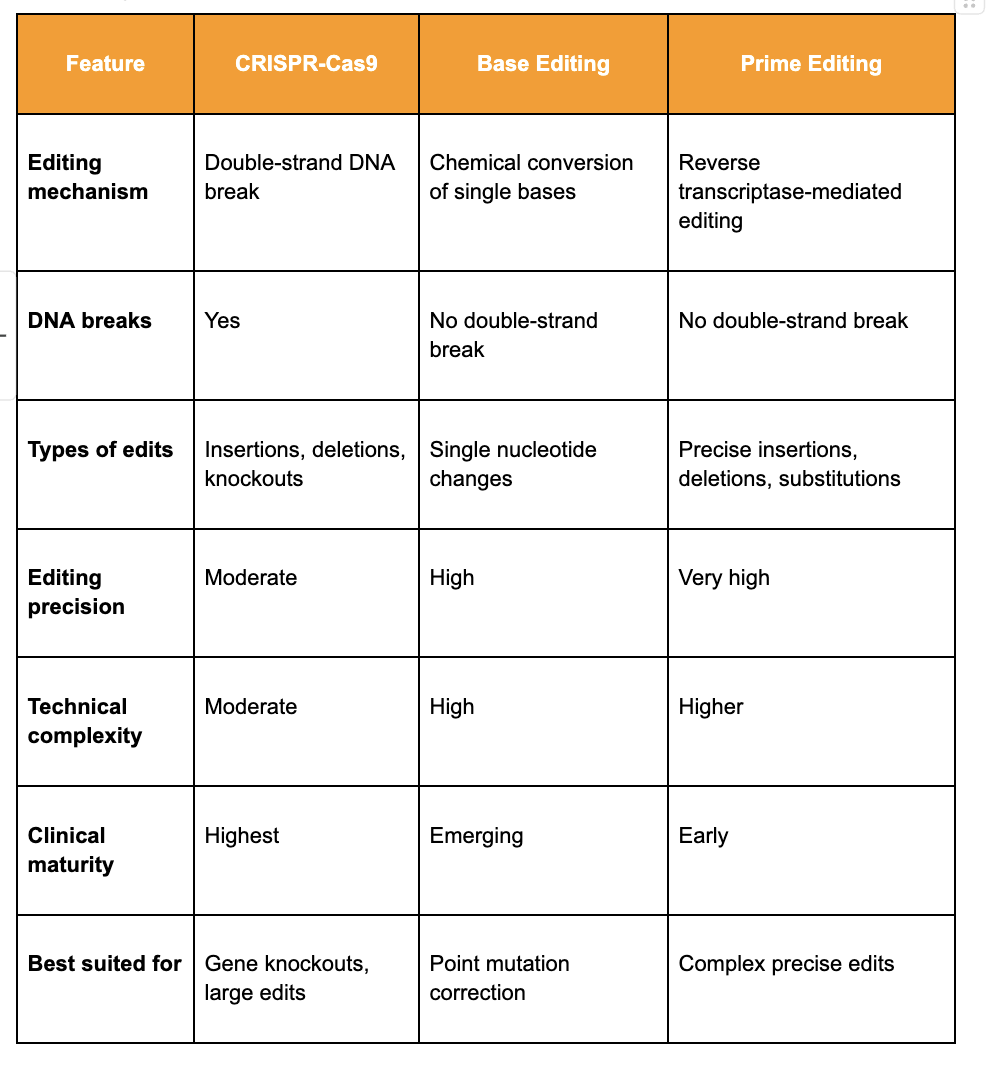 Mechanistic Differences
CRISPR-Cas9 editing works by using a guide RNA to direct the Cas9 nuclease to a specific DNA sequence, where it creates a double-strand break. Cellular repair pathways then introduce mutations or allow insertion of new DNA sequences.
Base editing modifies individual nucleotides without cutting both strands of DNA by combining a deaminase enzyme with a catalytically modified Cas protein.
Prime editing goes further by coupling a Cas nickase with reverse transcriptase, enabling precise rewriting of DNA sequences according to a programmable RNA template.
Manufacturing and Operational Considerations
From a development perspective, CRISPR systems are relatively straightforward to design and deploy, which has driven their widespread adoption.
Base editing and prime editing systems are more complex constructs and may require larger delivery payloads, which can complicate delivery strategies, particularly for viral vectors.
Regulatory and Clinical Implications
CRISPR-Cas9 therapies have already entered clinical trials and produced promising results in diseases such as sickle cell disease and beta-thalassemia.
Base-editing therapies are now entering early clinical studies targeting genetic diseases caused by point mutations.
Prime editing remains primarily in preclinical development but holds promise for correcting a broader range of genetic alterations.
Best Fit by Use Case
CRISPR-Cas9 is generally preferred when:
gene disruption is required
large DNA insertions or deletions are needed
delivery simplicity is important
Base editing is often preferred when:
a single nucleotide mutation must be corrected
Prime editing may be preferred when:
precise sequence changes are required
multiple editing outcomes must be achieved without double-strand breaks
Verdict: Which Should You Choose?
CRISPR-Cas9 remains the most mature genome editing technology, but base editing and prime editing provide more precise alternatives for specific genetic corrections.
Together, these tools represent a growing genome editing toolkit, with each technology suited to different therapeutic challenges.