The mRNA Drug Substance characterization requires specialized Analytical Methods because ubiquitous RNase Enzymes cause rapid structural degradation of both the nucleic acid payload and Lipid Nanoparticle (LNP) delivery vehicles.
Standardized Critical Quality Attributes (CQAs) are defined by bodies like the U.S. Pharmacopeia (USP) and FDA because structural features such as 5' Cap integrity and Poly-(A) Tail length dictate intracellular translation efficacy.
High-throughput Liquid Chromatography–Mass Spectrometry (LC-MS) workflows shorten characterization timelines because technologies like Immobilized RNase T1 Digestion enable over 80% sequence coverage within 90 minutes.
In vitro Potency Assays represent a major regulatory hurdle for Advanced Therapies because measuring target antigen expression does not always predict clinical efficacy or evaluate inter-antigen interference in Multivalent Vaccines.
1 General Background
1.1 The successful development, manufacture, and marketing approval of safe and effective mRNA vaccines and therapeutics requires accurate, sensitive, robust, and rapid analytical methods for use across all phases of the development cycle to determine their safety, identity, purity, and potency. The need for novel solutions to analytical problems not required for typical protein-based biologics and the high-speed evolution of mRNA technologies have resulted in challenges to establishing standard methods.
1.2 Candidate mRNA products must, of course, meet the regulatory requirements for analytical characterization as outlined by the International Council for Harmonisation (ICH), the World Health Organization (WHO), the FDA, the European Medicines Agency (EMA), and other health authorities. These regulations, however, do not specify particular methods, only the information that must be provided for applications to conduct in-human clinical trials and marketing authorization.
1.3 The U.S. Pharmacopeia (USP) in 2022 convened a panel of experts to propose test methods that could be used for mRNA vaccines.[1] (The third edition [2] of the proposed guidelines is open for public comment.) Presumably, methods used for vaccines would be largely applicable to non-vaccine therapeutics. The standardization of methods, however, leaves open the question of release criteria, which is a separate regulatory issue addressed in the next section.
2 Special Considerations for mRNA
2.1 Unlike recombinant proteins, for which posttranslational modifications influence efficacy, it is the structural characteristics of the mRNA and its delivery systems that directly impact cellular uptake, efficacy, and safety. As such, extensive characterization of the quality attributes of the mRNA drug substance and mRNA–LNP drug product is necessary from the earliest development phases.[3]
2.2 mRNA analytics can be challenging owing to the propensity for mRNA to be degraded by RNase enzymes, which are ubiquitous. The use of RNase-eliminating preparations and appropriate laboratory protocols is essential to ensure that accurate analyses can be performed.[3] Widely used techniques include capillary electrophoresis, high-performance liquid chromatography (HPLC), mass spectrometry, particle-size analysis, cryo-electron microscopy, dynamic light-scattering, Sanger sequencing, and PCR, as well as more traditional methods for residual solvents, metals, and so on.
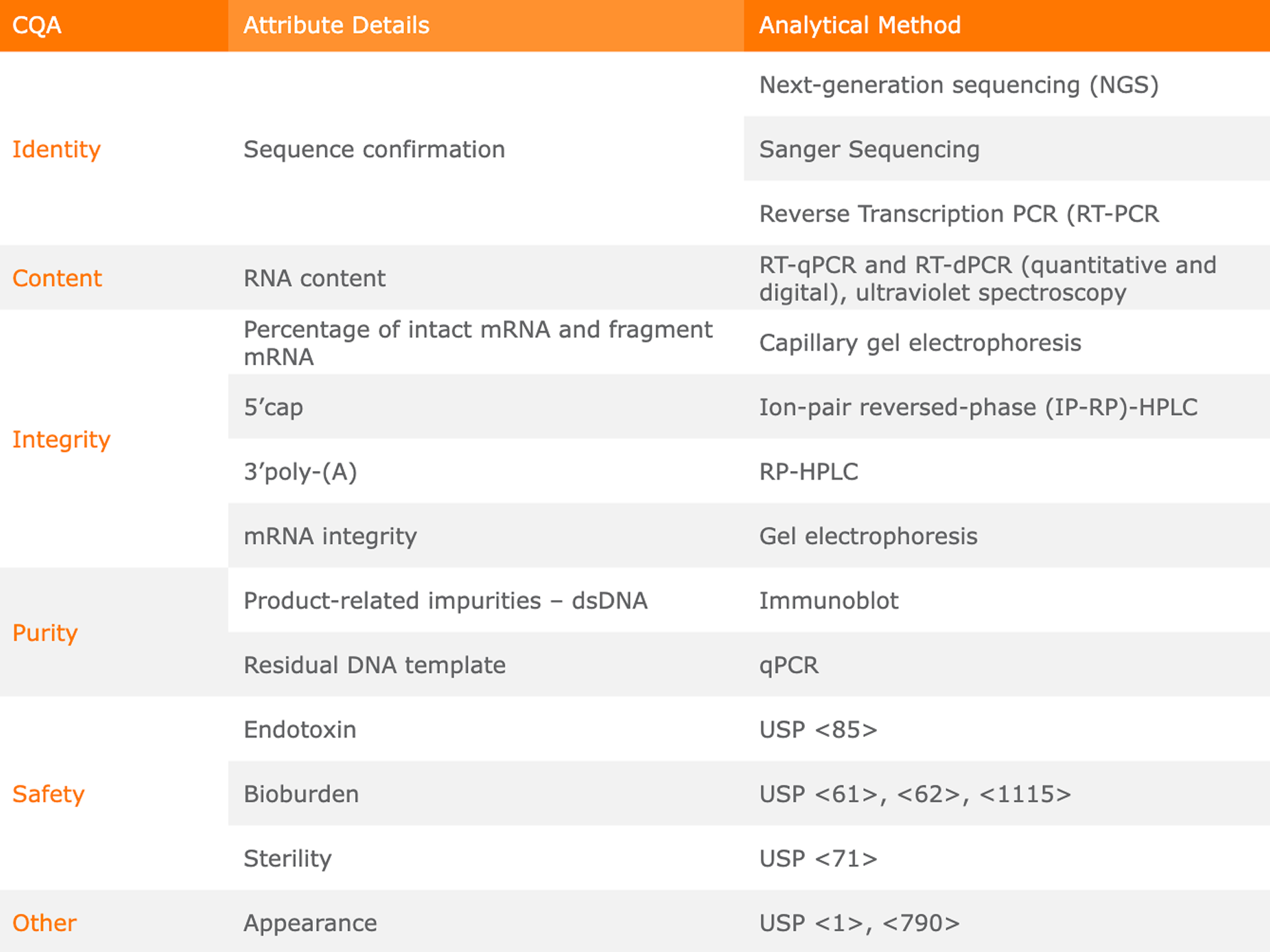
2.3 There are unique analytical requirements for current mRNA products stemming from the use of enzymatic IVT — a cell-free process — for drug substance production, their encapsulation in lipid nanoparticles, and the fact that the mRNA provides instructions within the cell for protein production. As a result, there is a need to extensively characterize the mRNA drug substance, including the 5' cap and poly-(A) tail, mRNA–LNP drug product (lipid components and ratios), and cellular uptake very early in the development process, including identification of process-related impurities, which are largely residual enzymes and genetic materials in mRNA and lipidic impurities and adducts in the final product.[3] A list of common critical quality attributes (CQAs) that must be monitored for RNA therapeutics is found in Table 1.
Table 1. mRNA Critical Quality Attributes (CQAs)
Reproduced from McCarthy.[1]
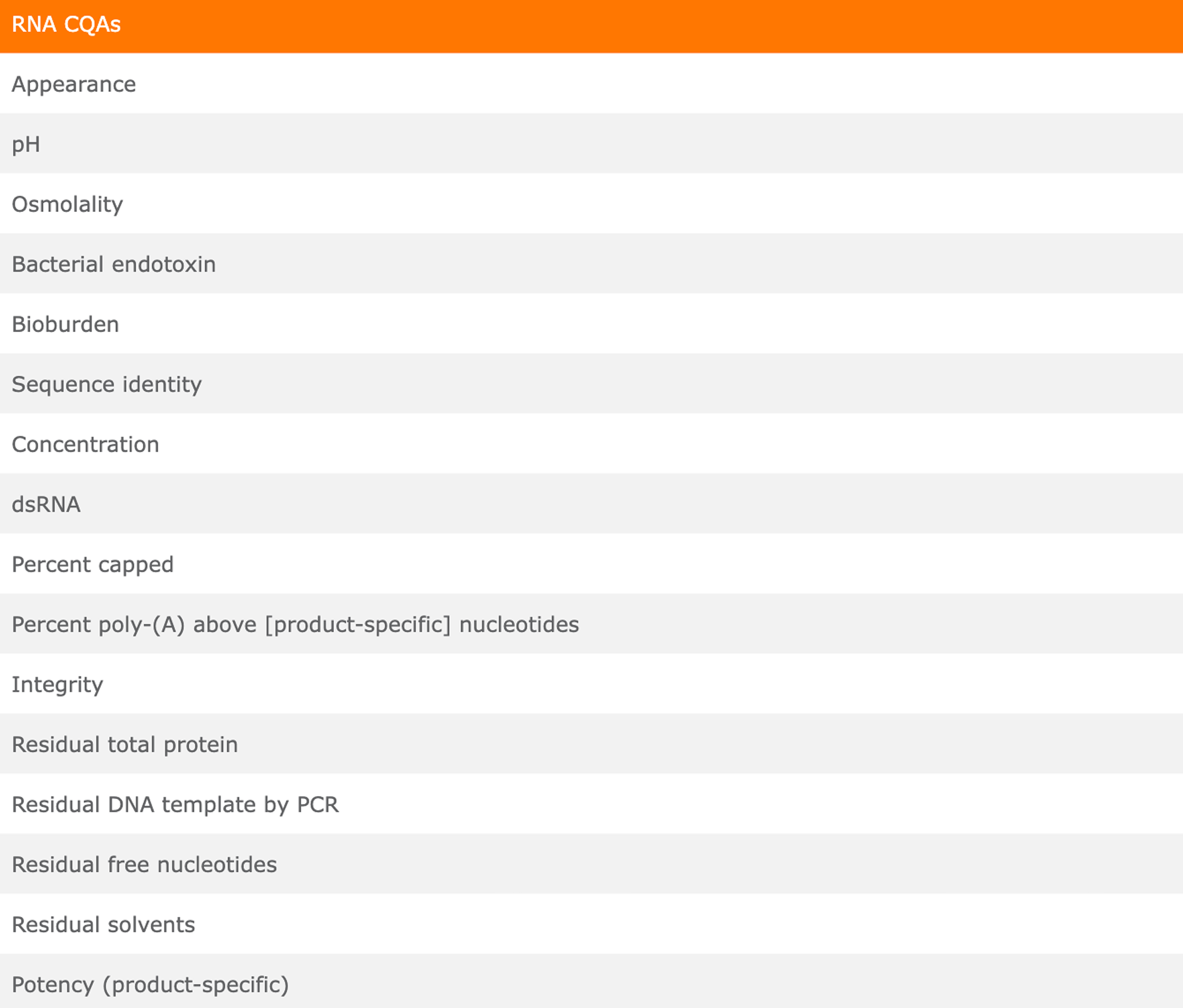
Table 2. Example CQA List from an mRNA Supplier
Source: Nice Insight analysis
2.4 In addition to their complexity, the sensitivity of both mRNA and formulated mRNA–LNP products to enzymatic degradation creates challenges. Steps must be taken to ensure that RNase enzymes are eliminated in analytical laboratories processing mRNA samples, including proper cleaning of physical phases, use of appropriate personal protective equipment, and technician training.[3]
3 Many Different Methods
3.1 Full characterization of both mRNA drug substances and formulated mRNA–LNP drug products requires the use of many diverse and complementary methods. Established techniques from the analysis of biologics, small molecule drugs, polymeric materials, and molecular biology research are employed, along with new methods developed specifically for this application.
3.2 Common methods include HPLC — often combined with mass spectrometry — as well as other detection techniques, such as ultraviolet or multi-angle light scattering and capillary electrophoresis (CE). Additional electrophoretic methods include capillary isoelectric focusing (CIEF), capillary zone electrophoresis (CZE), CE-SDS, CE-ultraviolet, and CE-laser induced fluorescence (CE-LIF). Other analyses may involve particle-size measurement, cryo-electron microscopy, PCR, Sanger sequencing, and functional cell-based assays. Many of these methods find use in early development stages, with simpler versions applied in the quality control (QC) environment.[3]
4 Desire for Simplicity and Speed without Sacrificing Performance
4.1 There is a fundamental desire to reduce the time required for the various assays that must be completed during mRNA product development. For many current cell-based functional assays, for instance, it can take days to receive results, leaving developers to choose between longer timelines or greater process risk. New intuitive, high-throughput solutions must still provide the sensitivity, accuracy, reliability, and robustness required for any pharmaceutical method.
4.2 SCIEX has been active in this area. The company has introduced the RNA 9000 Purity & Integrity kit, which simplifies mRNA analysis using various CE-based methods.[4][5] Multiple analyses can be performed simultaneously on the firm’s BioPhase 8800 multi-capillary CE system to accelerate both process and method development, with the optimal method transferrable to the PA 800 Plus system, which is already widely used to support GMP manufacturing.
4.3 Scientists at Thermo Fisher Scientific and the University of Sheffield developed a simplified liquid chromatography–mass spectrometry (LC-MS) method for characterization and direct sequence mapping of large mRNA molecules.[6][7] The key to the technique is partial RNase digestion using RNase T1 immobilized on magnetic particles. This approach generates larger RNA fragments with unique sequences that can be mapped to specific points on the mRNA molecule. Immobilization of the enzyme, meanwhile, prevents RNase contamination during chromatographic purification. The method, which includes automated sample preparation, affords >80% sequence coverage of a range of large RNAs and mRNA therapeutics, providing information for identity testing, sequence validation, and impurity analysis, all within 90 minutes.
4.4 LC-MS solutions from SCIEX include a new workflow using quadrupole time-of-flight MS for rapid determination of capping efficiency via generation of high-quality accurate mass data.[8] Separation of capped and uncapped species of 5' ends follows enzymatic digestion of mRNA samples, and determination of capping efficiency occurs within the SCIEX OS software environment, simplifying data processing.
4.5 The SCIEX ZenoTOF 7600 MS system leverages new Zeno trap technology that provides enhanced signal-to-noise for detection of fragments and thus greater sensitivity combined with a new MS fragmentation method known as electron activated dissociation (EAD), which can be used for both oligonucleotide and LNP characterization.[4] Used in electron-impact excitation of ions from organics (EIEIO) mode (energies >10 ev), it allows detection and identification of lipid impurities at even very low levels, including the exact location of sites of oxidation and double bonds in ionizable lipids that form adducts with mRNA molecules and thus impact safety and efficacy.[8]
4.6 Agilent, meanwhile, has introduced an improved LC-MS method for rapid analysis of mRNA 5' capping that can be completed in 75 minutes.[3] Flow cytometry is also being adapted for the direct analysis of cellular uptake of mRNA–LNPs, which could dramatically reduce turnaround times compared with cell-based assays. Next-generation sequencing is also increasingly being used in the QC environment, which is a new development.
5 Potency Assays for mRNA
5.1 Potency tests must reflect the biological activity and mechanism of action of the therapeutic and should ideally correlate with the clinical response. The potency of an mRNA therapy depends on both the uptake of the mRNA into the cells (determined largely by the LNP) and the translation within the cell (determined by the mRNA payload). As with other advanced therapies, a suitable potency assay is difficult to define. Eteplirsen was approved by the FDA in 2016, but only after the agency had delayed the decision once and over the objections of the advisory board. Although the drug appeared safe, its efficacy was called into question.[9] Although the regulatory debate will continue on this case, at heart is the question of potency and how to provide a representative measure of it in vitro: the basic molecular activity of the therapy could be demonstrated, but did that accurately predict the clinical efficacy?
5.2 While the potency for a vaccine (protein- or nucleotide-based) is established, multivalent vaccines also present a challenge. In a single-valent vaccine, the in vitro assay typically measures the expression of the target antigen from infected cultured cells. This dose response is correlated with whole-animal immunity to the pathogen challenge and is performed relatively consistently in mice because well-established models are available. In a multivalent vaccine, each of the mRNAs in the formulation must induce expression of its antigen at the same level it does in the absence of the other mRNAs. This is difficult to measure. It is also difficult to design and measure antigens so that they do not interfere with others in the formulation.[10] Nevertheless, trials are ongoing for multivalent vaccines to multiple variants of COVID-19 (BioNTech), COVID-19 + influenza (BioNTech), and COVID-19 + influenza + RSV (Moderna). For a review on the topic of potency assays for advanced therapies, including mRNA, the reader is directed to Salmikangas et al.[11]
6 The Need for Flexible Platform Solutions
6.1 Advances in analytical capabilities are needed not only due to the significant differences between mRNA-based products and more traditional biologics but also because the field is rapidly evolving, creating a need for flexible methods that can be used with both current and future mRNA technologies.[4] The ultimate goal is to establish standard, platform analytical technologies that are applicable across development phases and can evolve alongside advances in mRNA technology.[3]
FAQs
How are analytical methods for mRNA therapeutics regulated by global health authorities?
Global Health Authorities like the FDA, EMA, and WHO enforce general ICH characterization standards rather than specifying fixed assays for mRNA drug products. Drug developers rely on guidelines such as the USP Proposed Test Methods to establish acceptable identity, purity, and release criteria across clinical phases.
What are the most critical quality attributes (CQAs) for mRNA-LNP products?
Core Critical Quality Attributes (CQAs) include 5' Cap efficiency, Poly-(A) Tail length, mRNA sequence identity, Lipid Component ratios, and encapsulation efficiency. Formulators must also rigorously monitor process-related impurities such as residual In Vitro Transcription (IVT) enzymes, template DNA, and oxidized lipid adducts.
Why is RNase contamination a major technical challenge in mRNA analytics?
RNase Contamination poses a severe risk because RNase enzymes are ubiquitous and rapidly cleave single-stranded mRNA Drug Substances. Analytical laboratories must implement specialized decontamination protocols, RNase-free reagents, and controlled physical phases to maintain sample integrity during Capillary Electrophoresis and HPLC testing.
How does capillary electrophoresis accelerate quality control for mRNA constructs?
Capillary Electrophoresis (CE) accelerates Quality Control (QC) by resolving mRNA size, purity, and integrity with high automated throughput. Platforms like the SCIEX BioPhase 8800 multi-capillary system allow rapid method screening that seamlessly transfers to GMP-compliant instruments like the PA 800 Plus for routine manufacturing release.
Why are potency assays particularly difficult to establish for multivalent mRNA vaccines?
Potency Assays for Multivalent mRNA Vaccines are complex because each distinct mRNA Payload must express its target antigen without immune or expression interference from co-formulated strands. In vitro cell assays struggle to distinguish individual biological responses or accurately reflect whole-animal immune protection across multiple viral targets

 Reproduced from McCarthy.[1]
 Source: Nice Insight analysis