The Sterile CDMO Market is projected to surpass $29 Billion by 2030, advancing at a ~9% CAGR driven by outsourcing demand for biologics, antibody-drug conjugates (ADCs), and complex drug-device combinations.
Emerging Biotech Reliance is accelerating because small and virtual pharma companies lack internal aseptic infrastructure, requiring long-term CDMO partnerships spanning early-stage formulation to commercial Sterile Fill/Finish.
Regional Market Dynamics demonstrate that North America and Europe control the majority of revenue and capital expansion, whereas the Asia-Pacific region exhibits the fastest market growth rate for generic sterile injectables and fill/finish operations.
Generic Loss of Exclusivity (LOE) will trigger business spikes for specialized sterile CDMOs over the next decade as over 30 drugs lose patent protection alongside the expansion of the biosimilars market.
1.1. The increase in outsourcing of sterile injectable drugs is occurring for several reasons. The greater complexity of formulations and drug–device combination products is limiting the number of pharma companies willing to enter into sterile injectable drug manufacturing.[1] Small and emerging biotechs tend to outsource because they lack the resources and knowledge to implement complex aseptic production processes and all of the associated supporting activities, and such companies are showing increased interest in retaining new products beyond proof of concept, necessitating longer-term outsourcing relationships. Many of these smaller companies also look to CDMOs for assistance with formulation and analytical development, quality control, and regulatory support services.
1.2. Larger companies are also outsourcing at higher rates.[2] Some have elected to focus on core competencies and have reduced internal manufacturing capabilities as a consequence, leading to greater reliance on CDMOs. Others have filled their internal capacity with existing products and therefore must either outsource new projects or shift an existing project to external partners to make room for new ones.
1.3. The switch to personalized medicines is also driving outsourcing, because many of these drugs are sterile injectable products being developed by emerging biopharma companies.[1] Growing interest in ADCs and other potent sterile injectables is another contributor to the growth of sterile injectable outsourcing, as these highly potent products require highly specialized manufacturing facilities, equipment, and trained operators. The need to access technologies for the production of liposomal formulations, emulsions, suspensions, and other advanced drug delivery solutions is another driver of sterile injectable outsourcing.
1.4. With more than 30 drugs coming off patent in the next several years, contract manufacturers specializing in generic sterile injectables are likely to experience a rise in business.[1] Similarly, growth of the biosimilars market, which, like most biologics, are sterile injectable products, will likely lead to an increase in sterile injectable outsourcing over the next five years.[3] In general, CDMOs that have implemented technologies, equipment, and processes (e.g., isolators, automation) that reduce timelines and costs will benefit going forward.
1.5. Some of the challenges to sterile injectable outsourcing are focused on very specific needs, according to a recent survey by Industry Standard Research (ISR).[4] Top among the difficulties were finding available sterile filling capacity for small volumes and finding CDMOs with ADC filling capabilities. Other leading issues related to tech transfer are analytical development and/or analytical testing capabilities of CDMOs. ISR also found that manufacturing practices, CMO use, and future plans for sterile injectables vary by company size.[3] Small companies are typically looking for CDMOs with a history of sterile injectable quality and a strong regulatory track record and that have facilities and equipment suitable for their projects. Where possible, they prefer CDMOs with which they have worked previously.
1.6. For biopharma companies developing prefilled syringes and other drug–device combination products, there are additional selection factors that must be considered.[5] Such projects can involve coordination of a significantly larger number of vendors and other suppliers due to the need to work with contract manufacturers for the drug substance and drug product and a device developer.
1.7. This complexity can be simplified by working with CDMOs that have partnerships already established with device developers and previous experience shepherding drug–device combination products through development and commercialization. A few CDMOs have the capability to support both drug and device development, further reducing the supply chain and regulatory complexity.[6]
1.8. To achieve this goal, the sponsor and the CDMO must establish a true partnership with real transparency and two-way communication, both of which are necessary to ensure development of a full understanding of the process and product.[7] The more knowledge that is shared, the better prepared the partners will be to avoid potential problems and address those that do arise.
1.9. CDMOs with extensive experience in sterile injectable manufacturing can also help drug developers identify opportunities for optimization of container selection and final product designs, as well as process conditions, analytical test methods, and process validation strategies.[8]
1.10. Finding the right CDMO with the skills, expertise, and equipment needed for small-volume sterile injectables manufacturing is particularly important for companies developing more complex personalized medicines.[9] CDMOs with experience developing and manufacturing complex drug products with smaller batch size requirements, combined with flexibility to meet the widely varying needs of different precision drug products and demonstrated company stability, are limited in number, however.
1.11. Ideally, those that do offer this type of service are positioned to support clients from early phase through clinical development and commercialization to help minimize the cost and time required to get these challenging drugs to market.[9] Important capabilities for any sterile injectables outsourcing partner include analytical and biopharmaceutical testing, lyophilization capabilities, sterile fill/finish/aseptic processing, and highly potent compound handling, among others.
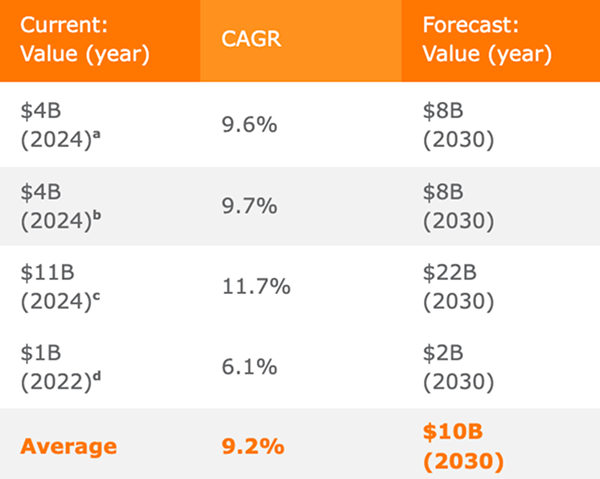
1.12. A survey of several market research reports (Table 1) estimates that the market is growing at around 9% CAGR and will exceed $22 billion by 2030.
Table 1. Market Forecasts: Fill/Finish CDMOs
Forecasts as of Oct. 2025. References: [10][11][12]
2. Regional Analysis
2.1. The overall sterile injectables market is led by North America and is followed closely by Europe in terms of revenue, but the greatest demand growth for these products is occurring in the Asia–Pacific region.[13] Similarly, North America is projected to continue to lead the generic sterile injectables market in terms of revenue (>25%) for at least the next several years, but Asia–Pacific will experience the highest growth rate.[14][15] The fill/finish manufacturing market, on the other hand, is led by Europe and closely followed by North America.[16] In this market, the Asia–Pacific region is, however, also growing at the fastest rate.
2.1. The global fill/finish market is segmented into contract manufacturing organizations, pharmaceutical and biopharmaceutical companies, and others. The contract manufacturing segment dominates the market, holding more than a 43% share in 2019.[17]
2.3. Interestingly, a 2017 study of nonpublic, internal FDA data from 2014 determined that new drug applications (NDAs) for branded sterile injectables were outsourced twice as frequently as abbreviated new drug applications (ANDAs) for generic products (39% vs. 19%), with the bulk of NDAs outsourced to companies located in the United States and Europe and nearly 60% of ANDAs outsourced to Asia.[18]
2.4. Overall, Europe accounts for the greatest share of the contract manufacturing market for sterile injectables, followed by North America, which is dominated by the United States. As indicated by the locations for recent and planned investments, the vast majority of new investments are being made in Europe and the United States, which are therefore expected to retain leading positions. The number of investments being made in Asia–Pacific countries by glass and component suppliers,[19] however, suggests that growth will be significant in this region as well.
3. Competitive Landscape
3.1. The CDMO landscape for bulk sterile injectables manufacturing is fragmented and includes both small firms focused only on sterile fill/finish and large, international, integrated CDMOs that offer support for the development and production of small- and large-molecule drugs in multiple dosage forms. Some large biopharmaceutical companies also offer outsourcing services through CDMO businesses.
3.2. Very few CMOs/CDMOs offer truly comprehensive support from discovery through drug substance manufacturing, formulation development, sterile fill/finish, lyophilization and secondary packaging, warehousing, and delivery for traditional vials and ampoules. Even fewer can support the development and commercialization of drug–device combination products, such as prefilled syringes and pen autoinjectors, which also require expertise in device design and regulatory approval.
3.3. These advantages have also been gained in a modified or “dancefloor” approach suitable for existing facilities with many adjacent smaller spaces.[20] These spaces can be joined with through-the-wall connections to maintain process closure and avoid the need for major structural modifications. Such a solution is attractive for CDMOs. The one challenge is the lack of standardized connectors (size, materials of construction) for joining closed systems from different vendors.
3.4. Some argue, however, that the capital and operating cost savings come at too high a price with respect to the need for more constrained, less flexible process and infrastructure elements for assuring appropriate process separation and minimization of cross-contamination risk.[21] In addition, scheduling needs (product changeovers and scaling activities, plus the need to be prepared for unanticipated changes) often limit the flexibility of the initial ballroom layout. These tradeoffs should be taken into consideration when considering whether to use traditional cleanrooms or adopt an open, ballroom approach to manufacturing.
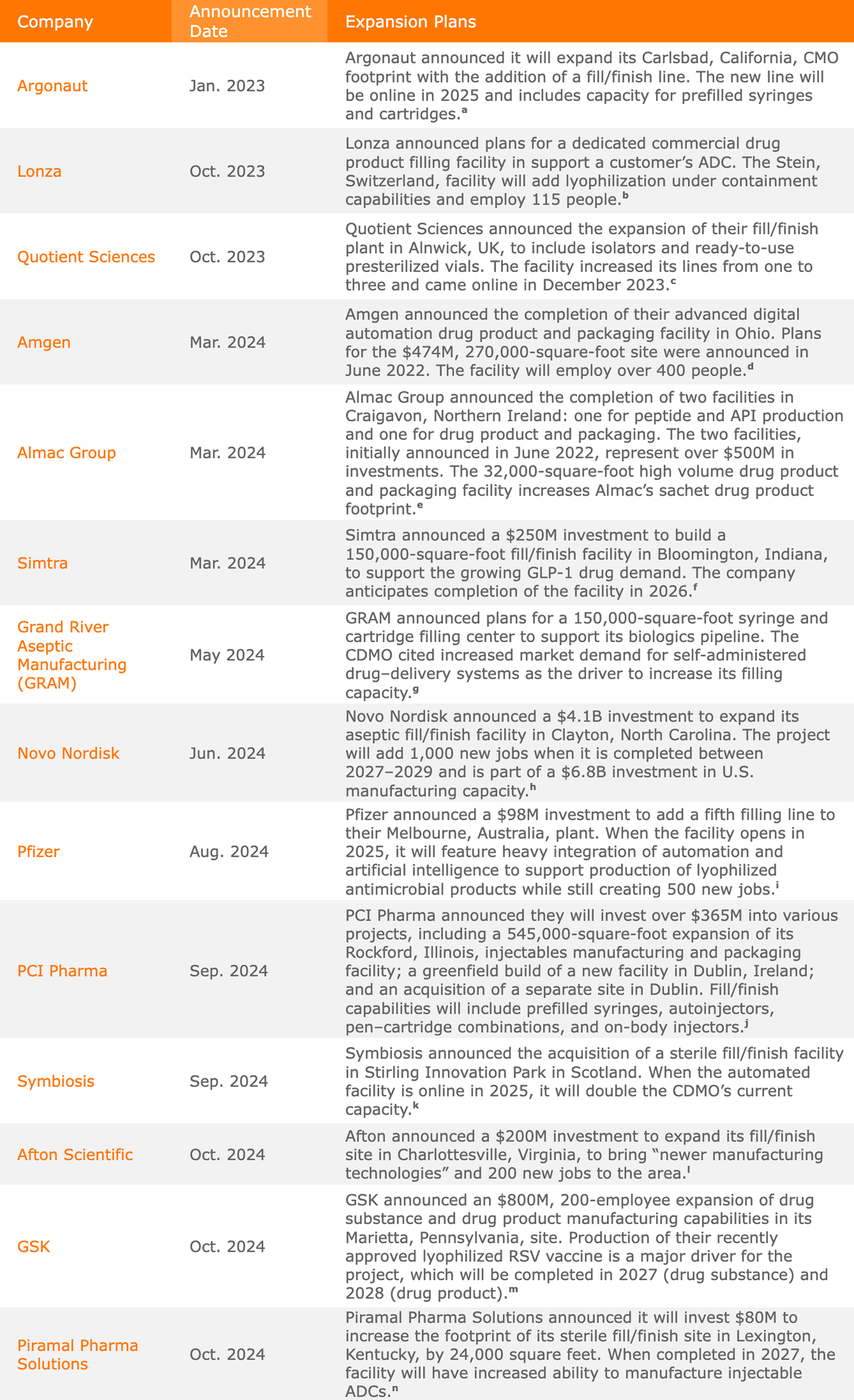
3.5. Before the COVID-19 pandemic, the global contract manufacturing market for fill/finish services for biologics was predicted to reach $4.2 billion by 2030 (CAGR of >10%). CDMOs at that time were already estimated to be operating at 95–98% capacity.[22] Much of that capacity was redirected to the production of COVID-19 vaccines, leaving fewer options for non-COVID-related therapeutics and vaccines. While additional sterile fill/finish capacity has been announced, many developers of novel medicines, including cell and gene therapies, are now planning to install in-house fill/finish capabilities. A survey of recent announcements is presented in Table 2.
Table 2: Recent Announcements of Capacity Expansion
FAQs
What is driving the growth of the sterile CDMO market?
The growth of the sterile CDMO market is driven by increasing drug formulation complexity, rapid expansion of biologics, and outsourcing by emerging biotechs lacking aseptic facilities. Additionally, upcoming patent expirations for over 30 branded sterile injectables are fueling demand for outsourced generic manufacturing.
Why do drug developers face small-volume sterile fill/finish capacity shortages?
Drug developers face small-volume sterile fill/finish capacity shortages because few CDMOs possess flexible equipment or specialized containment required for highly potent compounds like ADCs. This bottleneck is amplified by high baseline utilization across large-scale commercial lines and custom requirements for personalized therapies.
How do CDMOs simplify drug-device combination manufacturing for prefilled syringes?
CDMOs simplify drug-device combination manufacturing by offering integrated capabilities that manage both the drug product fill/finish and device assembly under one regulatory umbrella. Established partnerships with device developers streamline supply chains, reduce vendor coordination risks, and accelerate market delivery.
What geographic shifts are occurring in the generic sterile injectables market?
Geographic shifts in generic sterile injectables show North America leading overall revenue while the Asia-Pacific region posts the highest growth rate. While U.S. and European CDMOs capture the majority of branded NDA outsourcing, nearly 60% of generic ANDA manufacturing is outsourced to Asia.
How does open ballroom cleanroom design impact sterile CDMO operational efficiency?
Open ballroom cleanroom design improves CDMO operational efficiency by using closed-system equipment and wall connections to lower facility capital expenses and footprint needs. However, these savings require trade-offs regarding scheduling flexibility, product changeover constraints, and cross-contamination containment protocols.
 Forecasts as of Oct. 2025. References: [10][11][12]
 FAQs
FAQs