Somatic Cell Therapies utilize mature, differentiated cells—such as CAR-T and CAR-M—which are strictly autologous and genetically modified to target specific antigens, whereas CAR-NK cells provide an allogeneic alternative that reduces the risk of cytokine release syndrome (CRS).
Non-genetically engineered somatic therapies, such as Tumor-Infiltrating Lymphocytes (TILs) like FDA-approved lifileucel (Amtagvi) and Virus-Specific Cytotoxic T Lymphocytes (CTLs), target metastatic cancer and latent viral infections like Epstein-Barr virus (EBV) by expanding naturally occurring target-recognizing immune cells.
Islet cell transplants offer an allogeneic, cadaveric non-stem option for type 1 diabetes, though broad commercial adoption remains limited by the clinical trade-off between chronic insulin dependence and lifelong immunosuppressive therapy.
Induced Pluripotent Stem Cells (iPSCs), pioneered via reprogramming techniques from adult fibroblasts or peripheral blood, circumvent the ethical limitations of Human Embryonic Stem Cells (hESCs), though no iPSC-based therapeutic has received FDA approval to date.
Mesenchymal Stem Cells (MSCs) sourced from bone marrow, adipose tissue, or cord blood are multipotent cells well-suited for long-term regenerative application in chronic conditions such as amyotrophic lateral sclerosis (ALS), Parkinson's disease, and stroke due to their extended in vitro differentiation timeline.
1.1. Somatic cell therapies rely on isolation of some specific type of mature, differentiated cells from a patient, after which they are expanded and/or genetically modified in vitro. The classic example of autologous somatic cells used in therapeutics are the CAR-T therapeutics. These therapies rely on isolation of T cells from a patient, after which the T cells are genetically modified, expanded, and then injected back into the patient. Such therapies have been highly effective for engineering T cells of oncology patients to properly recognize specific tumor-associated antigens (TAA) and mount an effective immune response to the cancer.[1]
1.2. After CAR-T therapies had become common in clinical trials, the same inventors of CAR-T published early promising data for an autologous CAR-macrophage (CAR-M) therapy. Monocytes were isolated from a patient’s bloodstream and then differentiated and engineered in vitro. The resulting CAR-M cells displayed good cytotoxic effects, plus additional therapeutic effects on other cells in solid tumors.[2]
1.3. T cells and macrophages are strictly specific to the patient from which they are isolated, so CAR-T and CAR-M therapies must be autologous. The enormous expense and logistical challenges have spurred researchers to explore other somatic cells that can be modified for use across multiple patients. Such allogeneic therapies include CAR-natural killer (CAR-NK) cells.
1.4. Natural killer cells exhibit cytotoxic effects and can also be genetically engineered. They are not host-specific, however, so a CAR-NK created from one donor’s cells can be used across multiple patients. Although early evidence suggests they may be less potent than CAR-T, they appear to be less likely to cause cytokine release syndrome (CRS), graft-versus-host disease (GvHD), or off-target effects.[3]
1.5. In 2024, the FDA approved the first tumor-infiltrating lymphocyte (TIL) therapy, lifileucel (brand name Amtagvi), for advanced melanoma.[4] In treatment with this autologous cell therapy, a portion of a patient’s melanoma is removed, and the TILs are isolated. The TILs are then expanded and activated before being infused back into the patient. This type of therapy doesn’t require genetic modification because cells that already recognize the tumor are used. The activated immune cells, once reintroduced into the body, are capable of seeking out any metastasized melanoma cells throughout the patient’s body. These principles apply to any type of tumor, so more TIL therapies are entering development.[5]
1.6. Similar to TIL therapy, a virus-specific cytotoxic T lymphocyte (CTL) therapy has been developed against Epstein–Barr virus (EBV).[6] In this therapy, cytotoxic T cells are induced in vitro to recognize EBV and then injected into the patient. EBV often resides undetected in patient B cells long after an infection, so the CTL therapy is developed to clear it. TILs can be prepared from many methods, including stem cells (which yield an allogeneic therapy) and dendritic cells, which require a standard screen for matching donor–patient HLA epitopes.[6] Like TILs, the logic for development of a CTL should apply to many other types of viruses, such as HIV, for example.[7]
1.7. Outside of immune cells, islet cell transplants have shown promise in treatment of type 1 diabetes.
1.8. Functioning islet cells can be isolated from cadavers or living donors. These cells are typically not matched to the recipient patient, so research is focused on either protecting the transplanted cells from the recipient immune system or subverting the mismatch between donor and patient. Early data from several groups have demonstrated that the transplants can work, but the current trade-off — lifelong immunosuppressive therapy versus chronic insulin dependence — remains the final hurdle to commercialization of this type of cell therapy.
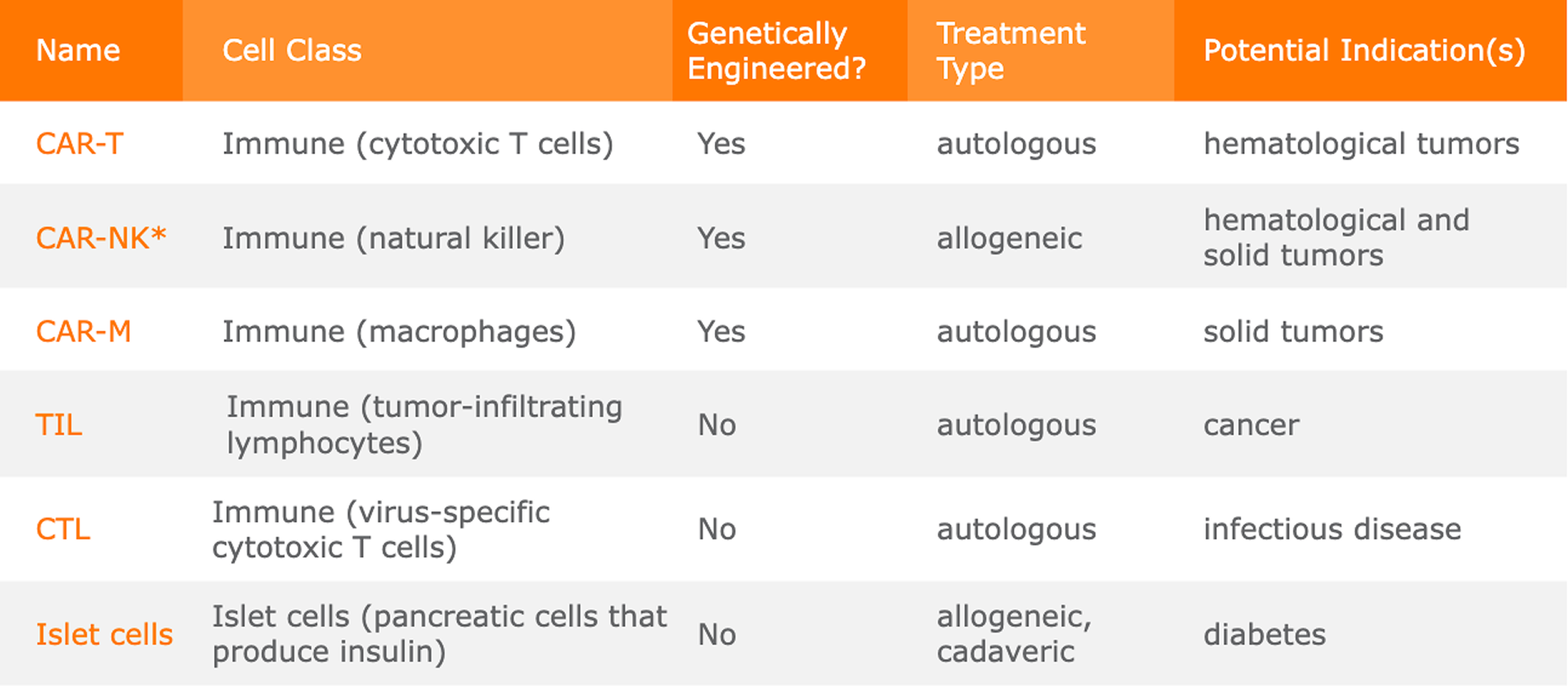
1.9. A summary of the common types of somatic cell therapies is presented in Table 3.
Table 1. Non-Stem-Cell-Based Therapies
*NK cells can be isolated from adults or derived from stem cells.
2. Stem Cell–Based Therapies
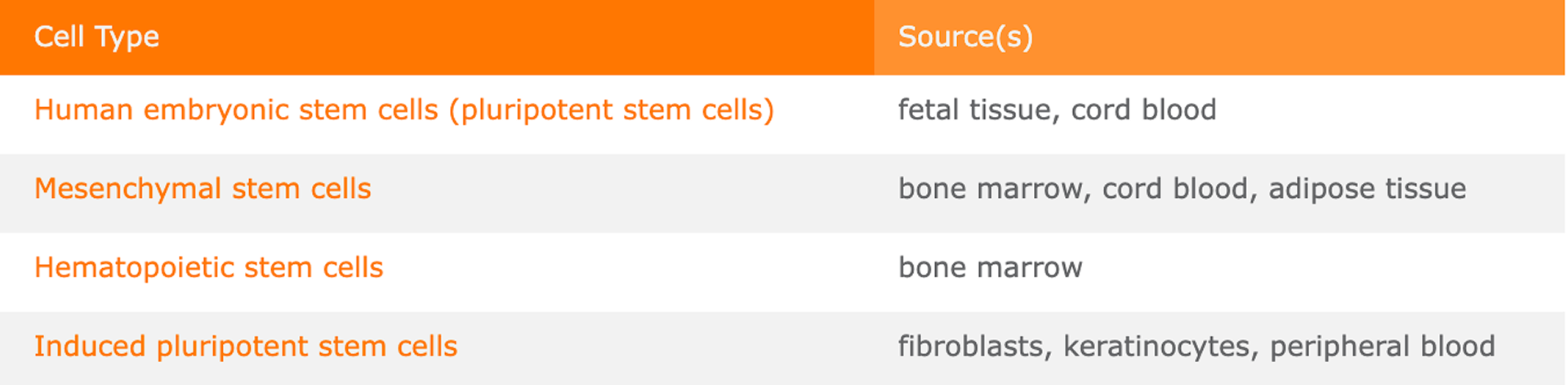
2.1. The ultimate stem cell is a fertilized egg (classified as totipotent), and human embryonic tissue has been demonstrated to retain the ability to differentiate into many types of cells (pluripotent). Use of human embryonic stem cells (ESCs), however, encounters a host of ethical, political, and regulatory issues, so these cells are not often used in the development of therapeutics, although they have been critical to our understanding of stem cells.[1] Adult multipotent stem cells that retain the ability to differentiate into several types of cells within the same class have also been successfully isolated from cord blood, and eight cord blood–based therapies have been approved, all of them for treatment of hematopoietic stem cell replacements.[8]
2.2. Because of the ethical challenges surrounding use of ESCs and the challenges associated with isolating adult stem cells, researchers have long endeavored to induce a differentiated adult cell to change into a stem cell. The first successful creation of induced pluripotent stem cells (iPSCs) was documented in 2006 by Takahashi and Yamanaka, and the use of iPSCs has been expanding ever since.[9] Although the potential for patient-matched, iPSC-based therapies is enormous, as of this writing, no iPSC-based therapy has yet been approved.
2.3. Mesenchymal stem cells (MSCs) are adult multipotent stem cells that were first described in the late 1960s by Friedenstein et al. These cells retain the ability to differentiate into several types of adult cells, including bone, cartilage, neurological tissue, and hepatocytes. They are typically isolated from bone marrow or adipose tissue and can be expanded rapidly in vitro, making them adaptable for clinical development.[10] Differentiation takes time, however, so these cells are more appropriate for chronic or long-term disorders such as neurological degeneration, chronic kidney disease, osteoarthritis, or chronic cardiovascular diseases. Numerous trials are underway to evaluate MSCs in the treatment of amyotrophic lateral sclerosis (ALS), Parkinson’s disease, stroke, and other conditions.[10]
2.4. Hematopoietic stem cells, found in bone marrow, are adult multipotent stem cells that can differentiate into other types of blood cells. Bone marrow transplants have long been used to treat a diverse array of conditions, including leukemia, sickle cell anemia, immune replacement after chemotherapy, and some genetic diseases such as adrenoleukodystrophy. Because they are regulated as a transplant, however, they are beyond the scope of this report.[11]
2.5. A summary of some common types of stem cell sources is presented in Table 2.
Table 2. Stem Cell Sources
FAQs
What is the difference between autologous CAR-T and allogeneic CAR-NK therapies?
Autologous CAR-T therapy relies on isolating and genetically modifying a patient’s own cytotoxic T cells, creating logistical complexity. Conversely, CAR-NK therapies utilize donor natural killer cells that are not host-specific, enabling off-the-shelf allogeneic administration with reduced risks of cytokine release syndrome (CRS) and graft-versus-host disease (GvHD).
How do Tumor-Infiltrating Lymphocytes (TILs) treat metastasized melanoma without genetic modification?
TIL therapies, such as FDA-approved lifileucel (Amtagvi), extract naturally occurring lymphocytes from a patient's tumor biopsy. Because these cells already express receptors for tumor-associated antigens (TAAs), they are expanded and activated in vitro without genetic engineering, enabling reinfused cells to target systemic metastasized melanoma.
What therapeutic challenges limit non-stem islet cell transplants for type 1 diabetes?
Non-stem islet cell transplants isolate insulin-producing pancreatic cells from cadaveric or living donors to restore endogenous glucose regulation. However, because donor and recipient HLA epitopes are typically mismatched, commercialization is constrained by the strict trade-off between chronic insulin dependence and lifelong immunosuppressive therapy.
Why are induced pluripotent stem cells (iPSCs) preferred over human embryonic stem cells (hESCs)?
Induced pluripotent stem cells (iPSCs) are reprogrammed from adult differentiated somatic cells—such as fibroblasts or keratinocytes—offering pluripotency without the ethical and regulatory constraints surrounding human embryonic stem cells (hESCs) derived from fetal tissue. Additionally, iPSCs enable patient-matched autologous applications.
What chronic indications are best suited for Mesenchymal Stem Cell (MSC) therapies?
Mesenchymal Stem Cells (MSCs) are multipotent adult stem cells derived from bone marrow, cord blood, or adipose tissue. Because their differentiation process requires time in vivo, MSCs are clinically optimal for long-term degenerative conditions, including amyotrophic lateral sclerosis (ALS), Parkinson's disease, osteoarthritis, stroke, and chronic kidney disease.
 *NK cells can be isolated from adults or derived from stem cells.