Key Takeaways
Flow reaction technology can address manufacturing challenges associated with hazardous reagents, unstable intermediates, difficult temperature control, moisture-sensitive chemistry, and other limitations of conventional batch processing.
Kaneka evaluates flow and batch processing according to the needs of the specific reaction, including safety, environmental impact, manufacturing cost, and process performance.
Kaneka used flow technology to reduce the amount of phosgene present in a manufacturing process from 100 kg per batch to 0.1 kg in the flow system at any given time.
Flow processing enabled Kaneka to perform a lithium-halogen exchange sequence involving unstable intermediates at −20 °C, compared with cryogenic conditions required for the batch process, while achieving substantially higher yield.
Kaneka is extending its continuous-processing capabilities beyond reaction chemistry through technologies such as ultrasonic crystallization for control of crystal form and particle size.
When Batch Processing Creates the Manufacturing Constraint
A reaction that can be performed successfully at laboratory scale may encounter very different constraints in industrial manufacturing. Reaction time, heat transfer, production equipment, and safety requirements can all become more consequential as scale increases.
Kaneka evaluates whether flow or batch processing offers the stronger manufacturing solution on the basis of the specific requirements of the reaction. Safety, environmental impact, manufacturing cost, and process performance all factor into that assessment.
Flow becomes particularly relevant when the way a reaction is run creates the manufacturing constraint. Hazardous reagents may be present in substantial quantities in a batch vessel. Unstable intermediates may require extreme conditions to remain controllable. Difficult temperature requirements can restrict available equipment and increase energy consumption, while highly moisture-sensitive chemistry may require tighter control over the reaction environment.
In these situations, flow technology can provide a different way to execute the same chemistry. Reagents move continuously through a defined reaction environment, allowing reactive species to be generated and consumed as the process proceeds and providing greater control over the amount of material present at a given time.
Match Flow Technology to the Problem
Different manufacturing constraints create different reasons to consider flow.
For hazardous chemistry, reducing the amount of reactive material present in the system at any one time can improve the practicality of industrial operation. For unstable intermediates, generating and consuming the intermediate in rapid succession can reduce the need to maintain it under demanding conditions. Flow can also create opportunities to operate reactions at less extreme temperatures or under conditions that better protect moisture-sensitive chemistry.
These applications reflect Kaneka's broader approach to flow development. The objective is not to convert established batch processes simply because continuous technology is available. Kaneka focuses on reactions for which flow can provide a clear advantage from both process chemistry and process engineering perspectives.
The company's phosgenation and lithium–halogen exchange processes illustrate how flow can solve very different manufacturing constraints.
Reducing Phosgene Inventory from 100 Kilograms to 0.1 Kilograms
Phosgenation provides a particularly clear example of how changing the processing mode can address a manufacturing problem.
Phosgene is a useful reagent for pharmaceutical synthesis, but handling the material as a gas presents significant safety challenges due to its high toxicity. Triphosgene provides a more manageable source of phosgene, but preparing a phosgene solution from triphosgene and then using that solution in a batch reaction still requires the resulting phosgene to be handled safely.
Kaneka addressed this issue by developing a flow process in which phosgene is generated from triphosgene inside the flow reactor and immediately consumed in the subsequent reaction. The process therefore avoids accumulating the same quantity of phosgene that would be present in the corresponding batch operation.
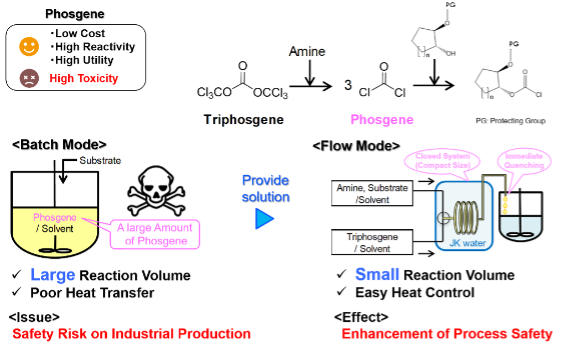 Figure 1. Flow phosgenation reduces the quantity of hazardous reagent present in the process.
The difference is substantial. The previous process used a solution containing 100 kg of phosgene per batch. In the flow process, only 0.1 kg of phosgene is present in the system at any given time, where it is consumed immediately as part of the continuing reaction.
The process also demonstrates that the approach can extend beyond laboratory or pilot-scale feasibility. Ten years after implementation, it continues to operate safely, using more than 2,000 kg of phosgene across more than 20 batches annually.
Here, flow technology did not replace phosgenation with a different synthetic transformation. It changed how the reagent was generated, handled, and consumed, allowing useful chemistry to be retained while addressing one of the major constraints associated with its industrial use.
Avoiding Cryogenic Conditions for Unstable Intermediates
A second Kaneka application demonstrates a different manufacturing challenge: chemistry that depends on highly unstable intermediates and demanding temperature control.
Lithium–halogen exchange using butyllithium (BuLi), followed by aromatic alkylation or boronic acid synthesis, is useful in pharmaceutical synthesis. The intermediates generated during these reactions are unstable, and conventional batch processes typically require cryogenic temperatures of approximately −80 °C. Maintaining those conditions can impose significant equipment requirements and increase energy consumption.
Kaneka applied a flow reactor so that the unstable intermediates could be generated and then consumed immediately. This allowed the reaction sequence to proceed without the same cryogenic conditions required in batch processing. The chemistry is also highly sensitive to moisture, and the flow configuration helps minimize moisture entering the system, supporting more reliable reaction performance.
The process advantage is clear in the yield and temperature comparison. In batch, the reaction produced an 8% yield at −40 °C and a 50% yield at −78 °C. Using the flow process, Kaneka achieved an 88% yield at −20 °C.
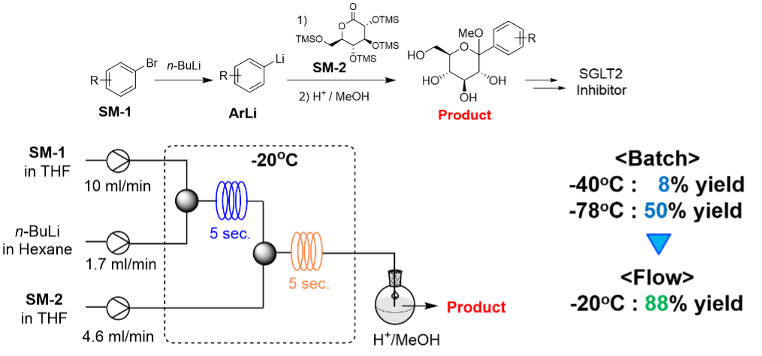 Figure 2. Flow processing enables lithium–halogen exchange under less demanding temperature conditions.
In this case, immediate consumption of the unstable intermediate allowed the chemistry to proceed at a substantially warmer temperature, reducing the burden associated with extreme cryogenic operation. The controlled reaction environment also helped address moisture sensitivity while supporting a substantial improvement in yield compared with the reported batch conditions.
A process may become difficult to manufacture because the chemistry demands temperature, equipment, or environmental conditions that are cumbersome to maintain at production scale. Flow can create value when more precise control changes those requirements.
Evaluate Flow Against the Best Batch Process
Flow processing still must provide a clear advantage over the practical batch alternative. Kaneka evaluates both approaches before selecting a development strategy. Safety is one consideration, but environmental impact and manufacturing cost also influence whether a conversion to flow creates sufficient value.
That comparison keeps flow development focused on reactions for which changing the processing mode materially improves manufacturability. A hazardous process may benefit from reducing the quantity of reactive material present at one time, while an unstable intermediate may benefit from immediate generation and consumption. In other cases, batch processing may already provide the necessary performance, control, and economics.
Kaneka identifies reactions in which flow provides advantages from both process chemistry and process engineering perspectives and develops those processes when the benefit over batch operation is clear.
Extending Continuous Processing Beyond the Reaction
Kaneka is also applying continuous-processing principles beyond reaction chemistry.
Active pharmaceutical ingredient (API) performance can depend on solid-state attributes, including crystal form, particle size, particle-size distribution, and polymorphs. Conventional processing generally controls crystal form through crystallization conditions and particle size through a subsequent milling step. Kaneka has developed ultrasonic crystallization as a technology intended to control crystal form, particle size, and polymorphs through the crystallization process itself.
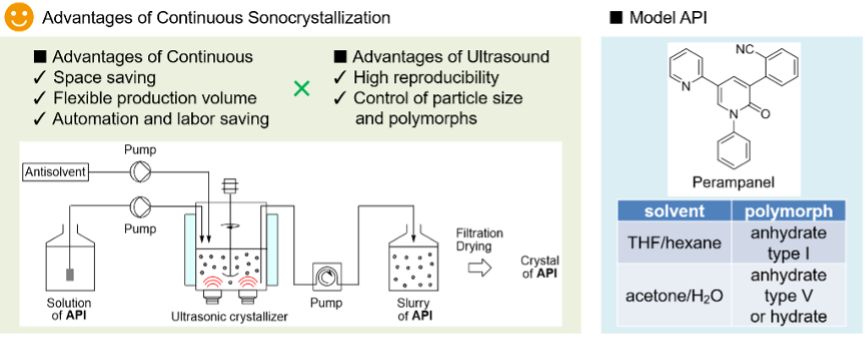 Figure 3. Kaneka is extending continuous processing into particle and crystal-form control.
Its continuous sonocrystallization concept is designed to combine reproducibility and control of particle size and polymorphic form with potential manufacturing advantages associated with continuous operation, including space savings, flexible production volume, automation, and reduced labor requirements.
The technology remains an emerging area, but it extends the same process-development logic beyond the reactor: identify a manufacturing constraint, determine whether continuous processing offers a practical advantage, and apply the technology where it can simplify or improve the process.
From Difficult Chemistry to Practical Manufacturing
Kaneka combines process chemistry and process engineering to identify reactions where flow provides a clear advantage over batch processing and to develop those reactions into practical manufacturing processes.
That approach allows Kaneka to apply flow selectively, where changing the mode of operation can create a clear advantage in safety, process performance, or manufacturing efficiency.
For chemistry constrained by hazardous reagents, unstable intermediates, extreme operating conditions, moisture sensitivity, or difficult process control, flow technology can provide a practical path to scalable pharmaceutical manufacturing.