The accelerating demand for biologics, driven by expanding therapeutic applications and continued market growth, has intensified the need for efficient, scalable, and reliable manufacturing strategies. Traditional fed-batch processes have long served as the backbone of commercial bioproduction because they are reliable at scale and evolve with advances in media, process control, and cell line engineering. As the industry aims to achieve higher productivity and tighter control, interest has grown in upstream methodologies for continuous nutrient management, improved metabolic balance, and more consistent culture performance as complementary options to fed-batch processes.
Among these next-generation approaches, perfusion culture has emerged as a strong candidate for intensified or continuous bioprocessing. Using constant media exchange to keep cells in a dynamic, nutrient-rich environment results in continuous perfusion, which refreshes the culture environment, minimizing physiological stress, improving cell viability, and sustaining high-density growth. While fed-batch systems have proven highly effective and remain central to many commercial processes, perfusion offers an additional route to further elevate productivity and consistency under intensified operating conditions.
The renewed focus on perfusion aligns with broader trends across the biopharmaceutical sector. Recent surveys indicate increasing interest in continuous bioprocessing, with many organizations expecting broader adoption of perfusion-capable platforms in the coming years. Market analyses similarly project the steady expansion of perfusion systems (Figure 1). As manufacturing programs scale and molecules become more complex, stakeholders seek process architectures that deliver tighter control, greater efficiency, and improved robustness in commercial production. Perfusion-based continuous processing offers a technical pathway to achieving these objectives through stable operating conditions, predictable performance, and efficient resource utilization.
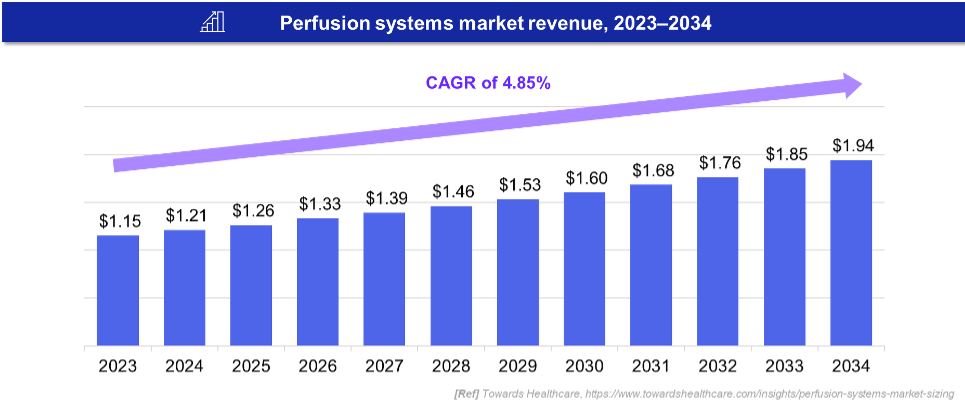 Figure 1. Perfusion systems market revenue. The perfusion systems market was estimated at US$1.21 billion in 2024 and is projected to grow to US$1.94 billion by 2034, rising at a compound annual growth rate of 4.85% from 2024 to 2034. (Source: Towards Healthcare)
Understanding Perfusion Culture and Its Advantages
Perfusion culture is a continuous upstream processing strategy that maintains cells in an optimal growth environment through steady media exchange and cell retention. In contrast to fed-batch systems, where nutrients are added intermittently and metabolites accumulate over time, perfusion continuously replaces the spent medium while maintaining a high viable cell density (VCD) within the bioreactor. This dynamic equilibrium reduces the buildup of inhibitory byproducts, such as lactate and ammonium, ensuring more stable culture physiology and supporting extended production windows.
Fed-batch remains the dominant upstream strategy across the industry, valued for its operational simplicity, well-established workflows, and continually improving performance. Advances in media design, cell-line engineering, and process automation continue to strengthen fed-batch performance. However, as biologics portfolios expand and expectations for consistency and yield continue to rise, some manufacturers are exploring perfusion as a complementary approach. By continuously replenishing nutrients and removing metabolic byproducts — conditions that can support higher VCD and longer productive phases — perfusion offers an additional pathway to intensification, enabling higher viable cell density and volumetric productivity, while building on the strong foundation that the fed-batch strategy already provides.
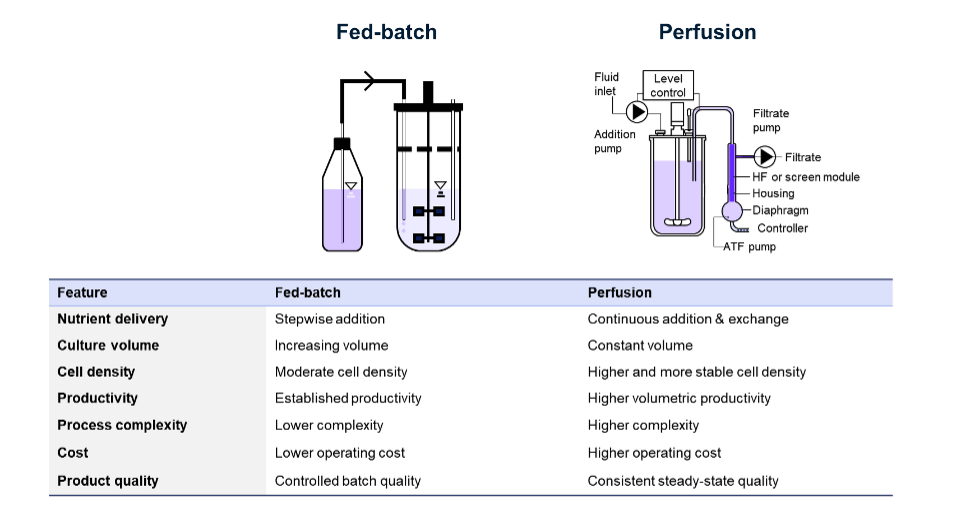 Figure 2. Fed-batch cell culture vs. perfusion cell culture. A comparison of the divergence points between fed-batch and perfusion operations.
By maintaining a constant bioreactor volume and continuously replenishing media, perfusion enables significantly higher VCD and sustained productivity. While adopting a perfusion approach typically involves more advanced equipment and upfront investment, many organizations find that the resulting gains in robustness, yield, and consistency deliver substantial long-term value. For teams aiming to intensify upstream operations or move toward more continuous bioprocessing strategies, perfusion offers the scalability to enhance current production models or serve as a foundation for next-generation facility designs.
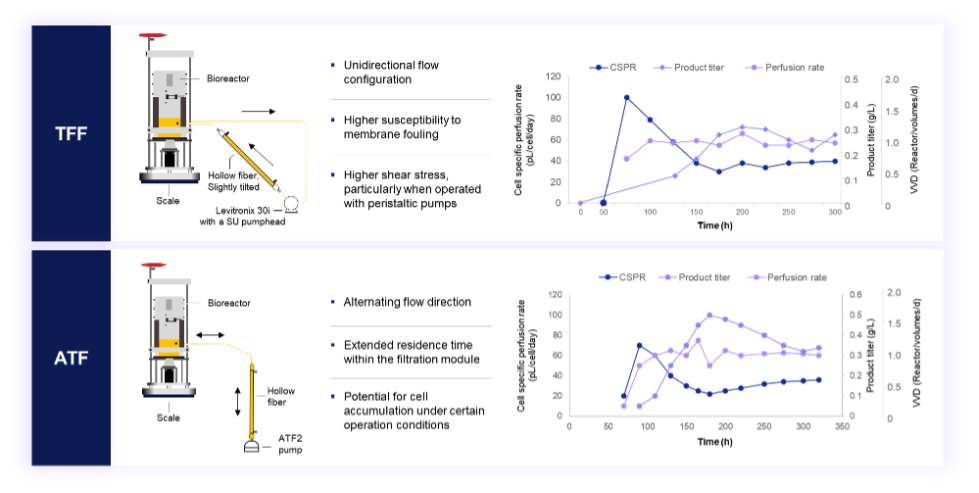 Figure 3. Tangential flow filtration (TFF) vs. alternating tangential flow filtration (ATF). TFF and ATF are membrane-based separation processes used in biopharmaceutical manufacturing. ATF is particularly effective in processes such as perfusion culture, where continuous cell harvesting and clarification are required, as it improves recovery rates and maintains high-quality product yields.
Several cell-retention technologies have been adopted across the industry for perfusion processing, each with distinct operational profiles. Figure 3 provides an overview of two commonly used configurations:
Tangential flow filtration (TFF): TFF employs crossflow filtration to separate cells from spent media. Its tangential flow pattern helps reduce membrane fouling, but long-term continuous runs may still be limited by gradual filter clogging and increasing transmembrane pressure. As a result, TFF is often used for shorter or semi-continuous perfusion strategies.
Alternating tangential flow filtration (ATF): ATF systems use an oscillating flow mechanism that alternates the direction of liquid movement across a hollow-fiber membrane. This alternating flow minimizes shear stress and significantly reduces fouling compared to conventional TFF, so ATF is better suited for extended or fully continuous operations. The low-shear environment helps maintain high cell viability and stable retention efficiency throughout long production campaigns.
Samsung Biologics consistently uses ATF-based perfusion systems for its operational robustness, compatibility with high-density cultures, and reproducible yield across a wide range of biologics modalities. ATF’s reliability in maintaining membrane permeability and supporting long-duration runs aligns with the company’s emphasis on stable, high-throughput, intensified upstream production.
Designing and Implementing Perfusion Systems
The effective deployment of perfusion technology requires a structured approach to process design, supported by rigorous experimentation and a clear understanding of the system behavior under continuous operations. Central to this effort is the use of Design of Experiments (DoE), which efficiently identifies optimal conditions while minimizing development time and resource use.
DoE frameworks establish a logical sequence, define factors and ranges, construct a study design, execute an experimental matrix, and analyze responses to characterize interactions that influence cell retention, productivity, and long-term stability. This systematic methodology ensures that perfusion processes are robust and reproducible across development scales.
While perfusion is often perceived as being more complex than a fed-batch approach, its challenges are manageable with appropriate engineering controls, which typically begin with establishing well-defined baseline parameters. In cases with limited prior knowledge, vendor-recommended starting points — such as maintaining shear rates at ≤2,000 sec⁻¹, operating within a 4–6 LMH (L/m²/h) flux range, and targeting a 70–80% ATF-to-filtration ratio — provide a rational foundation for initial setup. These conditions are subsequently refined through small-scale studies, where comparative data on cell culture performance, productivity, and product quality guide adjustments. Once the process is translated to manufacturing scale, continuous oversight through online trend monitoring and complementary offline analyses enables the timely identification and resolution of emerging issues.
Continuous operations introduce new variables, such as pump precision, flow balance, and membrane performance, yet modern automation mitigates many of these concerns by reducing manual intervention and tightening process control. Contamination risk, frequently cited as a barrier, is significantly lower in closed perfusion systems, where fewer operator touchpoints and a consistent flow regime create a highly controlled environment. Achieving and maintaining a steady state requires careful monitoring of cell density, metabolite levels, and perfusion rates, but once established, the system can deliver greater stability than the conventional fed-batch approach.
Scalability and validation demand deliberate planning, particularly in translating small-scale parameters to pilot and manufacturing volumes. Considerations include shear exposure, retention device capacity, and the interplay between the cell-specific perfusion rate and bioreactor geometry. Industry-wide uptake of perfusion has been gradual, influenced by limited operational familiarity and a lack of standardized workflows. Nevertheless, successful applications across multiple biologics programs underscore the value of perfusion technology for high-density, high-productivity manufacturing. Samsung Biologics continues to use small-scale models to refine control strategies, define scalable operating ranges, and establish a consistent foundation for reliable and efficient perfusion.
Case Study: Small-Scale Perfusion Development and Application
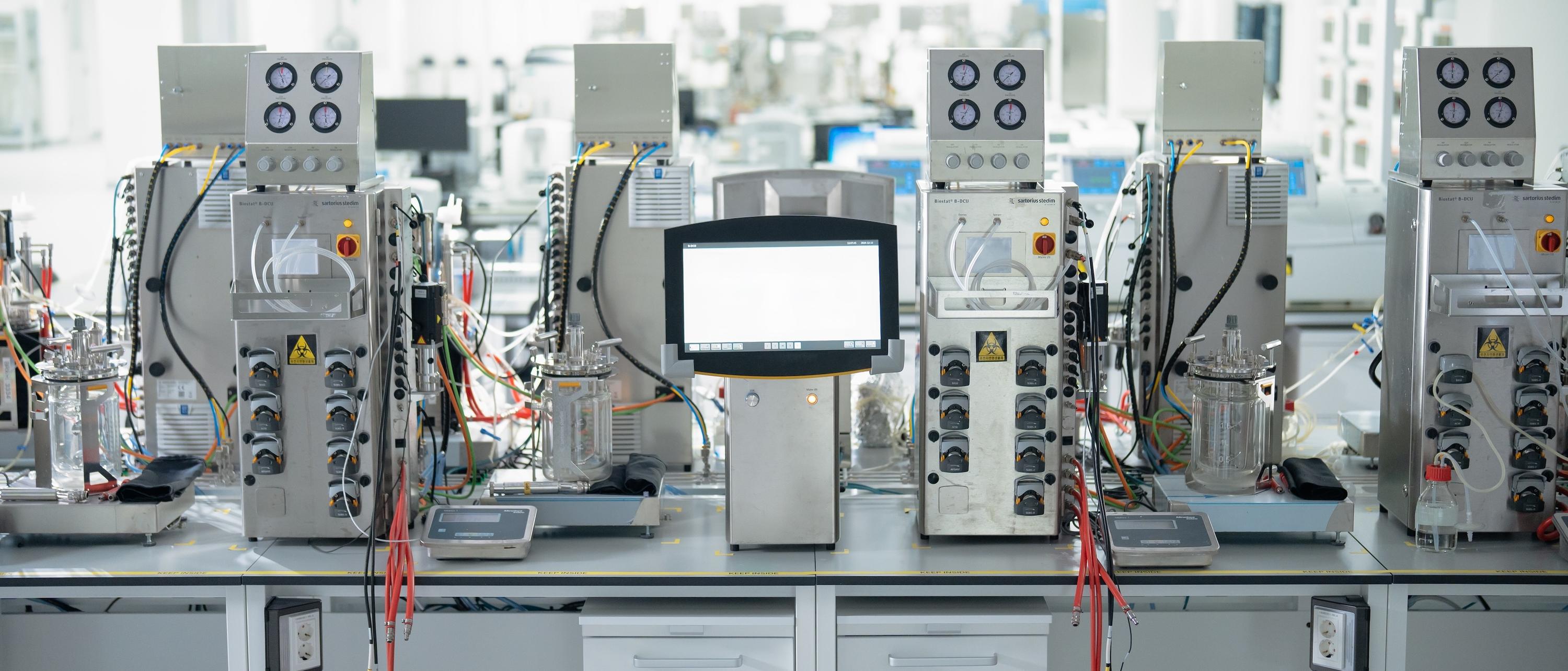
Small-scale perfusion studies provide an essential framework for understanding system behaviors, refining operational parameters, and establishing scale-up strategies suitable for manufacturing. The development platform used in this case integrated the core components of continuous processing: a controlled feed system, a single-use bioreactor, an ATF or TFF cell-retention device, and a permeate collection capability. An optional cell bleed was incorporated, depending on the target VCD.
The ATF configuration was run under defined constraints to ensure acceptable shear and membrane performance, maintaining shear rates below 2,000 sec⁻¹, holding fluxes within the 4–6 LMH (L/m²/h) range, and controlling ATF-to-filtration ratios at 70–80%. Media feed rates were dynamically adjusted based on cell expansion kinetics and typically increased nearly daily during exponential growth to maintain nutrient balance and metabolic stability.
This small-scale framework strategically focused on evaluating perfusion translation during N-1 intensification. In this configuration, only the N-1 bioreactor underwent perfusion, while the N stage used a fed-batch process. The results showed notably enhanced upstream performance: an eight-fold increase in VCD at N-1, a ten-fold increase in seeding density at the N stage, and a two-fold increase in protein productivity. These gains underscore the impact of N-1 perfusion as a targeted intensification to improve inoculum quality and increase the efficiency of production bioreactors without end-to-end continuous integration.
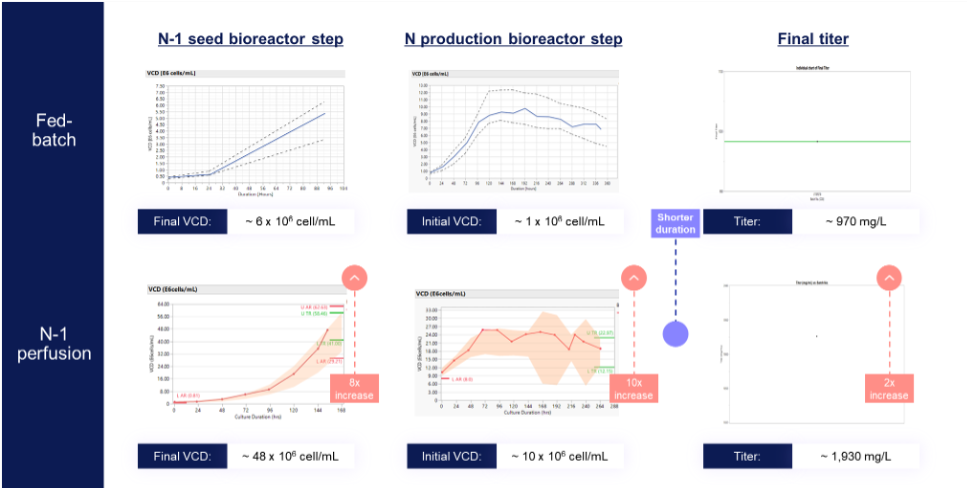 Figure 4. Case study: Process change from fed-batch to N-1 perfusion. The final viable cell density in the N-1 stage of the perfusion process increased approximately eight-fold, with N seeding density increasing ten-fold and protein productivity doubling. These results confirm that perfusion significantly boosts productivity.
Operational learnings from these studies highlighted practical considerations for equipment selection and process control. Initial ATF rates, near 80 liters per minute (LPM), exceeded the pump system’s physical limits, prompting an adjustment to ≤70 LPM to maintain stable pressure and flow profiles. This refinement established a more realistic operational window for future work. Samsung Biologics continues to assess the feasibility of implementing N-stage perfusion at larger scales, such as in 10–15 kL bioreactors, with particular attention to ATF throughput capacity and long-duration fouling behavior. These insights directly inform robust scale-up strategies and next-generation continuous bioprocess platforms.
Conclusion
Perfusion technology represents a pivotal advancement in upstream bioprocessing, enabling cultures to maintain high viability, achieve elevated cell densities, and sustain productivity over extended periods. By continuously supplying nutrients and clearing inhibitory byproducts, perfusion creates a highly stable and tightly regulated culture environment that can support consistent product quality as programs scale or intensify. Early barriers, such as operational complexity, contamination concerns, and scale-up limitations, once constrained broader adoption. But ongoing improvements in automation, equipment design, and process analytics have substantially mitigated these challenges.
Samsung Biologics continues to advance its perfusion capabilities through systematic small-scale validation, refined process control strategies, and the targeted development of scalable operating parameters. Ongoing work in ATF-based cell-retention systems, coupled with a focus on robust control and system characterization, strengthens the feasibility of applying perfusion in the N-stage and hybrid intensified processes. These efforts position the organization to support clients seeking higher productivity, more efficient use of manufacturing assets, and improved upstream process performance. As perfusion technologies mature and adoption accelerates, Samsung Biologics continues to drive innovation in the reliable, high-quality production of biologics at scale.