Ovarian cancer remains the most lethal gynecologic malignancy, and its global burden is increasing at an alarming rate. Clinical management has advanced in the past decade, with the traditional backbone of cytoreductive surgery and platinum/taxane chemotherapy now complemented by maintenance strategies, such as PARP inhibitors and bevacizumab, particularly for biomarker-selected populations. Yet resistance and relapse remain common, driving the need for new modalities. A rapidly evolving therapeutic landscape includes antibody–drug conjugates (ADCs), inhibitors of the additional pathways, novel approaches to DNA damage beyond PARP, and rational immuno-oncology combinations. Precision medicine strategies are also gaining ground in low-grade serous, clear cell, and platinum-resistant tumors. Closing the survival gap will require coordinated action: investment in data-linked screening trials, earlier and broader molecular typing, equitable access to testing and therapies, adaptive trial platforms, and systematic real-world evidence capture to guide practice and accelerate discovery.
The Global and U.S. Burden — Why Urgency Is Rising
Global Epidemiology and Projections
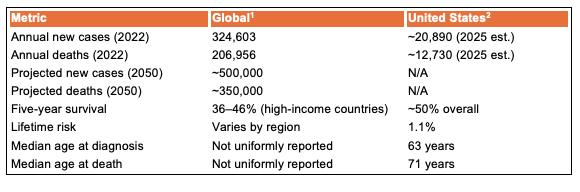
Ovarian cancer is already a major global health challenge, and its impact is projected to expand dramatically in the coming decades. In 2022, approximately 324,600 women were diagnosed worldwide, and nearly 207,000 died from the disease. By 2050, annual incidence is expected to approach 500,000, with deaths exceeding 350,000, representing a 55% increase in cases and nearly 70% increase in mortality.1 The cumulative toll is staggering: without meaningful intervention, nearly eight million women could be lost to ovarian cancer between 2022 and 2050.1
The burden is not distributed evenly. Africa is projected to see a 142.8% increase in deaths, while Asia faces a 67.6% increase. Latin America and the Caribbean are expected to experience a 78% rise, and Oceania nearly 82%. Even in regions with stronger health infrastructure, such as North America and Europe, mortality is projected to climb by 46% and 19% respectively.1 These disparities highlight the urgent need for global action, particularly as health systems in low- and middle-income countries (LMICs) may be least prepared to manage the rising wave of cases. Limited access to specialized oncology care, diagnostic testing, and advanced therapeutics could deepen inequities unless capacity building and international collaboration are prioritized.
Survival outcomes further underscore the problem. Even in high-income countries, five-year survival remains only 36–46%, reflecting the difficulty of achieving durable disease control with current strategies.1 In lower-resource settings, survival is likely even poorer, but reliable data remain limited, compounding the challenge of designing effective interventions.
The Burden in the United States
In the United States, ovarian cancer represents about 1% of all new cancer cases but carries a disproportionate mortality burden. For 2025, approximately 20,890 new cases and 12,730 deaths are projected.2 Age-adjusted incidence stands at 10.3 per 100,000 women per year, with mortality at 5.9 per 100,000.2 The lifetime risk of a woman developing ovarian cancer is roughly 1.1%, a modest proportion compared to more common cancers, yet despite its relative rarity, ovarian cancer remains the fifth leading cause of cancer-related death among women in the United States.
Prevalence data reflect both the chronic nature of management and the persistence of relapse. As of 2022, more than 243,000 U.S. women were living with ovarian cancer.2 Age distribution further illustrates the demographic weight of the disease. The median age at diagnosis is 63 years, with most cases occurring between the ages of 55 and 74. These patterns reflect both the biology of the disease and the challenges of delivering aggressive treatment in older populations with comorbidities.
A central reason for the disproportionate mortality lies in the stage at diagnosis. Unlike breast or cervical cancer, there are no established population-level screening strategies for ovarian cancer. Symptoms, such as bloating, pelvic pain, or changes in bowel habits, are nonspecific and often mistaken for benign conditions. As a result, the majority of patients present with advanced-stage disease, where prognosis is poor and curative options are limited.
Table 1. Global vs. U.S. Burden Snapshot
 Standard of Care and Outcomes — Progress and Limits
Frontline Treatment
For decades, the backbone of ovarian cancer management has been cytoreductive surgery followed by platinum- and taxane-based chemotherapy. The principle of maximal cytoreduction — removing as much visible tumor as possible — remains central to achieving favorable outcomes. Optimal debulking is consistently associated with improved survival, but complete cytoreduction is not always feasible, particularly in patients with extensive peritoneal spread or significant comorbidities.3,4 The decision between primary debulking and neoadjuvant chemotherapy continues to be shaped by patient fitness, disease distribution, and institutional expertise, but both approaches are considered appropriate within guideline-directed care.
Standard systemic therapy after surgery typically involves a doublet of carboplatin and paclitaxel. In patients with advanced disease, the addition of bevacizumab, an anti-VEGF antibody, may be considered, particularly for those with high-risk features, such as stage IV or suboptimal debulking. Bevacizumab has demonstrated benefits in progression-free survival (PFS), though overall survival (OS) improvements are less consistent, and cost, toxicity, and patient selection remain important considerations.4
While these strategies can achieve meaningful initial responses, the majority of patients relapse. This limitation has shifted attention toward maintenance therapies designed to extend remissions, delay progression, and potentially alter the long-term natural history of the disease.
Maintenance Therapy — Biggest Shift in a Generation
Maintenance therapy has been the most transformative development in ovarian cancer care over the past decade. The approval of poly (ADP-ribose) polymerase (PARP) inhibitors has redefined expectations, especially for biomarker-selected populations. Patients with germline or somatic BRCA1/2 mutations derive the most profound benefit, with marked improvements in PFS compared with observation alone.4,5 Beyond BRCA mutations, patients with homologous recombination deficiency (HRD)-positive tumors also respond favorably, though the magnitude of benefit is less pronounced. By contrast, homologous recombination proficient (HRP) tumors exhibit limited sensitivity, underscoring the need for more effective options in this subgroup.6,7
Combination approaches have further expanded the field. The pairing of PARP inhibitors with bevacizumab has demonstrated efficacy in HRD-positive, non-BRCA populations, creating new opportunities for patients who might not otherwise benefit from PARP monotherapy. However, these regimens introduce added toxicity and complexity, making patient selection and biomarker testing essential components of frontline planning.
Despite these advances, several challenges remain. Resistance to PARP inhibitors, whether intrinsic or acquired, is increasingly recognized and limits the durability of benefit. Mechanisms include restoration of homologous recombination function, replication fork stabilization, and drug efflux, among others.7 Strategies to overcome resistance, such as combining PARP inhibitors with agents targeting DNA damage response (DDR) pathways, immune checkpoint inhibitors, or angiogenesis, are now active areas of investigation.
Toxicity and quality of life are equally important considerations. Fatigue, hematologic adverse events, and gastrointestinal symptoms can lead to dose reductions or treatment discontinuation. Long-term tolerability becomes particularly relevant as maintenance regimens are often administered for years rather than months. Real-world studies are beginning to provide insight into adherence patterns and the need for proactive management of side effects to preserve quality of life.5,6
In sum, the integration of maintenance therapy represents the most significant shift in ovarian cancer treatment in recent memory, bringing personalized approaches to the forefront of clinical practice. Yet the uneven distribution of benefit, the inevitability of relapse, and the challenge of toxicity highlight why continued innovation is essential.
Unmet Needs Across the Patient Journey
Early Detection and Risk Stratification
Perhaps the most striking gap in ovarian cancer management is the lack of an effective population-level screening strategy. Despite decades of investigation, tools such as CA-125 serum testing and transvaginal ultrasound (TVUS) have not demonstrated sufficient sensitivity or specificity to reduce mortality when applied broadly. Their inability to reliably distinguish malignant from benign conditions has limited their use to monitoring recurrence rather than detecting cancer early. This shortcoming is a primary driver of the late-stage diagnoses that dominate clinical practice and contribute to the disease’s high mortality.
Promising innovations are now emerging. Multi-omic strategies, circulating tumor DNA (ctDNA) analysis, and proteomic profiling are being investigated as next-generation approaches capable of detecting molecular signatures of cancer before symptoms develop. These technologies hold potential but remain far from validation. Large-scale, longitudinal trials with diverse populations will be required to establish accuracy, reproducibility, and clinical utility.8 Without such rigorous evidence, these tools risk joining the long list of unrealized screening solutions.
For women already known to be at elevated risk, particularly those with BRCA1/2 or Lynch syndrome mutations, more effective interventions are available but unevenly applied. Genetic testing uptake remains variable, and cascade testing of family members is often inconsistent, missing opportunities to identify carriers before disease onset. Even among those identified, disparities in access to prophylactic surgery or enhanced surveillance persist due to geographic, economic, and cultural barriers.4 Addressing these gaps could yield substantial near-term impact, even before population-level screening becomes feasible.
Biomarker Equity and Testing Logistics
Molecular testing has become essential for guiding frontline and maintenance therapy, but real-world implementation lags behind scientific progress. HRD testing, for example, suffers from variability in methodology, interpretation, and access. Tissue-based assays are standard but can be limited by sample quality, while blood-based alternatives are not yet universally available. Turnaround times may delay treatment decisions, undermining the promise of personalization.7
Equity in testing is another persistent challenge. While academic centers often provide comprehensive genomic profiling, community practices — where many patients receive their care — may lack infrastructure or reimbursement pathways. Payer coverage is inconsistent, creating uncertainty for clinicians and patients alike.4,9 These barriers risk stratifying outcomes by geography and socioeconomic status, undermining the very concept of precision medicine. Ensuring universal access to biomarker testing, including germline and somatic assays, is a prerequisite for delivering equitable and effective care.
Platinum-Resistant Disease and Rare Histologies
Patients with platinum-resistant ovarian cancer continue to face poor prognoses. Responses to standard therapies are short-lived, and durable remissions remain elusive. The approval of the folate receptor alpha–targeted antibody–drug conjugate (ADC) mirvetuximab soravtansine has provided a meaningful option for a subset of patients, but most remain without effective alternatives.10 Additional ADCs targeting NaPi2b, Trop-2, and other antigens are in development, but questions remain regarding optimal sequencing, resistance, and toxicity management.
Immuno-oncology (IO) has so far delivered limited benefits in ovarian cancer, but rational combinations — pairing IO agents with PARP inhibitors, anti-angiogenics, or ADCs — are being pursued to overcome immune evasion.11 These strategies will be especially important for platinum-resistant disease, where mechanisms of relapse create biologically diverse and difficult-to-treat tumors.
Rare histologies, such as low-grade serous, clear cell, and mucinous ovarian cancers, further complicate the landscape. Their distinct biology renders standard therapies less effective, and clinical trial enrollment is challenging due to small patient numbers. Targeted inhibitors, metabolic pathway drugs, and precision medicine approaches are beginning to reshape expectations, but robust evidence is still limited.6 Dedicated investment in subtype-specific research is critical to ensure these populations are not left behind.
Five Places where Real-World Practice Falls Short
Universal germline testing – Ensure all patients are offered BRCA and Lynch testing at diagnosis, with cascade testing protocols standardized.
Routine HRD assessment – Mandate rapid, reimbursed HRD testing with results available before treatment initiation.
Equitable biomarker access – Extend testing and treatment infrastructure to community oncology, supported by payer alignment.
Prophylaxis and risk reduction – Expand access to counseling and preventive surgery for high-risk carriers.
Clinical trial enrollment – Broaden eligibility and facilitate referral pipelines, especially for rare subtypes.
The Emerging Therapeutic Landscape—What’s Here and What’s Next
The past decade has ushered in important advances for ovarian cancer, but survival gains remain modest and uneven. A new generation of targeted therapies and precision strategies is beginning to reshape expectations, particularly in historically intractable settings, such as platinum-resistant disease and rare histologies. Several modalities stand out as leading candidates to change the standard of care.
ADCs
ADCshave rapidly moved from experimental therapy to clinical reality in ovarian cancer. The folate receptor alpha (FRα) ADC mirvetuximab soravtansine, marketed as Elahere, has become the first ADC approved for platinum-resistant ovarian cancer with FRα-high expression. Its activity offers meaningful benefit in a setting historically defined by short-lived responses to chemotherapy.10 Patient selection is key: only those with tumors expressing FRα above a defined threshold are eligible, highlighting the role of biomarker testing in ensuring efficacy.
Beyond monotherapy, combination strategies are being explored to extend durability and to overcome resistance. Early studies are evaluating mirvetuximab alongside bevacizumab, immune checkpoint inhibitors, and other agents that may modulate the tumor microenvironment.7 These trials reflect a broader recognition that ADCs may function as the backbones for combinatorial regimens.
The pipeline is expanding rapidly. Agents targeting NaPi2b and Trop-2 are under investigation, and lessons from early ADC experience are shaping trial design. Key questions include defining biomarker thresholds for patient selection; managing overlapping toxicities, such as ocular and gastrointestinal adverse events; and optimizing sequencing relative to chemotherapy and PARP inhibitors.9 These challenges underscore the need for thoughtful trial structure but also affirm the promise of ADCs as a transformative class for ovarian cancer.
MAPK Pathway Targeting and Low-Grade Serous Ovarian Cancer
Low-grade serous ovarian cancer (LGSOC) represents a distinct clinical entity, characterized by indolent growth but poor responsiveness to conventional chemotherapy. Genomic profiling has revealed frequent alterations in the MAPK pathway, particularly KRAS and NRAS mutations, opening new therapeutic avenues.
The recent approval of avutometinib, a RAF/MEK clamp, in combination with the FAK inhibitor defactinib marks a milestone for patients with recurrent KRAS-mutant LGSOC.12 This regimen achieved durable responses in a population long underserved by standard approaches, and its success highlights the value of tailoring treatment to subtype-specific biology. Resistance remains a concern, with adaptive signaling and pathway reactivation likely to emerge as obstacles. Ongoing trials are evaluating combination strategies and the potential to expand benefit beyond KRAS-mutant tumors.
Importantly, the avutometinib–defactinib approval illustrates why earlier molecular typing is essential. Historically, indolent histologies like LGSOC were not prioritized for genomic testing at diagnosis. Incorporating routine molecular profiling into care pathways could accelerate identification of eligible patients and broaden access to targeted therapies.
DNA Damage Response Beyond PARP
PARP inhibitors validated DDR targeting as a therapeutic strategy, but resistance has limited their long-term impact. Efforts are now expanding into other DDR nodes, such as ATR, CHK1, and WEE1. These kinases regulate replication stress and checkpoint control, offering opportunities for synthetic lethality beyond BRCA mutations.
Clinical trials are testing ATR inhibitors both alone and in combination with PARP inhibitors or chemotherapy. WEE1 inhibitors are also under active study, with early data suggesting activity in HRP tumors, where PARP inhibitors have shown limited benefit.7 Biomarkers for patient selection remain under development, including genomic signatures of replication stress and functional assays of DDR capacity.9
Combination logic is central to DDR strategies. Pairing ATR or CHK1 inhibitors with PARP inhibitors may overcome resistance mechanisms by compounding replication stress. Likewise, integrating DDR inhibitors with immune checkpoint blockade could exploit DNA damage–induced neoantigen exposure. These avenues illustrate how the next generation of DDR therapies could broaden the scope of synthetic lethality in ovarian cancer.
PI3K/AKT/mTOR and Metabolic Targets
Alterations in the PI3K/AKT/mTOR signaling axis are common in endometrioid and clear cell ovarian cancers, providing rationale for targeted inhibition. While this pathway has been difficult to drug effectively in solid tumors due to toxicity and adaptive resistance, ovarian cancer subtypes with specific mutations may represent more tractable populations.
Early trials of PI3K and AKT inhibitors have shown mixed results, with modest activity tempered by tolerability challenges.9 Efforts are now focused on rational combinations, such as pairing pathway inhibitors with chemotherapy or immune checkpoint inhibitors to enhance efficacy. In clear cell carcinoma, metabolic vulnerabilities are also being explored, including glutamine and oxidative phosphorylation dependencies.6 These approaches remain largely experimental, but they illustrate the importance of moving beyond a “one-size-fits-all” model toward subtype-specific therapeutics.
Immuno-oncology and the Tumor Microenvironment
Despite remarkable progress in other cancers, IO has yet to achieve consistent success in ovarian cancer. Monotherapy with checkpoint inhibitors has produced only modest response rates, likely reflecting the immunosuppressive tumor microenvironment and limited tumor mutational burden.11
Nonetheless, combination strategies are generating renewed optimism. Trials are evaluating PARP inhibitors with PD-1 blockade, leveraging DNA damage to increase immunogenicity. Anti-angiogenic agents may normalize the tumor vasculature and improve immune cell infiltration, supporting combinations of bevacizumab with checkpoint inhibitors. ADCs are also being paired with a variety of IO agents, with the hypothesis that cytotoxic payload release could enhance antigen presentation.7,9
Other approaches are expanding the IO toolkit. Tumor-infiltrating lymphocyte (TIL) therapy, bispecific antibodies, engineered cytokines, and vaccines are under development, though most remain early stage. Biomarkers remain elusive: PD-L1 expression and tumor mutational burden (TMB) have not consistently predicted response, and immune gene signatures are under evaluation but not yet validated. Until reliable predictors are established, IO in ovarian cancer will remain an area of high interest but uncertain translation.
Precision Strategies and Platform Discovery
The success of targeted and maintenance therapies has underscored the importance of precision medicine. Efforts are now underway to accelerate target discovery and streamline translation into clinical care. Functional genomics, synthetic lethal screens, and CRISPR-based approaches are identifying novel dependencies in ovarian cancer cells.13
Collaborations between academia and industry are beginning to demonstrate how these insights can be operationalized. Recent precision medicine initiatives have used integrative multi-omic data to match patients with experimental therapies, highlighting workflows that could inform broader practice.14 Translational models are also evolving: patient-derived organoids and xenografts allow preclinical testing of drug sensitivity, while organ-on-chip technologies offer platforms to interrogate microenvironmental interactions. These tools shorten iteration cycles between discovery and clinical application, increasing the likelihood of success.
The integration of discovery science, translational modeling, and adaptive trial platforms could finally move ovarian cancer closer to the vision of true personalized medicine. By combining comprehensive profiling with rapid experimental validation, the field has an opportunity to break out of the cycle of incremental gains and deliver more durable impact.
Rethinking Clinical Development — Designing for Signal and Speed
The therapeutic complexity of ovarian cancer demands a parallel evolution in clinical trial design. Traditional, large-scale randomized studies remain important, but they are often too slow and costly and unable to capture the nuances of biomarker-defined populations. Innovative approaches are beginning to redefine how signal is detected and translated into practice.
Histology- and biomarker-anchored enrichment strategies have become central to modern trial design. Rather than enrolling broad, unselected populations, many contemporary studies focus on subtypes such as BRCA-mutant, HRD, or KRAS-mutant LGSOC. This design improves the likelihood of demonstrating efficacy and accelerates regulatory decision-making while sparing patients unlikely to benefit.15 Adaptive platform trials extend this concept by testing multiple interventions simultaneously under a unified infrastructure, allowing arms to be added or dropped in real time based on emerging data. This flexibility not only shortens timelines but also ensures that resources are concentrated on the most promising signals.
Endpoints are also evolving. Progression-free survival (PFS) remains the most common measure, but alternative endpoints, such as PFS2 and time to first subsequent therapy (TFST) offer insights into how maintenance therapies affect disease trajectory over multiple lines of treatment. Patient-reported outcomes (PROs) are increasingly incorporated to capture quality of life impacts, which is critical when treatments may extend for years and toxicity burden is non-trivial.
Enrollment remains a persistent challenge, particularly in rare histologies or biomarker-defined subsets. The “rare within rare” problem, where uncommon histologies overlap with uncommon mutations, can make recruitment nearly impossible using conventional methods. Solutions include decentralized trial elements that allow participation closer to home, molecular pre-screening networks that identify eligible patients earlier, and referral pipelines connecting community practices with specialized centers.7 These strategies can transform access and feasibility, ensuring that precision approaches are not confined to academic hubs.
Real-world evidence (RWE) provides another dimension for accelerating insights. Post-marketing studies, registry data, and electronic health record analytics can validate trial findings in broader patient populations, including those historically excluded from clinical studies. RWE can also illuminate long-term tolerability, adherence, and comparative effectiveness, feeding into adaptive learning systems that continuously refine treatment algorithms. Establishing such post-marketing feedback loops will be essential to maximize the value of novel agents and avoid repeating past cycles of enthusiasm followed by unmet expectations.
Five Protocol Features that Shorten Time-to-Signal in Ovarian Cancer
Biomarker pre-screening: Identify eligible patients at diagnosis to reduce trial recruitment lag.
Adaptive trial arms: Add or close study cohorts dynamically as data emerge.
Pragmatic endpoints: Use PFS2, TFST, and PROs alongside traditional measures to capture broader impact.
Decentralized elements: Incorporate telemedicine visits, local lab draws, and remote monitoring to widen participation.
Integrated RWE capture: Link trial data with registries and post-marketing studies to accelerate validation.
Health-System and Access Considerations
The rapid expansion of biomarker-driven therapies in ovarian cancer has magnified existing disparities in access. Universal germline testing for BRCA1/2 mutations and tumor testing for homologous recombination deficiency are now essential for guiding treatment decisions, yet implementation remains inconsistent. Some patients never undergo testing at diagnosis, while others face delays in receiving results that undermine timely initiation of maintenance therapy.4 Standardizing workflows to ensure testing is performed early and universally is one of the most actionable steps the health system can take to improve outcomes.
Access to maintenance therapy also remains uneven. PARP inhibitors and bevacizumab have become foundational in extending PFS, but insurance coverage and reimbursement policies vary widely. Even when approved, out-of-pocket costs may be prohibitive, and payer restrictions can delay or limit availability.9 Ensuring equitable coverage for all indicated patients is critical if the benefits of these therapies are to be realized across the broader population.
Disparities extend to the site of care. Patients treated at academic centers are more likely to receive comprehensive molecular testing, multidisciplinary evaluation, and access to clinical trials. In contrast, community oncology practices — where the majority of patients are treated — may lack the infrastructure to consistently deliver these services. This divide risks embedding inequities in care and outcomes, particularly for underserved populations. Toxicity management and adherence further compound the problem. Maintenance therapies are often long term, and without careful monitoring and support, patients may discontinue treatment prematurely. Establishing navigation services, patient education programs, and streamlined communication between providers can improve adherence and quality of life.
The global perspective reveals even greater challenges. Mortality is projected to rise most sharply in LMICs, where diagnostic resources and systemic therapies are limited.1 In these settings, scaling guideline-based care will require prioritization of affordable diagnostics, such as simplified germline testing, and the development of adaptable treatment protocols. International collaborations, generic drug access, and investment in oncology infrastructure will be essential to blunt the projected growth in deaths.
Where More Attention Is Needed
Despite significant advances, ovarian cancer research and care still face critical gaps that must be addressed to meaningfully improve outcomes. These gaps span early detection, biological understanding, therapeutic strategy, and implementation.
Screening remains one of the most urgent priorities. No population-wide screening test has yet demonstrated a survival benefit, leaving most women diagnosed at advanced stages. Multi-analyte blood tests, longitudinal ctDNA monitoring, and proteomic signatures are being explored as next-generation tools. A promising path forward will involve risk-adapted designs that stratify women by genetic background, family history, or molecular predisposition, ensuring that testing is targeted to those most likely to benefit. To generate robust evidence, trials must incorporate biobanking and analytics capable of integrating data across large, diverse cohorts.8 Such systematic approaches are essential to allow early-detection strategies to transition from concept to clinical practice.
Resistance biology also demands sharper focus. As PARP inhibitors and ADCs enter broader use, resistance is inevitable. Post-progression tissue and ctDNA sampling should become routine to understand resistance mechanisms in real time. Developing standardized taxonomies of resistance, analogous to what exists in lung cancer, could guide rational sequencing of therapies and inform novel drug development.6,7 Without these frameworks, clinicians remain forced to make empiric treatment choices after relapse, perpetuating cycles of short-lived responses.
The heterogeneity of ovarian cancer further complicates progress. High-grade serous ovarian cancer (HGSOC) dominates incidence and research investment, but certain subtypes, such as low-grade serous, clear cell, mucinous, and endometrioid cancers, present distinct biology and therapeutic challenges. Targeted approaches for KRAS-mutant low-grade serous tumors, metabolic inhibitors in clear cell carcinoma, and subtype-tailored clinical trial endpoints are beginning to emerge, but broader adoption requires greater investment and coordination.9,12 A molecular-first approach at diagnosis, ensuring all subtypes are characterized by their genomic and signaling landscapes, could catalyze more precise and effective strategies.
Another area of opportunity lies in refining combination logic and sequencing. PARP inhibitors, IO agents, DDR inhibitors, and ADCs each show promise, but single-agent activity is often limited. Rational combinations, such as PARP plus PD-1 blockade or ADCs as backbones layered with IO or DDR agents, may produce additive or synergistic effects. Just as important is sequencing: understanding how prior exposure to chemotherapy or PARP inhibitors influences response to later lines of therapy could optimize patient benefit and avoid wasted time on ineffective regimens. Establishing evidence-based sequencing pathways will be critical as the therapeutic toolkit expands.
Finally, implementation research must not be overlooked. Many patients do not access molecular testing or maintenance therapy even when indicated. Community oncology practices, where most women receive treatment, often lack the infrastructure for comprehensive genomic profiling or trial participation. Closing these gaps will require pragmatic solutions such as streamlined testing logistics, payer harmonization, and improved referral networks. Without deliberate strategies to ensure that advances reach patients equitably, the field risks a widening divide between what is possible in academic centers and what is delivered in real-world care.
The future of ovarian cancer treatment will depend not only on scientific discovery but also on the collective will to address these structural and biological blind spots. By prioritizing early detection, resistance biology, subtype-specific strategies, rational combinations, and equitable implementation, the field can move beyond incremental progress and toward transformative change.
Call to Action
Ovarian cancer stands at a pivotal moment. The global burden is rising sharply, but research progress has delivered an unprecedented therapeutic toolkit, from maintenance strategies to ADCS, MAPK pathway inhibitors, and novel IO approaches. The challenge now is to ensure that discovery translates into durable survival gains for all patients.
The first priority is investment in risk-adapted, data-linked screening programs. Multi-analyte tests and ctDNA assays must be tested through consortia that integrate academic centers, community practices, and biobanking infrastructures. Embedding federated analytics will be essential to generate robust, generalizable evidence for early detection.
Second, universal access to molecular testing must be established. Germline testing at diagnosis and rapid turnaround tumor assays for HRD should be the standard of care, supported by payer coverage and streamlined workflows. Without consistent testing, patients will continue to miss opportunities for therapies proven to extend survival.
Third, biomarker-anchored platform trials should expand, allowing simultaneous testing of multiple agents and combinations within unified frameworks. These designs, coupled with global access initiatives, are critical to counter projected mortality increases, particularly in LMICs where the burden is rising fastest.1
Fourth, the field must commit to RWE ecosystems. Capturing outcomes, toxicity, quality of life, and equity across diverse care settings will provide the data needed to refine treatment strategies and ensure accountability.
Finally, translational “matchbacks” must become standard practice. Post-progression tissue and ctDNA sampling should be systematically collected to map resistance mechanisms and guide the rational sequencing of next-line therapies.
References
1. “Ovarian Cancer Key Stats.” World Ovarian Cancer Coalition. Accessed 9 Sep. 2025.
2. “Cancer Stat Facts: Ovarian Cancer.” National Cancer Institute: Surveillance, Epidemiology, and End Results Program. Accessed 9 Sep. 2025.
3. Herzog. Thomas J and Bradley J Monk. “Bringing new medicines to women with epithelial ovarian cancer: what is the unmet medical need?” Gynecologic Oncology Research and Practice. 4: 13 (2017).
4. Banerjee, Susana, et al. “Maintenance olaparib for patients with newly diagnosed advanced ovarian cancer and a BRCA mutation (SOLO1/GOG 3004): 5-year follow-up of a randomised, double-blind, placebo-controlled, phase 3 trial.” The Lancet Oncology. 22: 1721–1731 (2021).
5. Blum, Karen. “Maintenance Therapy the 'Biggest Breakthrough in Decades' for Ovarian Cancer.” Cure. 15 Sep. 2022.
6. Garg, Vikas and Amit M Oza. “Treatment of Ovarian Cancer Beyond PARP Inhibition: Current and Future Options.” Drugs. 83: 1365–1385 (2023).
7. Eskander, Ramez N, et al. “Overcoming the challenges of drug development in platinum-resistant ovarian cancer.” Front. Oncol. 13: 1258228 (2023).
8. Carefoot, Helen. “Hope May Be on the Way for Women at Risk of Ovarian Cancer.” Flow Space. 8 Sep. 2025.
9. Ferrara, Nicole Brudos. “Ovarian cancer: New treatments and research.” Mayo Clinic Comprehensive Cancer Center Blog. 1 May 2024.
10. Wang, Linda. “Approval of Elahere Expands Treatment Options for Some Advanced Ovarian Cancers.“ National Cancer Institute. 24 Apr. 2024.
11. Zamarin, Dmitriy. “What Makes Immunotherapy for Ovarian Cancer a Promising Treatment?” Cancer Research Center. Accessed 9 Sep. 2025.
12. Grisham, Julie. “FDA Approves Avutometinib-Defactinib Combination for Treating Recurrent Low-Grade Serous Ovarian Cancer With a KRAS Mutation.” Memorial Solan Kettering Cancer Center. 12 May 2025.
13. Clancy, Rob. “Ovarian cancer breakthrough: tiny protein, big impact.” Hudson Institute of Medical Research. 25 Jun. 2024.
14. “New Precision Medicine Approach Identifies a Promising Ovarian Cancer Treatment.” Weill Cornell Medicine Newsroom. 7 Jul. 2025.
15. “Despite success of targeted therapies, personalised medicine is not yet a reality in ovarian cancer.” ESMO Daily Reporter. 14 Jun. 2021.