
Key Takeaways
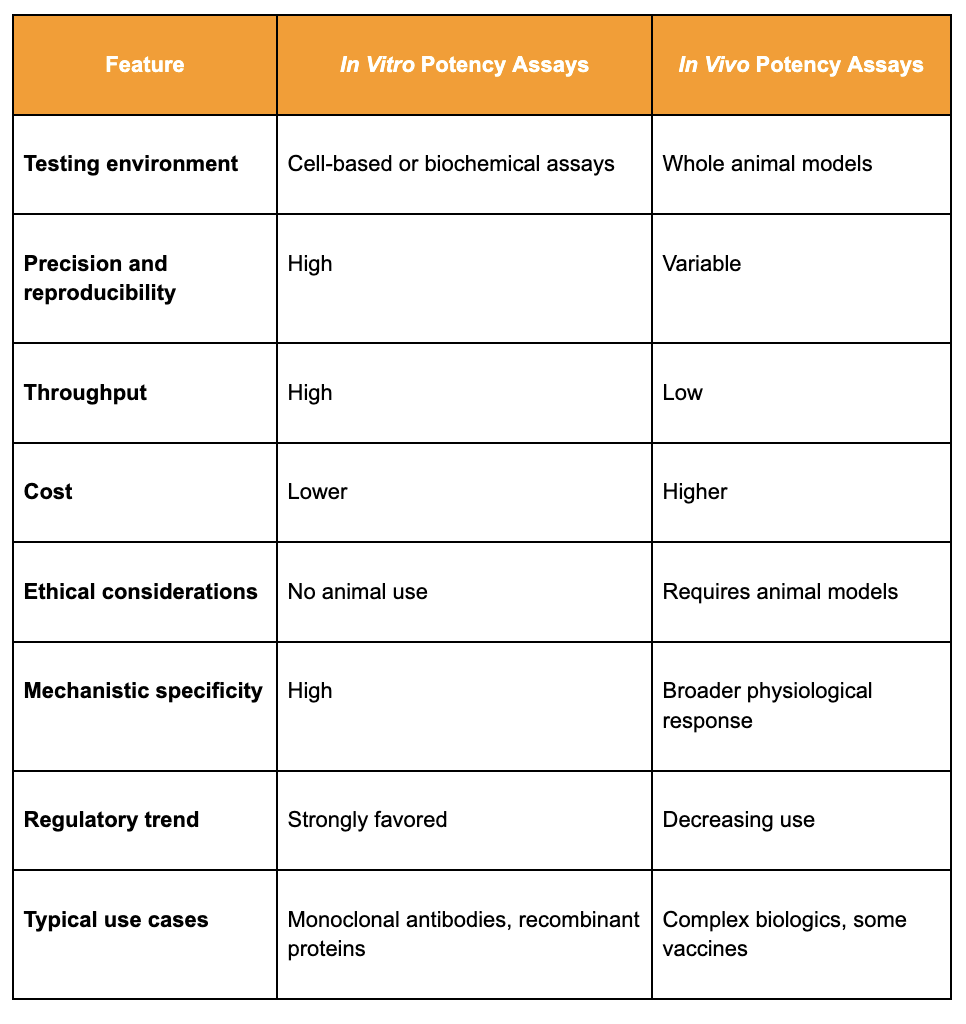
In vitro potency assays are increasingly favored because they offer higher precision, reproducibility, and scalability.
In vivo potency assays historically played a major role but are now used primarily when no reliable in vitro surrogate exists.
Regulatory agencies encourage replacing animal-based potency assays with validated in vitro alternatives whenever possible.
In vitro assays are typically faster, more cost-effective, and easier to standardize.
Some complex biologics, vaccines, or immune-modulating products may still require in vivo functional confirmation.
Why This Comparison Matters Now
Potency testing is a critical component of biologics quality control and regulatory approval. Potency assays measure the biological activity of a drug product and ensure that each batch maintains the expected therapeutic effect.
Historically, many potency tests relied on animal-based in vivo assays, which evaluated biological responses in whole organisms. While these assays can capture complex physiological effects, they are often variable, slow, and resource-intensive.
Advances in analytical biology and cell-based assays have enabled the development of in vitro potency assays that measure specific mechanisms of action under controlled laboratory conditions. Regulatory agencies now strongly encourage replacing animal-based potency assays with validated in vitro alternatives whenever scientifically feasible.
As biologics and cell therapies become more complex, developers must determine which potency strategy best reflects the product’s mechanism of action while meeting regulatory expectations.
 Mechanistic Differences
In vitro potency assays typically measure a specific biological mechanism associated with the drug’s activity. These assays may include receptor binding, signal transduction, enzyme activity, or cell-based functional responses.
Because they isolate a defined biological pathway, in vitro assays can provide highly reproducible measurements of drug potency and are easier to standardize across laboratories and manufacturing sites.
In vivo potency assays, by contrast, measure biological effects in living organisms. This can capture complex physiological interactions that cannot always be reproduced in vitro, but it also introduces variability due to differences in animal physiology and experimental conditions.
Manufacturing and Operational Considerations
From an operational perspective, in vitro assays offer several advantages:
faster turnaround times
higher throughput testing
lower costs
improved reproducibility
These characteristics make them particularly well suited for routine batch release testing in commercial manufacturing.
In vivo assays, however, can require longer experimental timelines, specialized facilities, and careful control of animal welfare protocols. These factors increase both operational complexity and cost.
Regulatory and Quality Implications
Regulatory agencies increasingly advocate for reducing or eliminating animal testing when possible. Modern regulatory guidance encourages developers to adopt mechanism-based in vitro potency assays that directly reflect the product’s mode of action.
However, regulators may still require in vivo assays if no validated in vitro test can adequately capture the drug’s biological activity.
In practice, many development programs begin with in vivo assays but transition to in vitro methods as mechanistic understanding improves.
Best Fit by Use Case
In vitro potency assays are generally preferred when:
the mechanism of action is well understood
reliable cell-based models exist
reproducibility and high-throughput testing are required
In vivo assays may be necessary when:
the biological mechanism is complex or poorly understood
no suitable in vitro surrogate exists
whole-organism responses must be evaluated
Verdict: Which Should You Choose?
For most modern biologics, in vitro potency assays represent the preferred regulatory and operational approach due to their precision, scalability, and ethical advantages.
In vivo assays remain important tools for certain complex biologics but are increasingly viewed as bridging or legacy methods that developers aim to replace with validated in vitro assays whenever possible.