
Key Takeaways
AAV (adeno-associated virus) is the dominant vector for many in vivo gene therapies, particularly for liver, retinal, and CNS applications.
Lentiviral vectors integrate into the host genome, enabling stable expression in dividing cells.
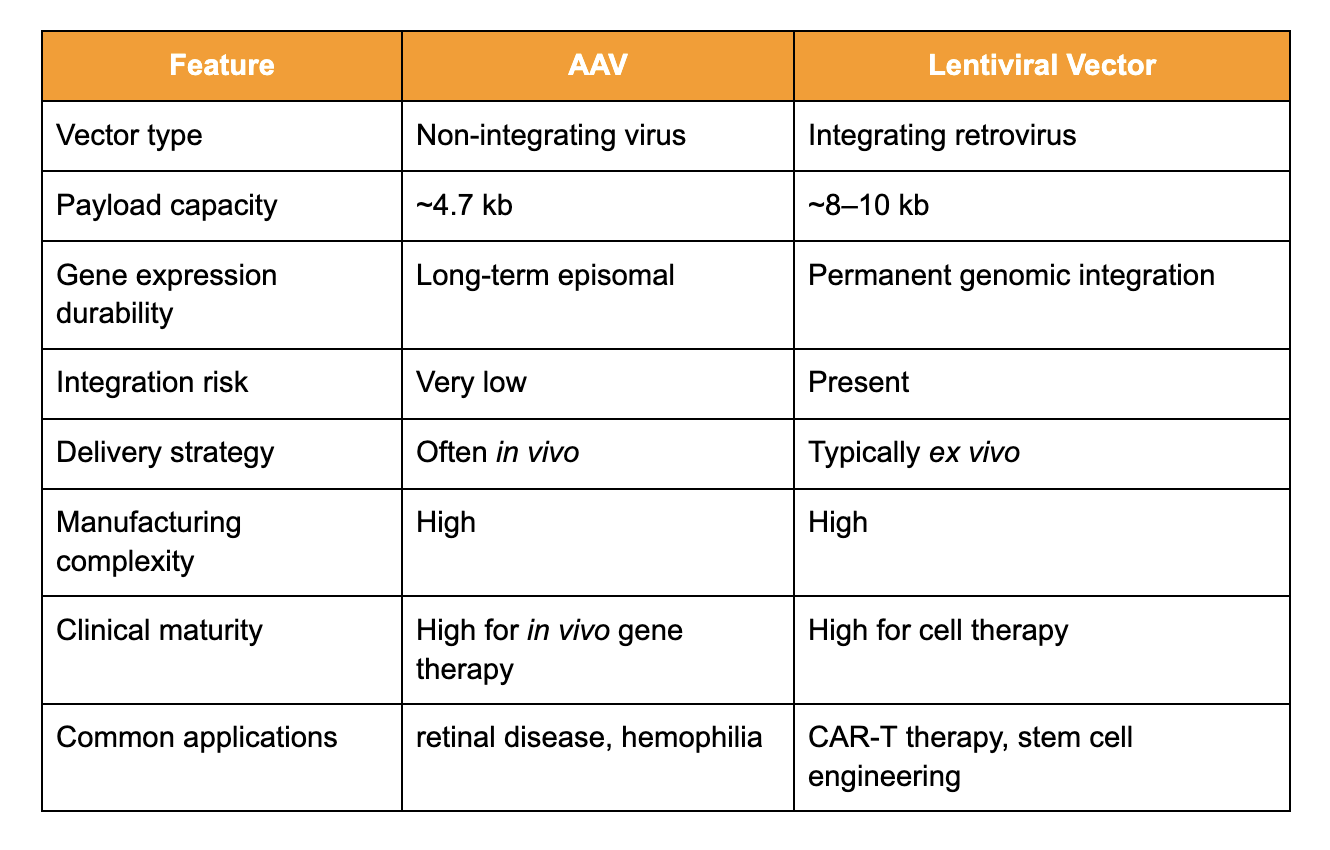
AAV has limited payload capacity (~4.7 kb), while lentiviral vectors can accommodate larger genetic constructs.
Lentivirus is widely used in CAR-T manufacturing and other engineered cell therapies.
AAV is typically used for direct patient administration, whereas lentivirus is commonly used for ex vivo modification of cells.
Why This Comparison Matters Now
Viral vectors remain central to gene therapy development, but different vector platforms serve different therapeutic strategies. Among the most widely used are adeno-associated virus (AAV) and lentiviral vectors.
These platforms differ significantly in how they deliver genetic material, the durability of expression they enable, and their suitability for in vivo versus ex vivo applications. As gene therapies expand into new disease areas, developers must determine which vector platform best aligns with their therapeutic objectives and manufacturing strategy.
 Mechanistic Differences
AAV vectors deliver DNA into the nucleus where it typically remains episomal rather than integrating into the host genome. This allows durable gene expression while minimizing insertional mutagenesis risk.
Lentiviral vectors integrate their genetic cargo into the host genome. This makes them ideal for modifying cells ex vivo because the engineered gene will be stably inherited as cells divide.
However, genomic integration introduces theoretical risks of insertional mutagenesis, which must be carefully evaluated during development.
Manufacturing and Operational Considerations
Both AAV and lentiviral vectors require complex biologic manufacturing processes involving mammalian cell culture and viral particle purification.
AAV manufacturing often faces challenges with capsid assembly, empty/full particle ratios, and large-scale purification. Lentiviral production also presents challenges, including vector stability and efficient large-scale production.
Best Fit by Use Case
AAV is typically preferred when:
the therapy is delivered directly to patients in vivo
long-term expression without genomic integration is desired
target tissues align with known AAV tropisms
Lentiviral vectors are preferred when:
ex vivo cell modification is required
stable genomic integration is necessary
engineered immune cell therapies are being developed
Verdict
AAV vectors dominate in vivo gene therapy, while lentiviral vectors remain essential for ex vivo engineered cell therapies.
The platforms are therefore complementary rather than competing, with each occupying a distinct role in modern genetic medicine.