Key Takeaways: High-Yield Biomanufacturing with E. coli
Efficient Biotherapeutic Production:E. coli remains a primary host for recombinant protein expression due to its rapid growth cycles and cost-effective scalability in biomanufacturing.
Mitigating Inclusion Body Formation: High-yield protein production can be optimized by reducing inclusion bodies through host engineering techniques, including codon optimization, modified expression leader sequences, and the use of weaker promoters.
Overcoming Downstream Bottlenecks: While solubilization and refolding of inclusion bodies present significant technical hurdles, these challenges are currently driving major innovation in downstream processing and bioprocessing technology.
Precision Engineering for Solubility: Strategic selection of genetic elements is essential for balancing protein expression levels with proper folding to ensure high-quality biotherapeutic yields.
Originally Published: July 2024
1 Advances in E. coli Strain Development
1.1E. coli was the first host in which researchers overexpressed a heterologous protein under a controlled induction, and it has been the workhorse of the industry ever since. The same methods used in 1982 are still sufficient to obtain reasonable yields of many recombinant proteins, but advances in strain engineering technologies have vastly expanded the repertoire of E. coli–based products.
1.2 By far the most common host and expression system is the BL21(DE3) host with a pET-based plasmid, induced by isopropyl-beta-d-1-thiogalactopyranoside (IPTG). The molecular basis of this system rests on three key parts:
The host genome of E. coli B strains, which is notable for its lack of a flagellum set of genes and is therefore immobile. B strains usually grow faster and produce less acetate per gram of glucose consumed. B strains also lack the Lon protease, which is a generalist protease that is present in other lineages. Although the Lon deletion is often cited as a reason for increased yields, it has been demonstrated that B strains have an overall protease activity similar to K and W strains. Similarly, the lack of flagella was thought to be a key reason B strains grow faster, but that has also been disproven.
The pET-based plasmids, which are modified from pUC plasmids. The pUC plasmids are a derivative of the naturally-occurring plasmid pBR322. A deletion in the rop gene on pBR322 removes the restriction of replication and increases the overall copy number of pUC and its derivatives.1 Although pBR322 is consistently maintained at about 25 copies per cell, pUC plasmids can achieve over 150 copies per cell. The rop gene, however, also ensures the 25 copies of pBR322 are equally distributed to daughter cells during cell division, whereas pUC-derived plasmids are distributed randomly to daughter cells. On average the daughter cells will receive approximately the same number of plasmids as the parent, but when a toxic gene is carried on a pUC plasmid, selective pressure can rapidly lead to loss of plasmids in a growing culture, and therefore instability of the plasmid in some production cultures.
The T7 promoter under control of lacUV5. The lacUV5 operator sequence from the lac operon induces the T7 promoter upon addition of lactose or the lactose analog IPTG. Note that wild-type lac operon is repressed when glucose is present (even if lactose is present in excess). The lacUV5 mutation allows for maximum induction of the operon even in the presence of glucose.2 T7 is a very strong promoter from bacteriophage T7. In nature, T7 phage production overwhelms the host and kills the cell after a few hours of induction, even when the phage lysis machinery is removed. One disadvantage of a T7-based expression system is that the host cell will usually die after a relatively short induction period, due to the extremely high volumes of RNA made from the promoter.
1.3 The extremely strong expression from the BL21(DE3)/pET system works well for some proteins and allows for very high yields of recombinant protein to accumulate in a production culture. E. coli, however, is notorious for producing misfolded proteins, inclusion bodies, or none of the desired protein at all. At a high level, the disappointing results can be categorized as a result of problems in either transcription, translation, folding, or degradation. These four processes need to be balanced for optimum expression of a heterologous protein. For example, if the transcription rate is very high but the protein cannot be folded very efficiently, proteases may degrade the unfolded peptides and reduce overall yields.
1.4 One reason that a protein may not fold properly or quickly is that the protein needs a disulfide bond. E. coli naturally creates disulfide bonds but performs this biochemistry in the periplasm. If a heterologous protein is expressed without a leader sequence that targets the nascent peptide for secretion to the periplasm, the required disulfide bonds will likely not be formed and the protein will be either degraded or folded into inclusion bodies. Some host strains carry an alternate allele of dsbA, which allows Disbar to form disulfide bonds in the cytoplasm. NEB’s Shuffle® strains are commercially available hosts that contain this mutation and can increase yields of proteins containing disulfides.
1.5 It is a common misconception that E. coli cannot create many disulfide bonds or fold complex proteins. Genentech demonstrated many years ago that E. coli can readily express fully folded, disulfide-bonded antibodies — but only in the periplasm, using a specific combination of promoter, periplasmic leader sequence, and DNA design that balanced the transcription, translation, secretion, and folding capacities of the host. This result demonstrates the power of fine-tuning the E. coli protein production machinery to the heterologous host.3
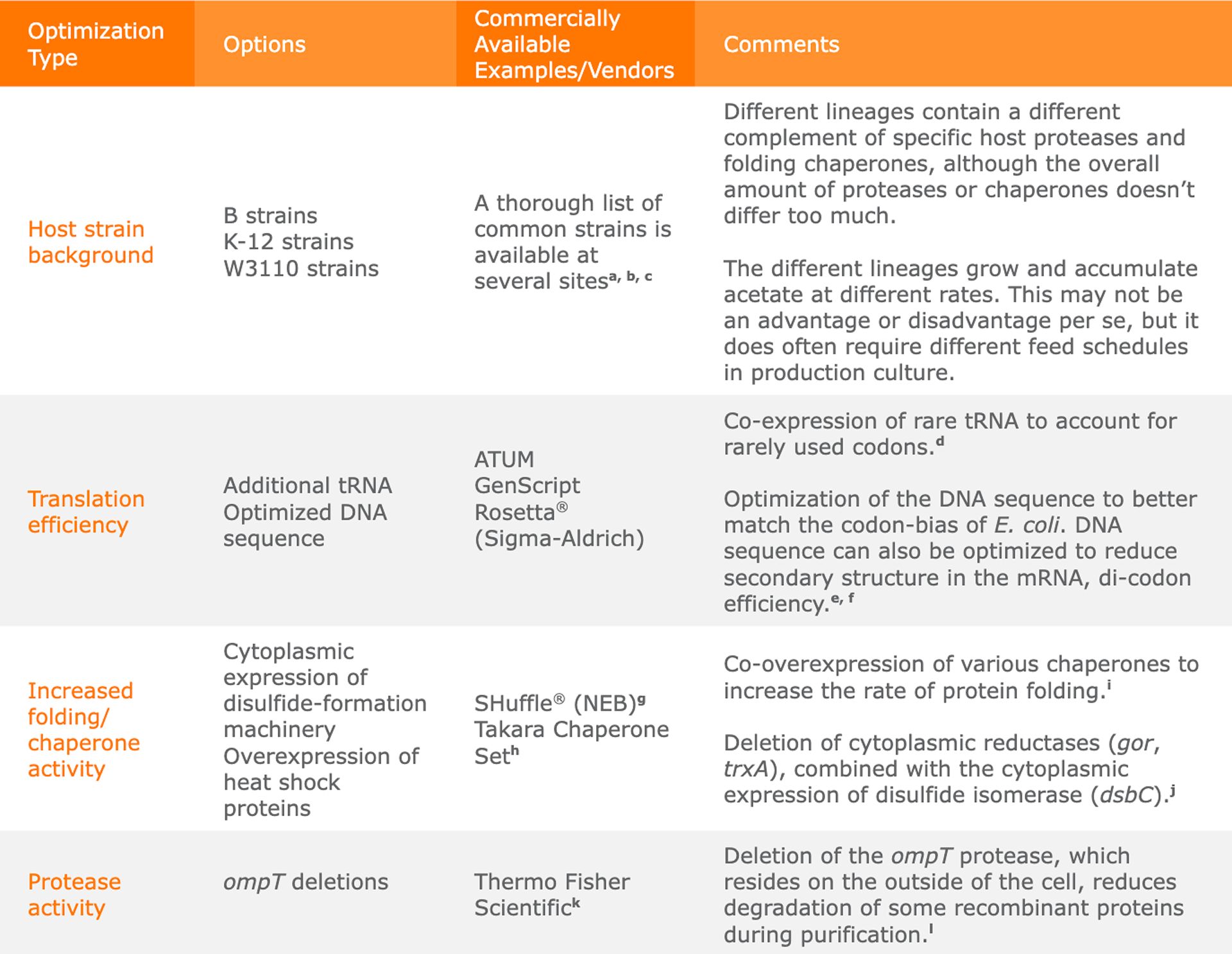
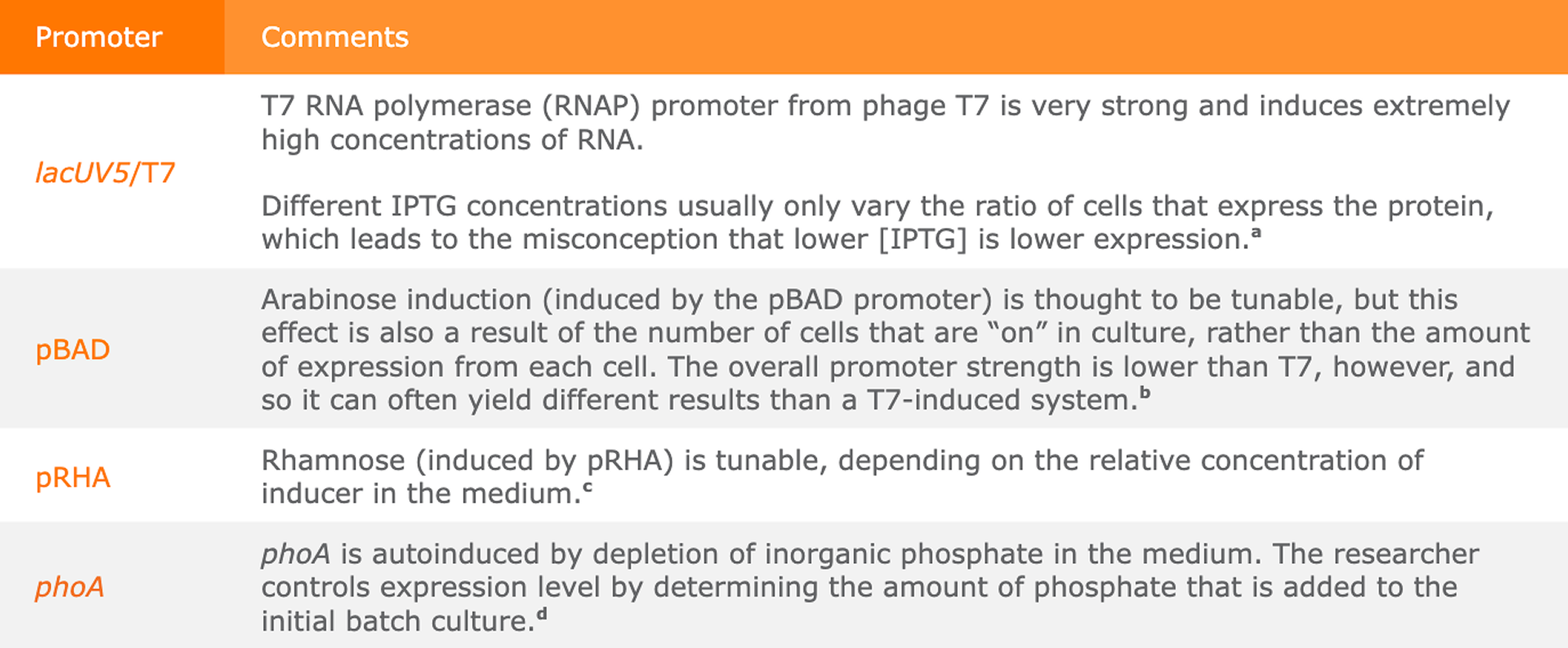
1.6 Table 1 lists some technologies that address the expression challenges at each process and Table 1 lists the most common promoters used for heterologous protein expression. Researchers who are attempting to increase yields of recombinant proteins in E. coli often do not investigate the cause of poor expression results, because it is usually faster and easier to empirically test several combinations of host strain, promoter, and leader sequence at once and then choose the strain with the most promising results.
1.7 After a production strain is created, the cell is cultured in a fermenter to very high cell densities, which can readily achieve >25% solids in well-optimized processes. The key to achieving high cell densities is to optimize the feed schedule so that acetate does not accumulate in the medium. Glucose is the most common carbon source used in industrial production, but glycerol feeds are also employed because E. coli produces acetate from glycerol at a lower rate than it produces acetate from glucose. Feed schedule optimization is often a critical part of E. coli upstream process development, and there are multiple approaches. Feed schedule algorithms are often proprietary among big pharma and CDMOs, but a few academic groups have published extensively on feed schedule optimization, and their work is familiar to many industrial researchers.4–7
Table 1. Selected Common E. Coli Strain Development Strategies
Table 2. Common Promoters for Heterologous Protein Expression in E. coli
References: a20; b21; c22; d23
2 Challenges and Innovation in Refolding
2.1 To refold a denatured protein, the denaturant must be removed. Simple dilution of the denaturant can require extremely large volumes at manufacturing scale. Refolding large volumes of solubilized inclusion bodies presents significant challenges, primarily due to the need for careful control of mixing conditions. For instance, a 1,000-L fermenter yielding 8 g/L of inclusion bodies could require up to a 3,200-L vessel for refolding after dilution. This considerable volume must be mixed quickly and thoroughly to prevent protein aggregation and ensure uniform refolding conditions.24
2.2 Inline mixing can mitigate the need for large refolding tanks by continuously mixing the solution as it flows through the system. This method helps manage volumes more efficiently and reduces the space and equipment required. However, it must be optimized to minimize shear forces, which can damage fragile proteins during refolding. Lower mixing speeds are preferred to reduce shear, but this compromises mixing efficiency and can result in incomplete protein refolding. Proteins are particularly delicate during the refolding process, necessitating a controlled environment to maintain their structural integrity. Shear forces generated by rapid mixing can cause protein denaturation and aggregation, leading to loss of functionality. Thus, balancing mixing speed to achieve thorough mixing without causing damage is crucial.24
2.3 Maintaining constant oxygen levels and temperature is critical for some proteins during refolding. Variations in these parameters can adversely affect protein folding, leading to misfolding or aggregation. Proteins with specific oxygen and temperature requirements need tailored refolding environments to ensure proper folding. For example, some proteins may require aerobic conditions and precise temperature control to achieve their native conformation.25
2.4 To address these challenges, optimization techniques such as response surface methodology (RSM) and design of experiments (DoE) are employed. These methods help identify optimal conditions for refolding by systematically varying and analyzing multiple factors, such as mixing speed, temperature, and oxygen levels. Advanced analytical techniques like infrared (IR) spectroscopy, circular dichroism (CD) spectroscopy, and differential scanning calorimetry (DSC) are used to monitor and evaluate the refolding process, ensuring that proteins achieve their correct structure.25
3 Solubilization of Inclusion Bodies
3.1 As mentioned above, one of the common features of recombinant expression in E. coli is the tendency for inclusion body production. This can simplify purification because they are easier to separate from the majority of host cell proteins, lipids, and DNA by relatively simple washing and centrifugation, but then processing of inclusion bodies has its own challenges, starting with solubilization. The traditional method for solubilizing inclusion bodies involves chaotropic solvents like urea and guanidine hydrochloride. These agents disrupt the non-covalent interactions within protein aggregates, rendering them soluble. However, their harsh nature often necessitates extensive subsequent refolding steps to regain the protein’s native structure. This process is critical for the recovery of functional proteins but is fraught with challenges due to the potential for protein denaturation and aggregation.26
4 Novel Approaches for Inclusion Body Solubilization
4.1 While traditional chaotropic solvents like urea and guanidine hydrochloride are effective for solubilizing inclusion bodies, their harsh nature often complicates subsequent refolding steps. Novel approaches, such as the use of ionic liquids (ILs) and deep eutectic solvents (DESs), offer promising alternatives that can solubilize protein aggregates under milder conditions, preserving native structures and enhancing refolding efficiency. These advancements hold potential for more sustainable and efficient protein production processes in biopharmaceutical applications.24
4.2 Ionic liquids are salts that exist in a liquid state at temperatures below 100 °C. They have gained attention due to their ability to dissolve protein aggregates while preserving native secondary structures. ILs achieve this by preferentially interacting with the proteins, stabilizing their native forms and preventing denaturation. This property makes ILs promising candidates for solubilization processes that require mild conditions. For instance, ILs can replace traditional denaturants like urea or guanidine hydrochloride, reducing the need for harsh chemicals and enabling more gentle protein handling.24
4.3 The unique physicochemical properties of ILs, such as their negligible vapor pressure and tunable solvent characteristics, contribute to their effectiveness in solubilizing proteins. By stabilizing the native-like structures of proteins, ILs minimize the risk of aggregation and enhance refolding efficiency. Furthermore, ILs can potentially reduce the environmental burden associated with protein solubilization processes, as they are recyclable and can be reused multiple times without significant loss of efficiency.24
4.4 Deep eutectic solvents are another class of novel solvents that have been explored for protein solubilization. These solvents are formed by mixing two or more components, typically a hydrogen bond donor and acceptor, resulting in a mixture with a melting point significantly lower than that of the individual components. DESs are considered environmentally friendly and economically advantageous due to their biodegradability and low cost. They have shown promise in stabilizing proteins and maintaining their activity during solubilization.24
4.5 DESs can dissolve protein aggregates while preserving their structural integrity, similar to ILs. The use of DESs in protein solubilization processes can lead to reduced operational costs and lower environmental impact. Additionally, DESs can be tailored to specific protein requirements by adjusting the composition of the solvent mixture, providing a versatile tool for protein chemists.24
5 Tangential Flow Filtration and Purification
5.1 Tangential flow filtration (TFF) is a critical step to concentrate protein solutions after the refolding process, making them suitable for further purification. TFF involves passing the refolded protein solution through a membrane that retains the protein while allowing smaller molecules to pass through. This step effectively reduces the processing volume, facilitating more efficient downstream purification steps.
5.2 Proper selection of TFF membranes and careful control of operational parameters are crucial to the success of this step. The membrane’s pore size must be appropriate for the specific protein being processed to ensure maximum retention while allowing unwanted smaller molecules to pass through. The flow rate and pressure settings need to be optimized to minimize shear stress, which can cause protein aggregation or denaturation. Maintaining low shear conditions is particularly important for preserving the integrity of the refolded proteins and preventing re-aggregation.25
5.3 TFF offers several advantages in the purification process. By concentrating the protein solution, TFF reduces the volume that needs to be handled in subsequent purification steps, such as chromatography. This not only enhances the efficiency of these steps but also reduces processing time and costs. Furthermore, TFF can be used to exchange buffers, which is often necessary to prepare the protein solution for specific purification conditions or storage.
5.4 Despite its benefits, TFF presents certain challenges that must be addressed to ensure optimal performance. Membrane fouling, where the membrane becomes clogged with retained proteins or other molecules, can reduce filtration efficiency and increase processing time. Regular monitoring and maintenance of the TFF system, and use of appropriate cleaning protocols, are essential to mitigate this issue. Additionally, the protein concentration process must be carefully controlled to avoid excessively high concentrations that could lead to aggregation or precipitation.25
6 Analytical Technologies in Refolding
6.1 Process analytical technology (PAT) tools are essential for ensuring the quality and consistency of the protein refolding process. These technologies provide real-time monitoring of critical parameters, such as protein concentration, aggregation state, and folding efficiency, allowing for immediate adjustments to process conditions.25 The real-time data provided by PAT systems enable on-the-fly adjustments, ensuring optimal refolding outcomes. This capability is crucial for maintaining the delicate balance required for successful protein folding, where slight variations in conditions can significantly impact the final product’s quality.25
6.2 The integration of PAT in protein refolding processes leads to significant improvements in product yield and quality. By providing detailed insights into the folding dynamics, PAT tools allow for precise control over the refolding process. This precision reduces the likelihood of protein misfolding and aggregation, which are common issues that can compromise the functionality of the final protein product.25
6.3 PAT tools utilize various analytical techniques to monitor the refolding process. For instance, infrared (IR) spectroscopy can track changes in protein secondary structure, while circular dichroism (CD) spectroscopy provides information on the folding state of the proteins. Differential scanning calorimetry (DSC) measures the thermal stability of the proteins, offering insights into the folding and unfolding transitions. Dynamic light scattering (DLS) assesses the size distribution of protein aggregates, helping to monitor aggregation during refolding.25
6.4 The use of PAT ensures that the refolding process is consistently producing high-quality proteins, leading to more reliable and reproducible results. By minimizing the variability in the refolding process, PAT helps maintain the stringent quality standards required for regulatory compliance.
FAQs:
What are the primary advantages of using E. coli in biomanufacturing?
Answer: E. coli is the preferred Microbial host for Biologics development because it offers unparalleled growth kinetics and a high density of Recombinant Protein yield. Its genetic flexibility allows for rapid Strain Engineering, making it the most cost-effective platform for producing non-glycosylated Drug Substances and fragments at an industrial scale.
How does codon optimization improve protein expression in microbial hosts?
Answer: Codon Optimization enhances Translational Efficiency by replacing rare codons in the transgene with those more abundant in the E. coli tRNA pool. This alignment prevents ribosomal stalling and premature translation termination, ensuring the consistent production of high-quality Recombinant Proteins during large-scale Fermentation cycles.
What is the role of inclusion bodies in recombinant protein production?
Answer: Inclusion Bodies are dense aggregates of misfolded Insoluble Proteins that form during high-rate Expression cycles. While traditionally viewed as a bottleneck, they protect the Biotherapeutic from proteolytic degradation and can be harvested with high purity, provided the Downstream Processing includes effective Solubilization and Refolding steps.
Why are weak promoters sometimes preferred for E. coli expression?
Answer: Weak Promoters are utilized in Biomanufacturing to slow the rate of Protein Synthesis, allowing the host's Chaperone Proteins sufficient time to fold the nascent peptide chains correctly. This metabolic balancing act reduces Inclusion Body formation and increases the ratio of Soluble Protein harvested during the Drug Development phase.
How do leader sequences influence protein secretion in E. coli?
Answer: Leader Sequences, or Signal Peptides, act as molecular zip codes that direct the Therapeutic Protein to the Sec-dependent pathway or TAT pathway. This translocation into the Periplasm provides a more oxidative environment necessary for Disulfide Bond formation, which is vital for the structural integrity of complex Biologics.

 References: a8; b9; c10; d11; e12; f13; g14; h15; i16; j17; k18; l19
 References: a20; b21; c22; d23