Biologics manufacturing depends on maintaining robust, comparable process performance as programs move across facilities, equipment configurations, and scales. Data-driven manufacturing uses connected process data and analytical or modeling tools to monitor performance, predict process behavior, and support earlier intervention. A digital twin is a virtual representation of the manufacturing process that can simulate, analyze, and increasingly interact with its physical counterpart. Together, these capabilities can help identify variability, improve cross-site comparability, and support more predictive and adaptive process control across the product life cycle. As a contract development and manufacturing organization, Samsung Biologics is advancing data-driven manufacturing by integrating standardized facilities, connected process data, multivariate analysis, computational fluid dynamics, mechanistic modeling, and emerging artificial intelligence capabilities. The aim is to improve predictive capabilities, technology transfer, cross-site comparability, and continuous process optimization across its manufacturing network.
From Retrospective Review to Proactive Manufacturing
Biologics processes often need to operate across different manufacturing facilities, equipment configurations, and scales. Even within a standardized network, differences in equipment, automation, environmental conditions, raw-material sourcing, analytical and quality-control methods, and scale can introduce variability that teams must understand and manage.
Traditional approaches frequently evaluate those differences through historical experience, facility-gap assessments, and physical experimentation. Data-driven manufacturing adds a predictive dimension, shifting process oversight from retrospective review toward prediction and proactive intervention. Samsung Biologics applies this approach through digital-twin tools that provide earlier insight into process behavior and enable more informed manufacturing decisions.
Digital twins are central to that transition, but they are not a single model. At Samsung Biologics, the broader digital-twin environment connects manufacturing data with process monitoring, physics-based simulation, multivariate analysis, predictive modeling, and emerging artificial intelligence (AI) capabilities. These tools can support activities from development and facility-fit assessment through technology transfer, commercial manufacturing, troubleshooting, and continuous improvement. Samsung Biologics is extending these digital capabilities across the product life cycle, from development through technology transfer and commercial manufacturing (Figure 1).
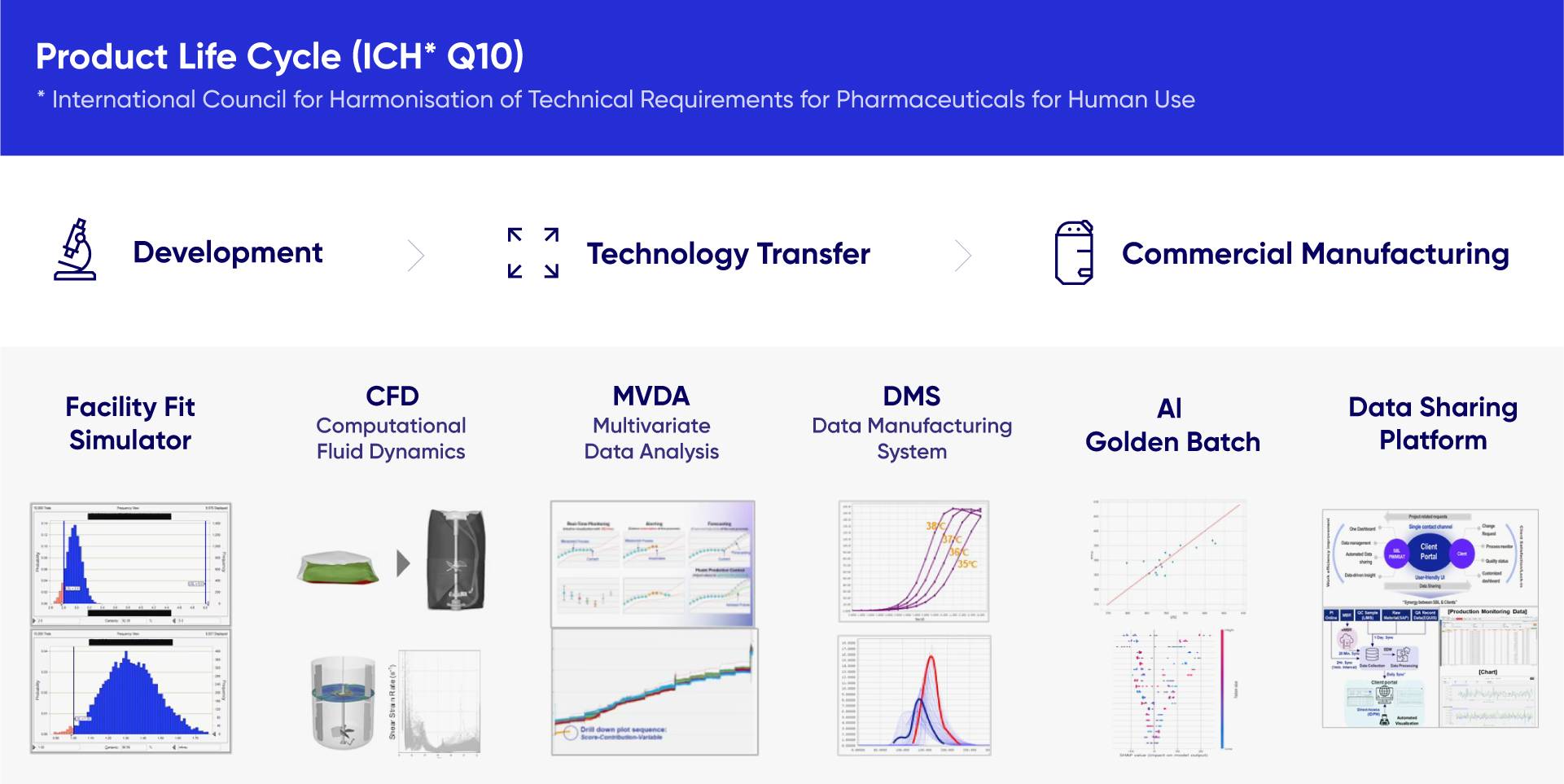 Figure 1. Digital-Twin Capabilities Across the Product Life Cycle. Samsung Biologics digital-twin capabilities across the product life cycle, from development through technology transfer to commercial manufacturing. The framework integrates a facility-fit simulator, computational fluid dynamics for mixing and shear assessment, multivariate data analysis, DMS for bioreactor and chromatography modeling, AI golden-batch modeling, and a data-sharing platform to support process understanding, prediction, optimization, and cross-site manufacturing.
The objective is to transform manufacturing data into earlier, more useful decisions: identifying meaningful differences between facilities, forecasting process behavior, virtually evaluating alternative operating conditions, and intervening before variability creates downstream consequences.
Standardization Creates the Foundation
A cross-site digital manufacturing strategy is more powerful when unnecessary sources of variability have already been reduced. The Samsung Biologics ExellenS™ manufacturing framework provides that foundation through standardized plant engineering and an emphasis on consistency across manufacturing facilities. ExellenS™ helps each successive plant replicate and enhance the performance and dependability of its predecessors, while integrated digital-twin capabilities provide another way to support equivalent process performance across sites.
Standardization does not eliminate every meaningful difference. Equipment dimensions, process scale, operating environments, automation levels, raw-material sources, and analytical methods can still vary among sites. Digital technologies can quantify those remaining differences and determine whether they are likely to affect process performance.
Samsung Biologics complements standardized facility design with unified digital systems, standardized data-collection templates, and analysis tools across plants. The team is also working to introduce more advanced data-collection and analysis capabilities into existing facilities.
The physical and digital layers therefore serve related purposes. ExellenS™ reduces avoidable differences across the manufacturing network, while the digital-twin environment helps identify, understand, and manage the differences that remain. That combination is particularly important when a process must be transferred from one facility or scale to another while maintaining comparable performance.
Connecting Manufacturing Data Across the Product Life Cycle
A useful digital twin depends first on sufficiently rich and contextualized manufacturing data. Samsung Biologics uses both online and offline process information, moving beyond isolated spot measurements toward continuous process data that provide a more complete view of manufacturing behavior.
The Samsung Biologics data architecture connects process and online sensor data, including process parameters, with quality-test results, in-process control data, critical quality attributes (CQAs), batch genealogy, vendor-lot and consumable information, deviations, change controls, and manufacturing records. For process parameters identified as critical, linking them with CQAs and the broader manufacturing context provides a stronger basis for understanding their relationship to product quality. These data feed centralized hubs and an enterprise data warehouse, where information can be organized at the batch, campaign, and product levels for analysis and modeling. Figure 2 illustrates how data from these diverse sources are captured, contextualized, and connected with the client portal, digital-twin tools, and AI systems.
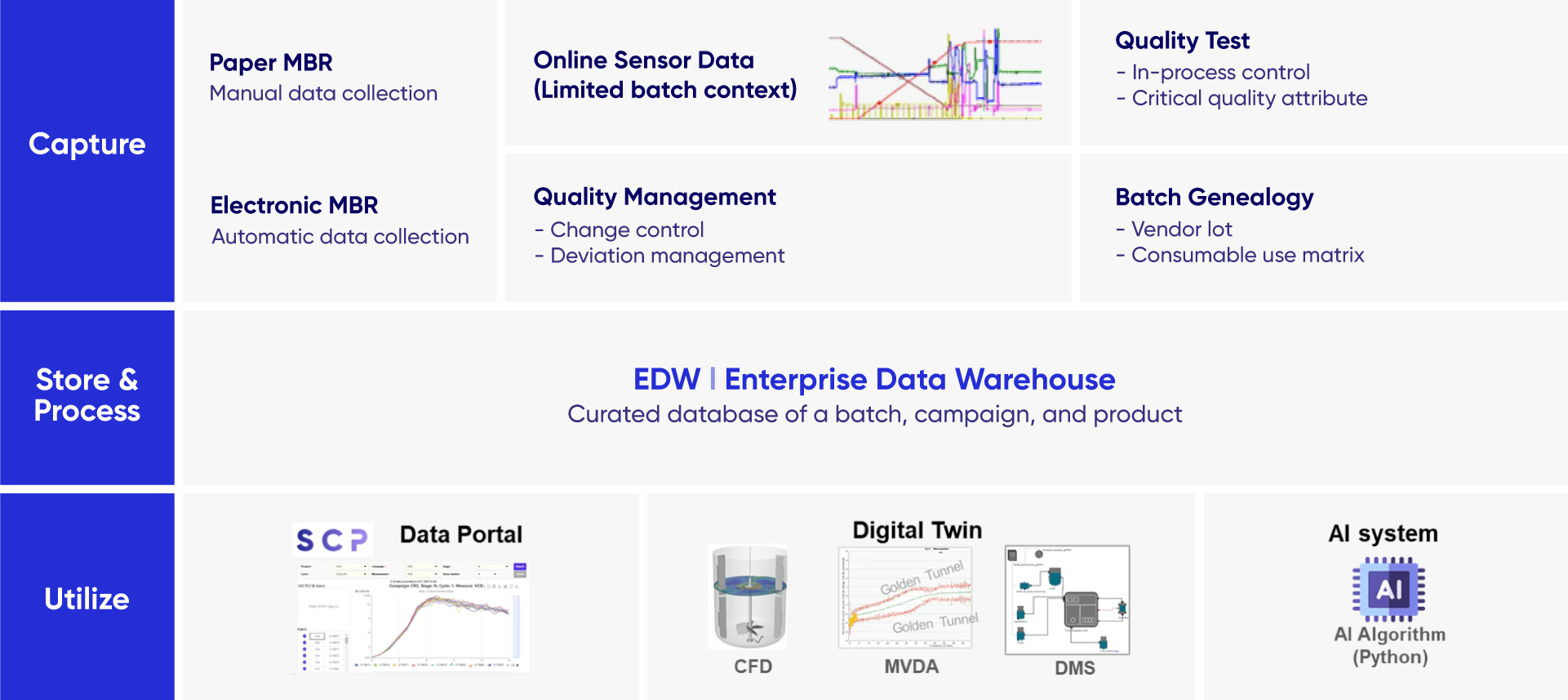 Figure 2. Data-Flow Architecture Supporting Data-Driven Manufacturing. Samsung Biologics data-flow architecture showing manufacturing, process, quality, and batch-context data captured from multiple sources and connected through centralized data systems for use by digital-twin tools, AI models, process-monitoring applications, and client data-sharing platforms.
Context is also critical to making those data useful. A shift in process behavior may be associated with operating conditions, equipment, raw-material lots, process interventions, or other factors. Linking those dimensions gives multivariate and predictive models a more informative foundation for understanding process performance and its relationship to product quality.
Automation is also increasing. In Bio Campus II, digital systems automatically collect and analyze manufacturing data, which can be accessed in real time. Samsung Biologics is working to reduce manual data collection further across the wider manufacturing environment.
The same infrastructure supports client collaboration. Through the Samsung Biologics Client Portal (SCP), authorized clients can access digitalized manufacturing information, QC sample-test data, raw-material data, and quality records on a web-based platform. Real-time access provides a shared information base for faster two-way communication and decision-making with clients.
From Data to Prediction: Multivariate Analysis and Real-Time Process Monitoring
Multivariate data analysis (MVDA) provides a statistical view of manufacturing performance, evaluating multiple variables simultaneously to identify relationships among process inputs and outcomes. By reducing complex, highly correlated process data to a smaller number of multivariate indicators, MVDA enables operators to assess overall process behavior without relying solely on individual parameter trends. Within the Samsung Biologics digital-twin environment, it supports real-time monitoring, anomaly detection, trend analysis, and prediction of preharvest titer, cell viability, and viable cell density.
Rather than evaluating each process parameter independently, multivariate monitoring tracks the combined pattern of multiple variables against expected process behavior as a batch progresses. Samsung Biologics represents this expected multivariate behavior as a “golden tunnel,” which provides a reference for identifying excursions, unusual trends, or inter-site differences that may require investigation.
This type of real-time multivariate monitoring can complement process analytical technology approaches and support a broader process control strategy by helping manufacturing teams identify departures from expected process behavior during a batch.
The value of prediction becomes clearer when it changes what manufacturing teams can do. By predicting key process outcomes before an ongoing batch is complete, MVDA models provide earlier visibility into how it is likely to evolve. Preharvest titer, for example, affects the material load that downstream processing must accommodate. If MVDA predicts a titer outside the expected range, the downstream team can assess in advance whether the existing process design and equipment are sufficient. If not, the team can evaluate and prepare potential equipment or process changes before the downstream operation is delayed.
The manufacturing team therefore does more than identify why an unexpected result occurred. It gains additional time to anticipate what may happen next, understand its potential manufacturing impact, and prepare an appropriate response.
Adding Physics-Based Understanding With CFD
Samsung Biologics currently uses MVDA to identify relationships in manufacturing data and support real-time process monitoring and prediction, while computational fluid dynamics (CFD) characterizes the physical environment that cells and process materials experience and supports facility-fit and scale assessments.
CFD simulates how fluids and gases move and interact within manufacturing equipment. These simulations can assess mixing, mass transfer, gas distribution, flow velocity, shear, and other hydrodynamic factors that may vary with equipment configuration or scale.
CFD formed an important foundation for earlier digital-twin work. It is now increasingly integrated into a broader data-driven architecture in which physics-based simulation can be considered alongside manufacturing data, multivariate trends, and predictive models.
Facility-fit assessment is one important application. Samsung Biologics conducts facility-gap assessments between sending and receiving sites to identify differences that may affect technology transfer. Where the assessment identifies gaps, a CFD model or another appropriate digital-twin tool can add a quantitative basis for evaluating conditions expected to support equivalent process performance, extending the analysis beyond a paper-based equipment comparison.
Virtual evaluation can also help focus physical experimentation on questions that remain unresolved after simulation. Samsung Biologics currently applies CFD primarily to upstream antibody processes and is working to expand its CFD capabilities to additional modalities. For example, CFD can support scale-up assessment of mixing-intensive operations in ADC manufacturing by evaluating how changes in vessel scale, geometry, and operating conditions affect mixing behavior and local process conditions. This physics-based understanding can provide additional quantitative evidence when defining scale-up strategies and identifying conditions that require experimental confirmation.
MVDA and CFD are complementary rather than interchangeable. MVDA can indicate what manufacturing data suggest is happening or is likely to happen, while CFD can help explain how the physical environment within the equipment may contribute to that behavior. Mechanistic what-if models add another dimension by exploring biological and process responses to changing conditions.
Extending Prediction into Process Optimization
A further step beyond prediction is determining which operating conditions are most likely to produce the desired outcome. Samsung Biologics is exploring AI-based modeling to identify influential parameters and favorable operating regions. Unlike the MVDA “golden tunnel” used for process monitoring, the AI golden-batch concept is intended to use historical manufacturing data to evaluate process inputs within established operating ranges and identify a “sweet spot” associated with optimized output.
The model concept evaluates objectives, including drug substance amount, production-bioreactor titer, and step yield. It is intended to rank process features by their influence on the selected objective, identify operating regions that maximize performance while minimizing variance, and surface relationships or potential risks that may not have been captured through traditional analysis. The approach links feature identification with operating-range analysis to identify a process “sweet spot” associated with the desired manufacturing objective (Figure 3).
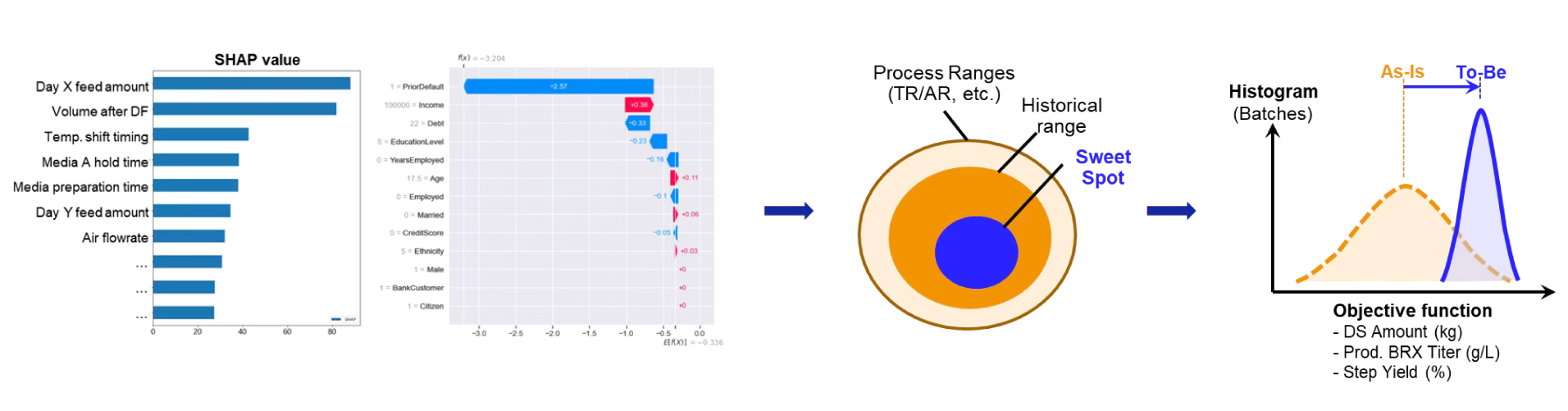 Figure 3. Methodological Framework for AI-Based Process-Parameter Optimization. Samsung Biologics AI-based process-optimization concept. The graphical outputs represent schematic reference templates designed to demonstrate model functionality. This framework illustrates how historical manufacturing data can be evaluated to identify influential process parameters, assess their effects on manufacturing outcomes, and identify an operating “sweet spot” intended to maximize performance while minimizing variability.
Historical manufacturing data thus become a basis not only for predicting future behavior but also for identifying operating conditions that could improve performance.
Reliable data are essential to that objective. Model development requires process data from more than two batches, and at least 30 data points are generally sought to improve model accuracy. Minimizing unnecessary process variability before modeling provides a stronger basis for accurate prediction.
De-Risking Technology Transfer Across Sites and Scales
Within the pharmaceutical product life cycle described in the International Council for Harmonisation (ICH) Q10 guideline, technology transfer connects development with commercial manufacturing and brings the value of complementary digital tools into sharp focus. Physical differences between sending and receiving facilities can require teams to reassess operating conditions even when the underlying process remains unchanged.
Samsung Biologics combines conventional facility-gap assessment with virtual evaluation. CFD can characterize physical differences associated with equipment and scale, while process data and predictive analytics provide additional information about expected process behavior. This approach concentrates physical studies on uncertainties that remain after virtual assessment, rather than relying on experimentation as the sole means of evaluating every difference.
Samsung Biologics operates bioreactors at multiple scales, with corresponding differences in physical dimensions. In one cross-site case, the same product was manufactured in two facilities at different scales. The team applied a previously verified CFD model to compare parameters, including mass-transfer coefficient, shear strain rate, air-volume fraction, and flow velocity, between the two environments.
The analysis provided a basis for understanding those hydrodynamic differences and selecting operating conditions expected to support comparable performance. The goal was not to make the vessels physically identical but to identify conditions that could deliver equivalent performance across bioreactor scales despite differences in physical dimensions.
The example also shows how a verified CFD model built from prior experience can be applied to a cross-site transfer assessment. This approach aligns with Samsung Biologics’ broader emphasis on agile technology transfer, rapid scale-up, and faster time-to-market.
Turning Manufacturing Data into More Consistent Performance
During commercial manufacturing, ongoing analysis of process data can support continued process verification and continuous improvement by helping teams identify trends, investigate variability, and assess process performance over time. Digital tools can make that analysis more timely and actionable.
In one case study, process monitoring detected repeated patterns in preharvest titer. Machine-learning analysis identified the process factors exerting the greatest influence. Set points were then refined within acceptable limits, after which titer stability improved without adversely affecting product quality.
A related analysis addressed variation in final product amount. The team examined contributors to that variability across the process flow, and targeted corrective actions reduced batch-to-batch variation. The resulting improvement in product-quantity consistency facilitated downstream planning. Figure 4 summarizes the two applications, pairing preharvest titer monitoring and prediction with analysis of the factors contributing to product-volume variability.
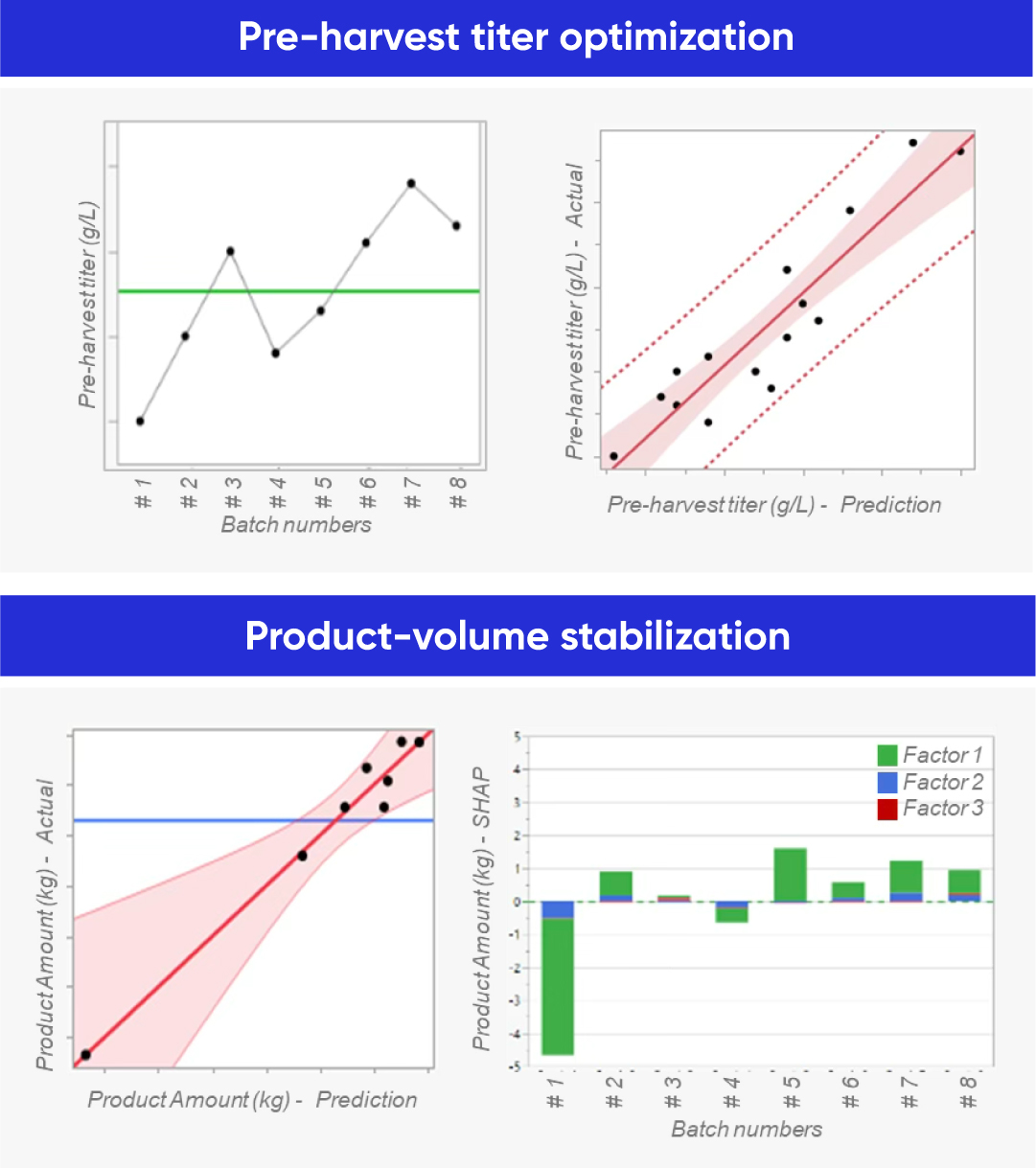 Figure 4. Machine Learning-Enabled Titer Optimization and Product-Volume Stabilization. Samsung Biologics case-study graphics showing preharvest titer optimization and product-volume stabilization. Process monitoring and predictive modeling are used to identify batch-to-batch patterns and influential factors, supporting set-point refinement, improved titer stability, reduced product-volume variability, and more consistent manufacturing performance.
These examples illustrate a practical workflow: continuous monitoring reveals a pattern, multivariate or machine-learning analysis identifies influential factors, teams evaluate targeted changes, and subsequent manufacturing data indicate whether performance becomes more stable.
The model used to address batch-to-batch variation is now being applied at additional sites, a concrete example of how a digital solution developed around one manufacturing challenge can be extended across the wider manufacturing network.
Toward Predictive and Adaptive Manufacturing
The longer-term direction extends beyond real-time monitoring and prediction toward increasingly adaptive process control. A digital manufacturing system represents a potential next step toward autonomous control through real-time interaction between virtual and physical manufacturing equipment.
Separately, Samsung Biologics has developed mechanistic what-if simulation models for upstream and downstream manufacturing scenarios. Its upstream models address conditions involving pCO2, titer, viable cell density, viability, and metabolites, while downstream applications include yield optimization and reduced experimental requirements. These simulations can evaluate technology-transfer scenarios, process risks, and potential operating strategies before teams commit to physical changes.
The broader architecture points toward increasingly tight integration among manufacturing data, digital models, and physical operations. Within it, MVDA supports real-time monitoring and prediction; CFD contributes physics-based understanding of equipment and scale; mechanistic simulations enable what-if analysis; and AI models can identify potentially favorable operating regions. Ultimately, Figure 5 illustrates this conceptual framework, showing how physical and virtual bioreactors can be linked through complementary modeling capabilities to enable real-time process interaction.
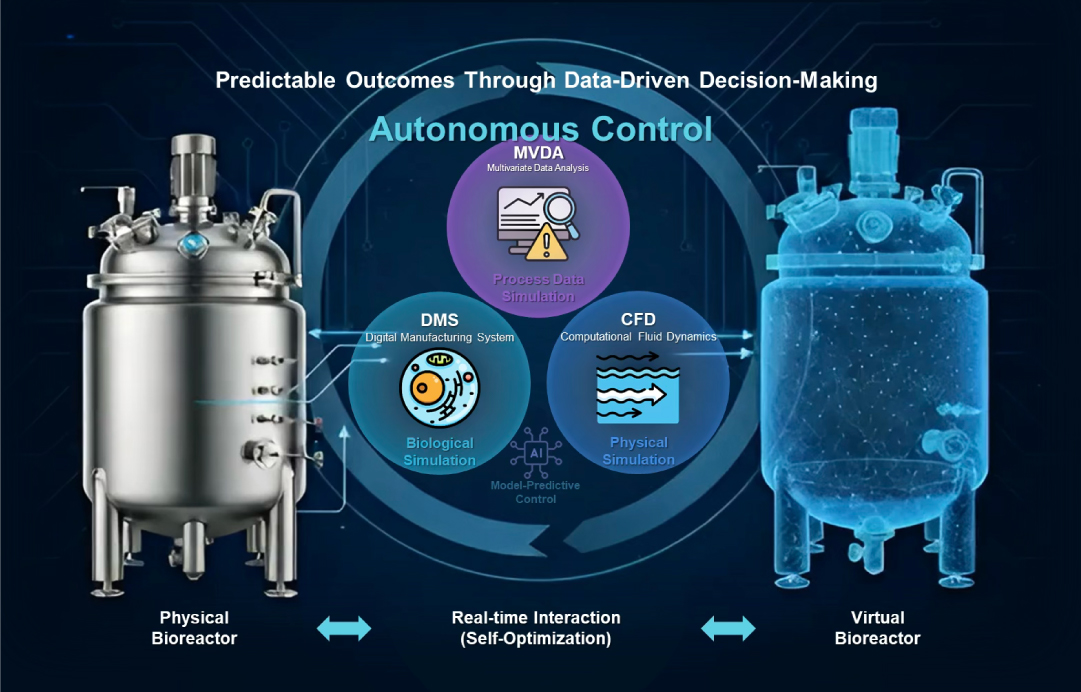 Figure 5. Conceptual Architecture of the Samsung Biologics Bioprocess Digital Twin. Conceptual illustration of Samsung Biologics bioprocess digital twin linking a physical bioreactor with a virtual bioreactor through real-time data interaction. The architecture combines multivariate data analysis, computational fluid dynamics, and other digital models to support prediction, process optimization, and the longer-term objective of increasingly autonomous process control.
The progression is from retrospective review to real-time prediction, from prediction to proactive intervention, and from intervention toward optimization and, ultimately, autonomous process control. Within a standardized multisite network, each step can make manufacturing knowledge more transferable.
Data-driven manufacturing is therefore built on integrating these capabilities across the manufacturing life cycle. ExellenS™ establishes a standardized manufacturing foundation, complemented by connected digital systems and data. MVDA, CFD, mechanistic modeling, and emerging AI approaches turn those data into prediction, physical understanding, and optimization. As these capabilities become increasingly integrated, the digital twin can evolve from a means of observing and simulating manufacturing toward more predictive and adaptive process control. This integrated digital-twin approach is associated with continuous improvement, predictable outcomes, streamlined processes, speed-to-market, and data-driven insights (Figure 6).
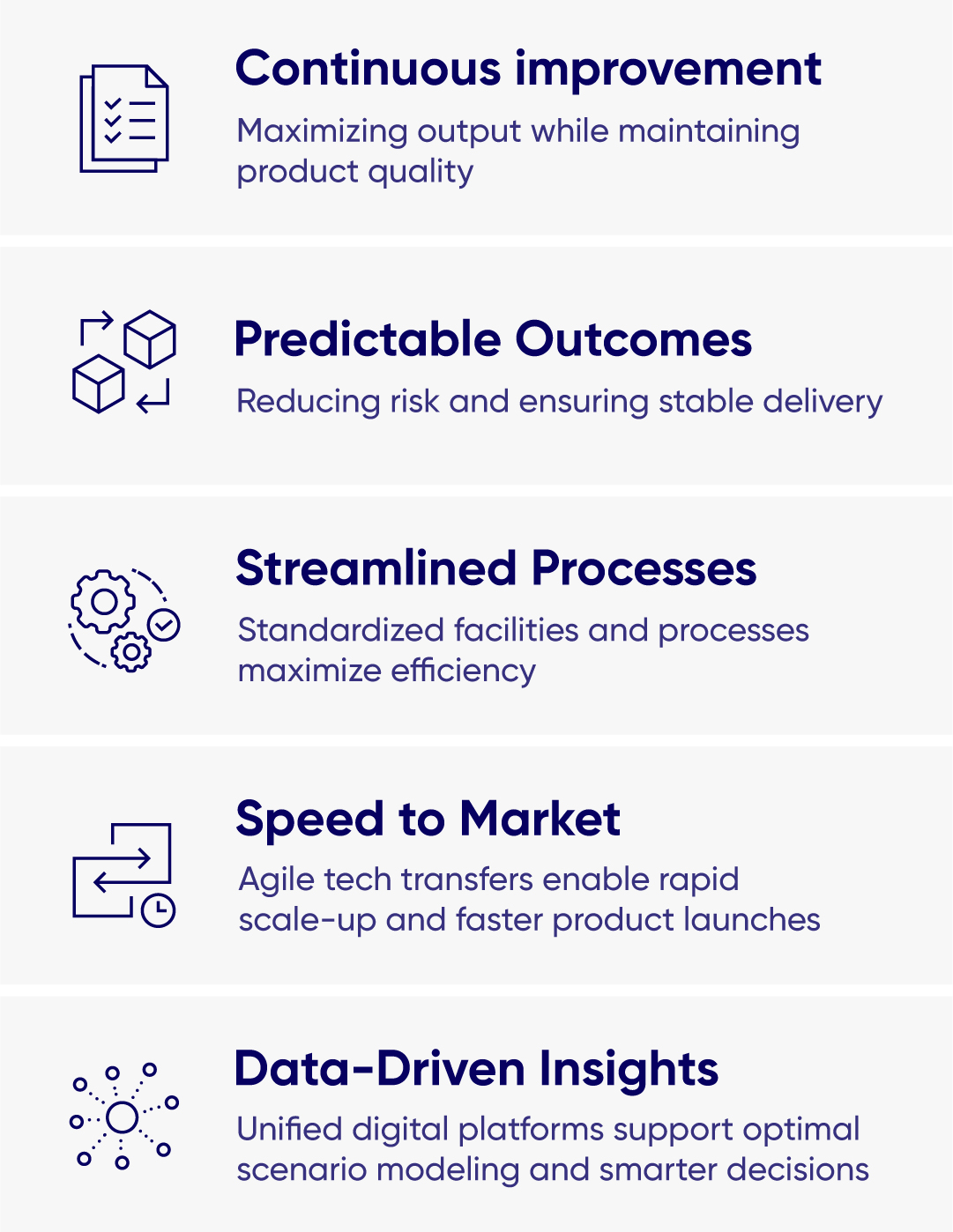 Figure 6. Five Key Advantages of Samsung Biologics’ Digital-Twin Approach. Five benefits associated with Samsung Biologics’ integrated digital-twin approach: continuous improvement, predictable outcomes, streamlined processes, speed-to-market, and data-driven insights, supported by standardized manufacturing, digital platforms, predictive modeling, and cross-site process optimization.