
Key Takeaways
AAV vectors enable durable gene expression but are constrained by payload size and redosing limitations.
Non-viral delivery systems offer greater flexibility, scalability, and compatibility with gene editing technologies.
Manufacturing complexity and cost remain major differentiators, favoring non-viral platforms.
Immunogenicity and repeat dosing are key challenges for AAV, while delivery efficiency remains a challenge for non-viral systems.
Platform selection should be driven by payload size, durability requirements, dosing strategy, and scalability needs.
Why This Comparison Matters Now
Gene delivery has emerged as one of the defining constraints — and opportunities — in modern therapeutic development. While adeno-associated virus (AAV) vectors have enabled several landmark gene therapies, a rapidly expanding class of non-viral delivery systems, including lipid nanoparticles (LNPs), polymeric carriers, and electroporation-based approaches, is reshaping the landscape.
This shift is driven by a convergence of scientific and commercial pressures. AAV vectors, though highly efficient, are limited by payload size, immunogenicity, and challenges with repeat dosing. At the same time, non-viral systems offer greater flexibility and scalability, particularly for emerging modalities such as gene editing and RNA therapeutics.
As a result, developers are increasingly faced with a critical strategic decision: which delivery platform best aligns with the therapeutic mechanism, target tissue, and life cycle strategy of a given program.
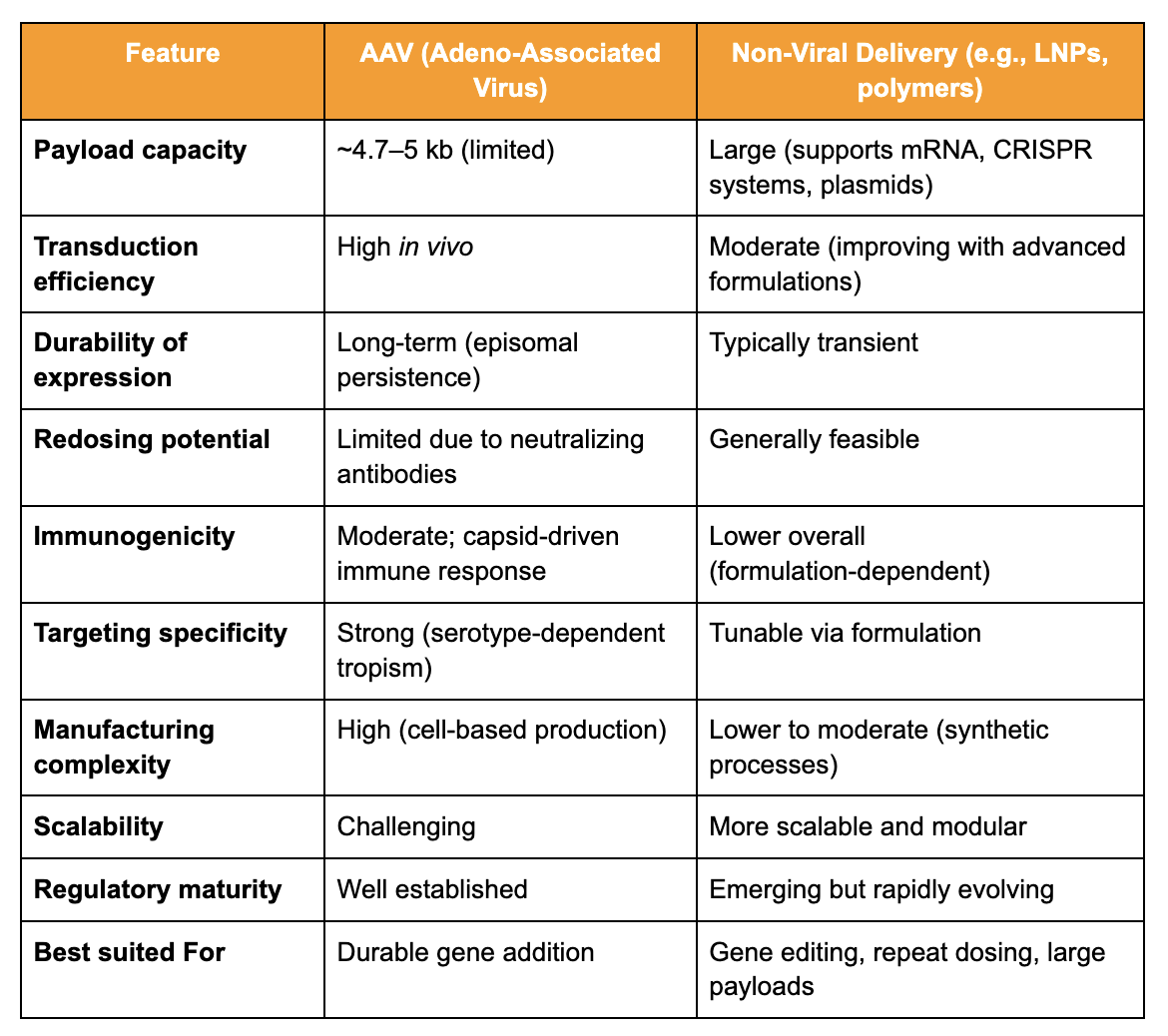 Key takeaway: The comparison is not binary: each platform reflects a fundamentally different therapeutic philosophy.
Mechanistic Differences
AAV vectors are engineered viral systems that leverage the natural ability of viruses to infect human cells and deliver genetic material. Once inside the nucleus, AAV-delivered DNA typically persists as episomal concatemers, enabling sustained gene expression without integrating into the host genome.
Non-viral delivery systems, by contrast, rely on synthetic or physical mechanisms. LNPs, for example, encapsulate nucleic acids and facilitate uptake through endocytosis, while polymer-based carriers and electroporation approaches enable intracellular delivery without viral infection pathways.
This distinction has important consequences:
Viral vectors inherently possess high transduction efficiency, reflecting their biological origins
Non-viral systems offer greater design flexibility, but often require optimization to overcome delivery barriers
In most cases, non-viral approaches result in transient expression, particularly when delivering RNA payloads or gene-editing components.
Manufacturing and Operational Considerations
From a manufacturing perspective, AAV and non-viral systems represent two fundamentally different paradigms.
AAV Manufacturing
AAV production relies on complex, cell-based systems, typically involving transient transfection of mammalian or insect cells, followed by multi-step purification processes. These workflows introduce variability and scalability challenges, particularly when separating full and empty capsids.
As a result, AAV manufacturing remains:
resource-intensive
difficult to scale
associated with high cost of goods
Non-Viral Manufacturing
Non-viral systems (particularly LNPs) are produced using chemical or microfluidic processes, enabling greater consistency and scalability.
Advantages include:
rapid production timelines
platform-based manufacturing
easier tech transfer across programs
This difference has significant implications for commercialization, especially as gene therapies move toward larger patient populations and chronic indications.
Regulatory and Clinical Implications
AAV vectors benefit from a relatively mature regulatory foundation, with multiple approved therapies demonstrating long-term efficacy across indications, such as retinal disease and spinal muscular atrophy.
However, key limitations remain:
immune responses to viral capsids
inability to redose due to neutralizing antibodies
dose-related safety concerns
Non-viral systems, while newer in gene therapy, are supported by regulatory experience from RNA therapeutics and vaccines. These platforms are increasingly attractive for:
repeat-dose regimens
transient or controllable expression
gene editing applications
Importantly, regulators are becoming more comfortable with non-viral delivery as clinical data accumulates, particularly in RNA-based therapies.
Best Fit by Use Case
AAV is generally preferred when:
Long-term or potentially curative expression is required
The therapeutic gene fits within size constraints (~5 kb)
A single-dose treatment is desired
Established tissue tropism (e.g., liver, CNS, retina) can be leveraged
Non-viral delivery is often preferred when:
Large or complex payloads are required (e.g., CRISPR systems)
Repeat dosing is necessary
Transient expression is sufficient or advantageous
Manufacturing scalability and cost are critical
Platform flexibility is needed across multiple programs
Notably, non-viral systems are increasingly enabling applications that are not feasible with AAV, particularly in gene editing.
Verdict: Which Should You Choose?
There is no universally superior platform: only platforms that are better aligned with specific therapeutic goals.
Choose AAV when durability and one-time treatment are the primary objectives, and payload size is not limiting.
Choose non-viral delivery when flexibility, repeat dosing, or large genetic payloads are required.
In practice, the field is moving toward a complementary model, where AAV and non-viral systems coexist as distinct but synergistic tools in the gene therapy toolbox.