Key Takeaways
Drug–device combination products are expanding rapidly. Growing use of self-administered therapies—particularly GLP-1 drugs delivered through prefilled syringes and autoinjectors—is driving strong market growth, with the sector projected to approach $380 billion by 2030.
Combination products can improve treatment convenience, adherence, and outcomes. By integrating drugs with optimized delivery systems, DDCPs can simplify therapy, support at-home administration, enable targeted drug delivery, and address unmet clinical needs.
Advanced technologies are transforming drug delivery. Digital tools, connected devices, wearable injectors, and emerging intelligent drug delivery platforms are enabling more responsive, personalized treatment approaches.
Development requires integration across disciplines. Successful DDCP programs must align drug formulation, device design, analytical development, regulatory strategy, and manufacturing processes through coordinated cross-functional workstreams.
Partnerships and infrastructure investment are expanding rapidly. Collaborations among drug developers, device companies, and CDMOs—along with major industry investments—reflect growing demand for integrated drug–device development and manufacturing capabilities.
What Qualifies as a Drug–Device Combination Product?
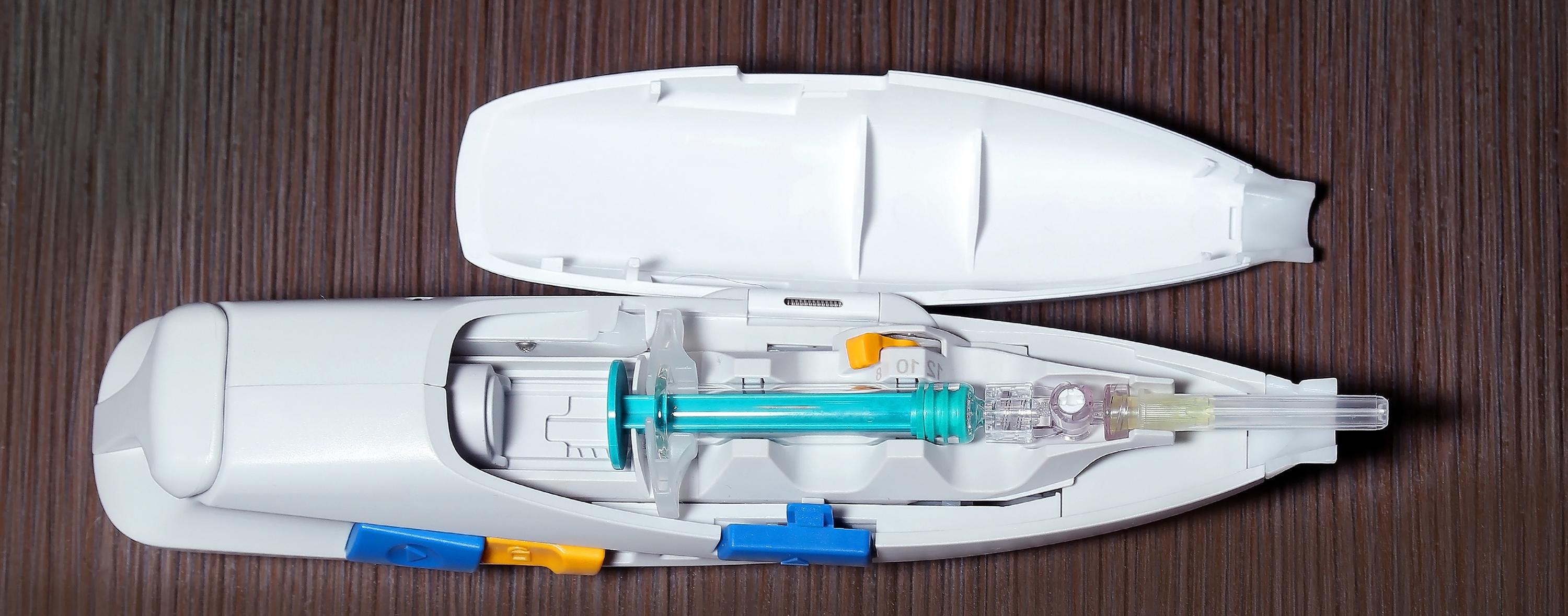
Drug–device combination products (DDCPs) encompass a wide range of formats, but all share a defining feature: they integrate both a medical device and a therapeutic or diagnostic agent within a single product or coordinated system.1–3 Some DDCPs are integrated products in which the drug and device are physically combined. Implantable drug-delivery systems, such as drug-eluting stents are well-known, examples, as are prefilled syringes, autoinjectors, transdermal patches, and drug-containing inhalers.
Other DDCPs are co-packaged, meaning that the drug and device components are supplied together but remain distinct. Surgical trays that include both devices and antimicrobial solutions are one example. Cross-labeled combination products represent another category. In these cases, the drug and device are marketed separately but are specifically labeled to be used together. Some cross-labeled products also involve digital components, such as software that recommends dosing of a particular drug and requires corresponding label updates for that therapy.
Regardless of format, each DDCP is defined by a primary mode of action (PMoA) — the mechanism expected to provide the greatest therapeutic effect. The PMoA determines how the product is classified and which regulatory pathway will apply.
Autoinjectors Driving Growth in Drug–Device Combination Market
Given the many possible formats of DDCPs, it is not surprising that several different technologies are contributing to market growth. Among them, prefilled syringes and autoinjectors have emerged as particularly important drivers due to their ability to support convenient at-home administration.4 This trend is especially evident in the expanding use of glucagon-like peptide-1 (GLP-1) therapies for diabetes and weight management, many of which rely on user-friendly injection devices designed for self-administration.5
Broader epidemiological trends are also contributing to market expansion. The rising prevalence of chronic conditions, including cancer, cardiovascular disease, and respiratory disorders, continues to increase demand for therapies that can be delivered conveniently and reliably outside traditional healthcare settings.2,4
Reflecting these dynamics, the global DDCP market is projected to grow at a compound annual growth rate of 7.7–9.1%, increasing from $243.02 billion in 2025 to approximately $379.17 billion by 2030.4
The Value Proposition of Combination Products
The wide range of DDCPs and their applications translates into a similarly broad set of benefits for drug developers, patients, caregivers, and healthcare systems. At a basic level, integrating a drug with its delivery mechanism often simplifies treatment and improves convenience for patients.2
Implantable devices that release drugs over extended periods can reduce treatment burden while ensuring consistent and timely dosing.1 These systems may also enable more targeted drug delivery, which can help limit systemic exposure and reduce side effects, both of which contribute to improved patient outcomes.
Prefilled syringes and autoinjectors offer another set of advantages. By enabling patients to administer therapies themselves at home or while traveling, these devices support greater adherence while reducing the likelihood of dosing errors. They can also play an important role in life cycle management strategies for drug sponsors.6
More broadly, DDCPs create opportunities to address unmet medical needs by enabling therapies that would be difficult to deliver effectively through conventional formulations or administration methods alone.7
Smart Technologies Transforming Drug Delivery
Many of the newest DDCPs entering the market or advancing through clinical development incorporate increasingly sophisticated technologies, particularly digital capabilities.2 Smart drug delivery systems, such as wearable injectors (on-body devices) and connected inhalers, integrate artificial intelligence (AI) and the Internet of Things (IoT) to enable real-time monitoring of patient health indicators and support dose adjustments when appropriate.8
Digital functionality is also being combined with advances in materials science and device engineering to create new categories of combination products. Emerging platforms include intelligent and miniaturized drug delivery devices (IMDDDs), which can detect physiological changes and release therapeutic agents in response to specific biological signals.9 These systems are designed to deliver drugs at precise locations and with tightly controlled pharmacokinetics, opening new possibilities for more responsive and personalized treatment approaches.
Regulation at the Intersection of Drugs and Devices
Securing regulatory approval for DDCPs requires developers to satisfy requirements for both the drug and device components. In practice, this often means managing parallel regulatory and compliance activities across two traditionally distinct frameworks. At the same time, widely accepted best practices for applying quality-by-design principles specifically to final combination products are still evolving.10 Developers must also establish the appropriate regulatory pathway by identifying the product’s PMoA and determining its classification.8
Beyond demonstrating the safety, efficacy, and quality of both components, DDCP developers must also show that the product can be used safely and effectively by patients or healthcare providers. This typically involves incorporating human factors engineering into device design, applying risk-based development strategies, and conducting formal usability studies.11 In addition, developers must evaluate how the drug formulation may affect device performance — and how the device may influence drug stability, delivery, or dosing accuracy.12
Global regulatory complexity adds further challenges. Requirements are not fully harmonized across regions, and guidance continues to evolve as regulators gain experience with increasingly sophisticated combination products.12 When therapies receive accelerated approvals, developers may also be required to conduct post-marketing studies to confirm safety and effectiveness under real-world conditions.7
The emergence of newer platforms, including wearable delivery systems and digitally enabled products, introduces additional regulatory uncertainty. These technologies may require regulators and developers alike to adopt more flexible approaches as existing frameworks adapt to new types of integrated therapies.7,12 While some agencies have introduced initiatives intended to streamline approval pathways and encourage innovation, developers must still maintain rigorous design control systems that support compliance across the entire product life cycle. Such systems must address planning and design activities through development and product realization while documenting key elements including risk management, design verification and validation, design transfer, human factors data, manufacturing processes, and labeling.6
Where Drug Development Meets Device Engineering
Developing novel drugs is already a demanding process. When drug development must proceed alongside — and ideally in close coordination with — device engineering, the complexity increases significantly. Even terminology can create early obstacles. Terms that appear straightforward, such as primary packaging, may carry very different meanings in pharmaceutical versus device development contexts, creating potential misalignment between teams if not clarified early.6
Compatibility between the formulation and the device is another critical consideration.8,13 Drug formulations must be designed with the device in mind, and device specifications must account for the physical and chemical characteristics of the drug product. For example, selecting the appropriate needle size becomes especially important when delivering high-concentration, highly viscous parenteral formulations through prefilled syringes.6 The final combination product must also tolerate sterilization processes while maintaining stability during storage and transport. In some cases, dual-chamber DDCP designs are used to address stability challenges by storing the drug substance and diluent separately until the moment of administration.
Testing requirements for DDCPs are correspondingly more demanding than for drugs or devices alone. Developers must characterize the attributes of both components and evaluate how they interact, while analytical requirements evolve as programs progress through development stages.
Given this complexity, many developers now adopt a more holistic development strategy. Drug formulation, device engineering, analytical development, regulatory planning, and manufacturing considerations must be coordinated through integrated workstreams with clear cross-functional alignment around critical quality attributes and regulatory expectations.14 Early tools, such as proof-of-principle (PoP) test rigs, can generate data that inform both formulation and device design decisions, enabling teams to identify potential issues earlier in development. Combining such tools with a data-driven approach can accelerate optimization while strengthening the regulatory foundation for the final product.15
Manufacturing introduces additional challenges. Many DDCP production processes require custom equipment capable of integrating drug filling with device assembly.8 Automation systems commonly used for pharmaceutical manufacturing are typically designed to handle standardized vial formats, whereas combination products often involve more complex geometries and assembly requirements.16 Sealing operations may also be more intricate than the capping processes used for traditional vial presentations, and some steps may still require manual intervention.
Selecting manufacturing equipment early in development can help mitigate these risks. When the equipment used to produce early clinical materials closely reflects the intended commercial process, developers can avoid bridging studies, additional stability testing, and manufacturing requalification later in development.14 Although early investment may increase upfront costs, it can ultimately support scalable, robust manufacturing processes that are better aligned with the final product design.
Organizational and Human Challenges
The highly integrated nature of DDCP development requires attention not only to technical hurdles but also to organizational and personnel considerations.13 Because development activities span multiple disciplines, including pharmaceutical development, device engineering, analytical science, regulatory affairs, and manufacturing, effective coordination across teams is essential.
Project management frameworks, risk management processes, and quality systems must be structured to support integrated workstreams and ensure that information flows efficiently across functions. In addition, cross-functional training can help team members better understand the priorities, terminology, and constraints of adjacent disciplines, improving collaboration and reducing the likelihood of miscommunication during development.
Collaboration Across the Drug–Device Ecosystem
In addition to strong internal coordination, successful development of DDCPs often depends on effective collaboration across organizations. Partnerships between drug developers and device manufacturers have become increasingly important for accelerating the development of safe, effective, high-quality, patient-centric combination products.8 Strategic collaborations, along with M&A activity, have also increased as companies seek to bring together complementary capabilities and expertise.
Collaboration with contract development and manufacturing organizations (CDMOs) is common. CDMOs with experience in DDCP development and manufacturing — and established relationships with device vendors — can help sponsors navigate the technical and operational complexity of these products.6 The most capable partners can support DDCP programs across multiple stages, from device design and selection through proof-of-concept studies and the development and implementation of optimized manufacturing strategies.15
Capital Flows into Combination Product Infrastructure
Both DDCP developers and CDMOs are expanding their capabilities to support the growing demand for both established and emerging combination products. Recent investments and strategic transactions across the sector illustrate the scale of this momentum. Examples include:
Novo Holdings: Acquisition of Catalent for $16.5 billion, followed by the $11 billion sale of three fill-finish facilities to Novo Nordisk.17
PCI Pharma Services: Investment of $350 million in its biologics facility in Philadelphia, Pennsylvania; acquisition of a pharmaceutical device assembly and packaging facility near Dublin, Ireland; and establishment of a Center of Excellence for advanced drug delivery and DDCP assembly and packaging in Rockford, Illinois.18
Sharp Services: Investment of $20 million to expand autoinjector and pen assembly, labeling, and packaging at its Macungie, Pennsylvania, site,19 along with an additional $100 million across U.S. and European facilities, including new capacity for assembly and packaging of prefilled syringes and autoinjectors.20
SHL Medical: Construction of a $220 million autoinjector manufacturing facility in North Charleston, South Carolina.21
Thermo Fisher Scientific: Strategic collaboration with SHL Medical, a leading developer of advanced drug delivery systems, alongside expansion of sterile fill–finish and autoinjector final assembly capacity in Ridgefield, New Jersey.22
These investments reflect continued industry focus on expanding manufacturing capacity, strengthening drug–device integration capabilities, and supporting the rapid growth of combination products across multiple therapeutic areas.
References
1. Tataru, EA, et al.,“Drug–device combinations in rare diseases: Challenges and opportunities.” Drug Discovery Today. 30: 104343 (2025).
2. Shivarkar, Aditi. “ Global Market Trends For Drug–Device Combination Products.” Drug Delivery Leader E-Book. 17 Jan. 2024.
3. Lim, Beng Ee. “What are Combination Products? 2025 FDA Medical Device Guide.” Complozen. 17 Oct 2025.
4. Drug Device Combination Products Market worth $379.17 billion by 2030. MarketsandMarkets. May 2025.
5. Lowth, Josh “The impact of GLP-1 demand on the autoinjector supply chain.” Ensera. 27 Jan. 2026. https://www.ensera.com/thinking/the-impact-of-glp-1-demand-on-the-autoinjector-supply-chain/
6. Guo, Jeremy. “Addressing the Pain Points of Making Drug-Device Combination Products.” Contract Pharma. 7 Feb. 2025.
7. Gupta, Deepak Kumar, et al. “Ensuring safety and efficacy in combination products: regulatory challenges and best practices.” Front. Med. Technol. 6: 1377443 (2024).
8. Anbil, Partha. “Impact of Combination Products on the Medical Devices Industry.” MedTech Intelligence. 2 Sep. 2025.
9. Wei, X, et al. “Towards intelligent and miniaturized drug delivery devices.” Nature. 651: 897–908 (2026).
10. DeGrazio, Fran. “Your Best Chance at Regulatory Compliance for Combination Products: Integrated Development.” Drug Delivery Leader E-Book. 17 Jan. 2024
11. Sandle, Tim. “FDA Releases Q&A Guidance on Human Factors Engineering for Combination Products.” Drug Delivery Leader. 17 Jan. 2024
12. Muralidharan, Barker. “Bridging the Bench and Bedside: Regulatory Challenges in Drug Device Combination Products.” Pharmaceut. Reg. Affairs. 14: 03 (2025).
13. Bonnefond, Guillaume, and Loïc Mennrath. “Injectable Combination Products. Issues and challenges for industry.” A3P. Accessed 31 Mar. 2026.
14. Seaward, Dave. “The challenges of developing combination products: Regulatory complexity and the case for a holistic development strategy.” 3P Innovation. 15 Feb. 2026.
15. Welch, Bill. “Optimizing Drug-Device Combination Product Manufacturing.” PCI Resources. 19 Jun. 2025.
16. “Overcoming Challenges in Combination Product Manufacturing.” Argonaut Manufacturing Services. Accessed 31 Mar. 2026.
17. Van Arnum, Patricia. “On the Rise: CDMO/CMO Expansions for Injectables.” DCAT Value Chain Insights. 12 Jun. 2025.
18. “PCI Invests Over $365 Million in Facilities for Supply of Advanced Drug Delivery and Drug-Device Combination Products.” Pharma’s Almanac. 24 Sep. 2024.
19. Sharp Services Invests $20M in US Autoinjector and Pen Assembly Lines. Sharp Services. 16 Sep. 2025.
20. Sharp Services invests $100 million in US and European facilities to increase capacity and service offerings. Sharp Services. 22 Oct. 2025.
21. SHL Medical opens new autoinjector manufacturing facility in US. SHL Medical. 2 Apr. 2025.
22. Thermo Fisher Scientific and SHL Medical Collaborate to Deliver Fully Integrated Drug-Device Solutions. Thermo Fisher Scientific. 25 Mar. 2026.