Key Takeaways
After decades of decline, antibiotic R&D is showing signs of renewal, with first-in-class candidates, AI-accelerated discovery, and new economic incentives beginning to reverse long-standing scientific and financial barriers.
The global need is urgent: antimicrobial resistance contributes to nearly five million deaths each year, while innovation remains limited — only 12 of 32 antibiotics for WHO priority pathogens are considered novel, and just two new chemical classes have been approved since 2017.
Scientific challenges remain formidable, as Gram-negative pathogens, high failure rates, and rapid resistance evolution make antibacterial discovery uniquely complex.
Economic conditions continue to suppress innovation, with development costs near $1.3 billion and most new antibiotics generating far below the revenues needed for commercial sustainability.
Emerging technologies and incentives, such as AI-enabled molecular design, subscription payment models, and new FDA manufacturing policy tools, are beginning to reshape the development landscape and create more stable pathways to approval and adoption.
Sustained multi-sector commitment will determine whether today’s momentum becomes a true inflection point, enabling a durable ecosystem where antibiotic innovation, commercial viability, and public-health needs finally align.
A Turning Point After Decades of Decline
Antibiotics remain among the most powerful tools ever created in medicine, enabling not only the treatment of once-lethal infections but also the safety of procedures that define modern healthcare, including organ transplantation, cancer therapy, and joint replacement. Their centrality to contemporary medicine is clear, yet antibiotic R&D was neglected for decades even as it underpinned these advances. The result was a widening gap between the accelerating threat of antimicrobial resistance (AMR) and the dwindling number of new therapeutic options entering the clinic, creating a paradoxical situation in which some of the most essential drugs in human history became some of the least supported in the pharmaceutical pipeline.1
Today, however, the landscape is beginning to shift. Despite longstanding scientific, economic, and operational barriers, antibiotic R&D is showing signs of revival. New funding frameworks, first-in-class clinical candidates, non-traditional therapeutic modalities, and the emergence of artificial intelligence (AI)-enabled discovery platforms reflect a renewed willingness across sectors to confront antibiotic resistance with fresh ideas and coordinated investment. These developments do not yet represent a full correction of decades of underinvestment, but they are meaningful signals that the field is regaining momentum.
The urgency behind this resurgence cannot be overstated. AMR continues to worsen, threatening the effectiveness of existing treatments and the stability of healthcare systems worldwide. Nearly five million deaths each year are linked to antibiotic resistance, underscoring the scale of the crisis and the consequences of continued inaction.2 While the recent progress offers grounds for optimism, it also highlights how much more work remains to build a resilient, sustainable innovation ecosystem capable of staying ahead of evolving pathogens.
The Historical Arc — From the Golden Age to the Long Decline
The early decades of antibiotic discovery represent one of the most productive periods in the history of pharmaceutical innovation. From the early 1940s through the mid-1960s, researchers identified a remarkable diversity of antibacterial agents, and nearly two-thirds of all antibiotic classes in use today were first discovered during this window.3 Much of this success stemmed from exploration of microbial natural products. Filamentous actinomycetes alone accounted for roughly 64% of known natural-product antibiotic classes, reflecting both the richness of microbial chemical diversity and the relative accessibility of productive discovery pathways during this era.4 This “Golden Age” established the antibacterial armamentarium that modern medicine continues to rely on, but it also created the impression that similar progress would continue indefinitely.
Instead, innovation slowed dramatically after 1970. Only eight new antibiotic classes have been approved in the more than 50 years since, a stark contrast to the rapid expansion of the preceding decades.3 The reasons for this decline are multifactorial. As large pharmaceutical companies increasingly prioritized chronic disease therapies with higher and more predictable revenue potential, antibiotics — with their short treatment durations, low price points, and strict stewardship-driven restrictions — became less economically attractive. At the same time, development costs remained high while expected returns diminished, creating a structural misalignment between public-health need and private-sector incentives.1,3
Scientific and technical challenges compounded these economic realities. Screening campaigns frequently re-identified known compounds, and the natural-product space grew increasingly saturated, making it more difficult to find novel chemotypes with desirable properties.3,5 Even when promising leads emerged, the path to approval was daunting. Fewer than one in 200 discovery hits ultimately reaches the market, and bacteria can evolve resistance even during clinical evaluation, further complicating development timelines and reducing the commercial life span of new agents.1 As these pressures mounted, many large pharmaceutical organizations exited the antibiotic field altogether, unfortunately.
The consequences of this retreat were swift and far-reaching. The net present value (NPV) of antibiotic development fell to a level described as “close to zero,” underscoring the extent to which traditional market dynamics failed to support antibacterial innovation.1 A fragile ecosystem of small and medium-sized companies stepped in to fill the void, but these companies often lacked the financial resilience to carry candidates through the most resource-intensive stages of development.6 The result was a pipeline too narrow and too slow-moving to counter the growing threat of antimicrobial resistance, a structural deficit that continues to shape global health outcomes today.
The Urgency Today — Biology, Pathogens, and the AMR Burden
The antibiotic resistance crisis is driven not only by gaps in the development pipeline but also by the inherent adaptability of bacterial pathogens. Bacteria employ a wide array of resistance mechanisms, including target modification, enzymatic drug inactivation, reduced membrane permeability, and active efflux. Collectively, these strategies diminish the effectiveness of even the most clinically important antibiotics and contribute to increased mortality rates and higher healthcare costs worldwide.7 Compounding this challenge is the fact that environmental microbes contain vast reservoirs of resistance genes. These genes can move from environmental species into human pathogens through horizontal gene transfer, enabling resistance traits to spread rapidly and unpredictably across bacterial populations.8
Among the most concerning threats are Gram-negative pathogens, such as Acinetobacter baumannii, Pseudomonas aeruginosa, and members of the Enterobacteriaceae family. These organisms are particularly difficult to treat because their outer membrane acts as a formidable barrier to antibiotic entry, and they often possess multiple, overlapping resistance mechanisms that render many existing drugs ineffective. The World Health Organization (WHO) has classified several of these Gram-negative pathogens as “critical” priorities for new antibiotic development, reflecting the scale of clinical need and the scarcity of viable treatment options.9
This biological complexity intersects with a troubling global landscape. The WHO reports that AMR continues to worsen even as innovation lags behind clinical demand. Too few antibacterial agents in development are truly novel, and access to new treatments remains uneven across regions and healthcare systems.10 Within the subset of 32 antibiotics in development targeting WHO priority pathogens, only 12 are considered innovative, and only four show activity against any of the critical Gram-negative organisms of greatest concern.10 Even recent market approvals illustrate the limitations of current innovation: of the 13 new antibiotics authorized since 2017, only two represent new chemical classes.10
The consequences of this stagnation are reflected in the human toll. Nearly five million deaths globally each year are linked to AMR, underscoring that resistance is not a future threat but an ongoing public health emergency.2 Without sustained progress in discovery, development, and deployment of new antibacterial modalities, the burden of resistant infections will continue to escalate, further constraining the ability of healthcare systems to deliver safe and effective care.
Why Antibiotic Development Is So Challenging
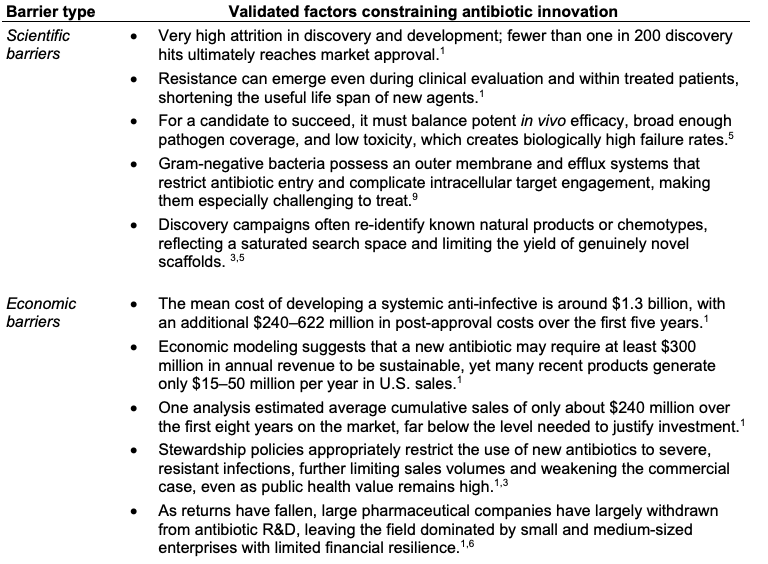
The difficulty of antibiotic innovation begins with the science itself. Developing a new antibacterial agent requires achieving a balance of properties that is exceptionally hard to optimize simultaneously. Candidates must demonstrate potent, often broad-spectrum activity against diverse pathogens while maintaining low toxicity to human cells and sustaining efficacy in vivo under complex physiological conditions. Meeting these criteria leads to a high attrition rate even early in discovery, as many promising compounds fail to deliver adequate therapeutic windows or sufficient robustness in animal models or human studies.5 These challenges are especially pronounced for Gram-negative bacteria, whose outer membrane and efflux systems limit antibiotic penetration and impede intracellular target engagement, demanding even more stringent molecular design and optimization.
These scientific hurdles intersect with an equally imposing set of economic barriers. The cost of bringing a systemic antibiotic to market is substantial, with total discovery and development expenses averaging around $1.3 billion, followed by an estimated $240–622 million in post-approval commitments during the first five years of commercialization.1 Yet the revenue potential for antibiotics stands in stark contrast to these investment requirements. A new antibiotic often needs at least $300 million in annual revenue to be commercially sustainable, but many recently launched products generate only $15–50 million per year in the United States. One analysis estimated that cumulative sales during the first eight years on the market average roughly $240 million — far below what would be required to support a healthy innovation ecosystem.1
This mismatch is exacerbated by stewardship practices, which restrict use of novel agents to the most resistant infections to preserve their effectiveness. While essential from a public health perspective, stewardship further limits sales volumes and erodes the commercial return that could support continued R&D investment. Over time, this dynamic pushed many large pharmaceutical companies to withdraw from antibiotic development entirely, leaving the field dominated by small and mid-sized companies. These organizations play a critical role in advancing early-stage innovation but often lack the financial resilience to sustain long, expensive development programs or absorb late-stage failures.6 As a result, the antibiotic pipeline remains structurally fragile, even as the scientific and medical need for new therapies continues to grow.
Table 1. Scientific and economic barriers to antibiotic innovation
 The State of the Pipeline — A Fragile but Reviving Ecosystem
The current antibacterial pipeline reflects both the consequences of past underinvestment and the early signs of renewed scientific momentum. According to the WHO, the number of antibacterial candidates in clinical development grew from 80 in 2021 to 97 in 2023, suggesting that efforts to stimulate innovation are beginning to have an impact.10 Yet the composition of this pipeline makes clear that meaningful progress remains limited. Most candidates are modifications of existing classes rather than truly novel agents, underscoring how difficult it has been to introduce fundamentally new mechanisms of action into clinical practice at a pace sufficient to keep up with evolving resistance.
Understanding the distribution of modalities in development helps illuminate both the challenges and the emerging opportunities. Traditional antibacterials —small molecules that directly inhibit bacterial growth or kill bacteria by targeting essential components of survival — continue to dominate the landscape.9 These agents form the backbone of clinical therapy and remain indispensable to modern medicine. At the same time, the field is expanding to encompass a diverse range of non-traditional approaches. These include bacteriophages and phage-derived lysins, antibodies, anti-virulence agents, immune-modulating therapies, microbiome-based strategies, and CRISPR-driven antimicrobials.9,10 The preclinical pipeline reflects this diversification: approximately half of candidates are direct-acting small molecules, while about 22% fall into these non-traditional categories.6
Several of these emerging strategies have progressed into clinical evaluation. Phage-derived lysins, such as exebacase, CRISPR-enhanced phages engineered for targeted bacterial killing, and live microbiome-directed biotherapeutics designed to reshape pathogen-colonization dynamics, all represent attempts to overcome the limitations of conventional chemotypes.9 These modalities allow developers to target resistant organisms in ways that circumvent traditional resistance mechanisms or exploit previously inaccessible biological vulnerabilities. However, they also pose significant operational and regulatory challenges. The WHO notes that studying and regulating non-traditional biological antibacterials is complex, and that additional support will be required to ensure these agents can advance efficiently through the clinic.10
Taken together, the pipeline shows signs of revival and diversification, but it remains fragile. The majority of candidates do not represent true step-change innovation, and many of the most promising emerging modalities face uncertain pathways to approval and adoption. Sustained progress will depend on ensuring that scientific advances are matched by adequate regulatory, commercial, and financial infrastructure capable of supporting a broader range of antibacterial technologies.
Signs of a Rebirth — Where New Momentum Is Emerging
After decades of scientific stagnation and commercial retreat, several developments now signal that antibiotic R&D may be entering a period of cautious revival. These signs span scientific breakthroughs, technological accelerations, new economic frameworks, and a gradual reawakening of industry interest. While the overall ecosystem remains fragile, the momentum emerging across these fronts suggests that meaningful renewal is possible if current efforts are sustained.
One of the clearest markers of this resurgence is the arrival of genuinely first-in-class agents into late-stage clinical development. Among the most notable is zosurabalpin, a novel antibacterial targeting carbapenem-resistant Acinetobacter baumannii (CRAB), one of the WHO’s critical-priority pathogens. Zosurabalpin’s mechanism of action differs fundamentally from existing therapies, and the compound has progressed into a global phase III program enrolling approximately 400 patients.11,12 Its advancement is striking not only for its scientific novelty but also for what it represents. Over the past several decades, antibiotic development has suffered repeated setbacks, and CRAB in particular has been associated with mortality rates reaching up to 60% in invasive infections.12 Against this backdrop, zosurabalpin’s progress should be viewed as a major breakthrough for a field that has not seen frequent first-in-class successes. The candidate’s trajectory illustrates that even the most resistant pathogens can be addressed with persistent innovation and targeted investment.
Scientific renewal is also being fueled by dramatic advances in AI. Traditional discovery approaches rely on slow, iterative screening of chemical libraries, often producing known scaffolds or derivatives of existing molecules. AI-enabled platforms are beginning to transform this paradigm. At Stanford, the SyntheMol generative AI model produced roughly 25,000 potential antibiotic structures and associated synthetic routes in under nine hours.2 From this vast output, researchers synthesized 58 compounds, six of which demonstrated activity against multidrug-resistant A. baumannii, including strains resistant to many clinically available therapies.2 This represents a meaningful leap in early-stage discovery throughput and novelty generation. While it remains early days for AI-driven antibiotic development, the field’s ability to access new chemical space at unprecedented speed is a compelling counterweight to long-standing challenges in hit identification.
Table 2. Key drivers of the antibiotic R&D rebirth
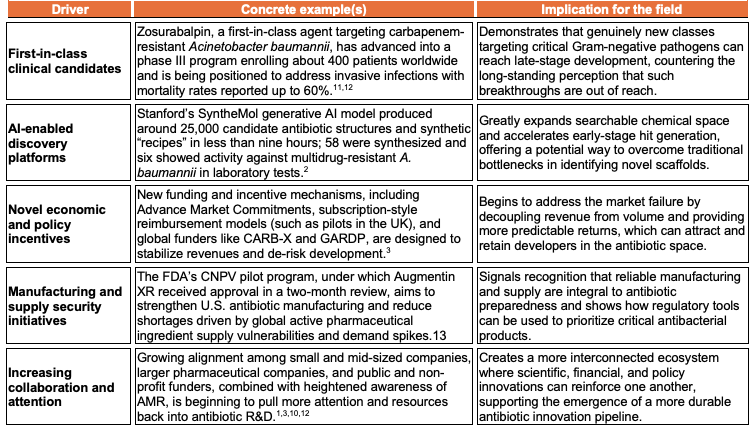 Parallel progress is emerging on the economic and policy front, where new models aim to correct the misalignment between public health needs and commercial incentives. Approaches, such as Advance Market Commitments and subscription-style reimbursement systems, attempt to decouple antibiotic revenue from sales volume, ensuring that developers can achieve financial sustainability even when stewardship appropriately limits use. Global funders, including CARB-X and the Global Antibiotic Research and Development Partnership (GARDP), also play a central role by providing early-stage support, de-risking discovery efforts, and enabling projects that might otherwise be impossible for small or resource-constrained companies to pursue.3 In the United States, new regulatory mechanisms are beginning to complement these incentive structures. The FDA’s Commissioner’s National Priority Voucher (CNPV) program, designed to bolster domestic antibiotic manufacturing and address supply vulnerabilities, recently issued its first approval: Augmentin XR, reviewed and authorized within two months.13 The initiative explicitly targets vulnerabilities in global active pharmaceutical ingredient (API) supply chains and aims to reduce shortages that undermine clinical care. These efforts are early, but they signal a growing recognition that economic innovation is as essential as scientific innovation in solving the AMR crisis.
These scientific and policy shifts are contributing to a gradual re-expansion of industry engagement. While the antibiotic ecosystem remains dominated by small and medium-sized players, increased collaboration between biotech companies, large pharmaceutical firms, and public-sector funders reflects a renewed understanding of the shared stakes involved. Rising unmet medical need, growing global health pressure, and the emergence of non-traditional modalities are creating an environment in which involvement in antibiotic R&D is once again scientifically compelling and strategically relevant.1,3,10,12 Industry participation today is still far from the scale required to fully restore the pipeline, but the direction is notable and encouraging.
Together, these developments — first-in-class candidates advancing toward phase III, AI-enabled discovery breakthroughs, evolving economic and policy frameworks, and nascent commercial reinvigoration — point to a field in transition. They demonstrate that the scientific barriers long considered insurmountable can be overcome and that with sufficient structural support, antibiotic innovation can regain its footing. The challenge, now, is ensuring that these early signs of progress mature into a durable and self-sustaining revival.
The Road Still Ahead — and Gaps That Could Stall Momentum
Even as signs of renewal emerge across antibiotic R&D, the path forward remains constrained by structural gaps that threaten to limit the impact of current progress. These challenges span scientific, economic, manufacturing, and regulatory domains, and together they illustrate why the field cannot yet rely on momentum alone to sustain meaningful innovation.
A central concern is the persistent innovation gap. Although the number of antibacterial candidates in clinical development has risen in recent years, the proportion of truly novel agents remains troublingly low. Among the 32 antibiotics targeting WHO priority pathogens, only 12 are considered innovative, and only four demonstrate activity against any of the critical Gram-negative threats that represent the most urgent unmet need.10 This imbalance underscores the reality that incremental modifications to existing classes, while valuable, cannot compensate for the accelerating pace of antimicrobial resistance. Without a steady influx of first-in-class or best-in-class agents with new mechanisms of action, the therapeutic arsenal will continue to erode faster than it can be replenished.
The fragility of the developer ecosystem compounds this challenge. Small and mid-sized drug developers dominate the preclinical and early clinical stages of antibiotic development, but many lack the financial resources to navigate the lengthy, capital-intensive path to approval.6 Their dependence on external funding creates instability, especially in a market where returns remain limited and unpredictable. This has contributed to repeated cycles of promising candidates stalling before late-stage development, and in some cases, to companies collapsing shortly after bringing new antibiotics to market. The limited resilience of the small and mid-sized company–driven pipeline raises concerns about whether even promising scientific advances can be translated into approved therapies at the scale required to confront global resistance trends.
Manufacturing and supply chain vulnerabilities further threaten the stability of antibiotic availability. In the United States, shortages of essential antibiotics have increasingly been linked to global API supply chain disruptions and sudden spikes in clinical demand.13 These shortages not only affect routine care but also force clinicians to rely on broader-spectrum agents when first-line therapies are unavailable — an outcome that accelerates resistance and undermines stewardship. Strengthening domestic manufacturing and diversifying supply chains will be necessary to ensure that newly developed antibiotics, as well as long-standing foundational agents, remain reliably accessible.
Finally, the regulatory and clinical evaluation environment has not yet fully adapted to the growing diversity of non-traditional antibacterial modalities. Therapies such as bacteriophages, antibodies, antivirulence agents, immune modulators, and microbiome-targeted approaches operate through mechanisms that do not fit neatly within established clinical-trial frameworks. The WHO has highlighted the complexity of studying and regulating these emerging approaches and the need for greater support to facilitate their advancement through the clinic.10 Without clear regulatory pathways and appropriate endpoints, promising technologies may face delays or fail to reach patients altogether.
Taken together, these gaps illustrate that the recent resurgence in antibiotic R&D, while encouraging, remains precarious. Innovation is emerging but is not yet deep or diverse enough; developers are committed but financially constrained; new policies are forming but not yet sufficient; and manufacturing and regulatory infrastructures require modernization to support a broader therapeutic landscape. The progress to date lays an important foundation, but sustained and coordinated action will be essential to ensure that the revival of antibiotic R&D becomes lasting rather than fleeting.
A Moment of Opportunity That Requires Bold Action
The landscape of antibiotic research and development is shifting in ways that would have seemed improbable only a decade ago. Scientific progress is accelerating, the development pipeline is gradually widening, and first-in-class agents, such as zosurabalpin, and AI-enabled discovery engines offer tangible demonstrations that a new era of antibacterial innovation is possible. Yet this momentum is undeniably fragile. The gains are real but modest relative to the scale of global need, and without deliberate reinforcement, they could dissipate as quickly as they emerged.
AMR remains one of the world’s deadliest and most pressing public-health threats, contributing to nearly five million deaths each year. The current pace of innovation does not match the severity of this burden. While new modalities and policy mechanisms signal progress, the gap between what is scientifically achievable and what is being delivered to patients continues to widen. Addressing this disconnect requires more than isolated breakthroughs — it demands structural change across the entire ecosystem.
A sustained revival of antibiotic innovation will depend heavily on scaling the economic incentives that allow developers to survive long enough to translate promising discoveries into approved therapies. Subscription-style reimbursement models, Advance Market Commitments, expanded public–private partnerships, and more reliable early- and mid-stage funding for small and medium-sized enterprises represent some of the most promising mechanisms available to correct the market failures that have long suppressed investment. These approaches do not eliminate the underlying scientific difficulty of antibiotic development, but they can create the stability needed to support a healthier, more resilient pipeline.
Achieving this future will require coordinated action across government, industry, academia, and global health organizations. As others have argued in high-level terms, antibiotic resistance is not a challenge that any single sector can solve independently. Ensuring that antibiotics remain effective foundations of modern medicine will depend on a unified and sustained commitment to scientific innovation, regulatory modernization, manufacturing resilience, and global access strategies.
If that coordination can be realized, the ideal future state is within reach: an antibiotic innovation ecosystem where scientific creativity is encouraged rather than constrained, where financial viability aligns with public health necessity, and where new therapies arrive at a pace that can genuinely keep ahead of evolving pathogens. The early signs of a rebirth in antibiotic R&D are encouraging, but transforming those signals into lasting progress will require bold, collective action now—before resistance closes the door on opportunities that may not come again.
References
1. Blaskovich, Mark AT and Matthew A Cooper. “Antibiotics re-booted—time to kick back against drug resistance.” npj Antimicrobials and Resistance. 3: 47 (2025).
2. Tompa, Rachel. “Generative AI develops potential new drugs for antibiotic-resistant bacteria.” Stanford Medicine News Center. 28 Mar. 2024.
3. Dattani, Saloni. “What was the Golden Age of Antibiotics, and how can we spark a new one?” Our World in Data. 22 Dec. 2024.
4. Hutchings, Matthew I, Andrew W Truman, and Barrie Wilkinson. “Antibiotics: past, present and future.” Current Opinion in Microbiology. 51: 72–80 (2019)
5. Hughes, Diarmaid and Anders Karlén. “Discovery and preclinical development of new antibiotics.” Ups. J. Med. Sci. 119: 162–169 (2014).
6. Gigante, Valeria, Hatim Sati, and Peter Beyer. “Recent advances and challenges in antibacterial drug development.” ADMET DMPK. 10: 147–151 (2022).
7. Muteeb, Ghazala, et al. “Origin of Antibiotics and Antibiotic Resistance, and Their Impacts on Drug Development: A Narrative Review.” Pharmaceuticals (Basel). 16: 1615 (2023).
8. Schneider, Yannik K. “Bacterial Natural Product Drug Discovery for New Antibiotics: Strategies for Tackling the Problem of Antibiotic Resistance by Efficient Bioprospecting.” Antibiotics. 10: 842 (2021).
9. Shim, Hyunjin. “Three Innovations of Next-Generation Antibiotics: Evolvability, Specificity, and Non-Immunogenicity.” Antibiotics (Basel). 12: 204 (2023).
10. WHO releases report on state of development of antibacterials. World Health Organization. 14 Jun. 2024.
11. “New era of antibiotics potentially in sight after more than 50 years.” Roche. 3 Jan. 2024.
12. Petere, Roohi Mariam. “First antibiotic in 50 years to tackle superbug nears approval: what’s going on in the field?” Labiotech. 9 Jun. 2025.
13. Xavier, Joji. “FDA Approves First Drug Under Program To Strengthen US Antibiotic Manufacturing.” RTT News. 10 Dec. 2025.