Real-time glucose control is central to achieving consistent performance in mammalian cell culture, yet biomanufacturers have long lacked a simple, cost-effective sensor capable of delivering continuous, in situ data. Existing approaches — offline assays, at-line analytics, and complex spectroscopic or enzymatic systems — either provide delayed results or require specialized expertise and infrastructure. Hamilton’s GlucoSense sensor closes this gap with a robust, easy-to-use optical platform that delivers accurate real-time glucose measurements across fed-batch and perfusion processes, enabling tighter control strategies, improved process robustness, and seamless scalability from development to GMP manufacturing.
How Glucose Shapes Cell Metabolism and Product Quality
Glucose is the primary carbon and energy source for mammalian cells and plays a central role in determining both the pace of cell growth and the metabolic routes that govern product quality. Its concentration at any given point in a culture run shapes key pathways, including glycolysis and the hexosamine biosynthetic pathway, and directly influences the critical quality attributes (CQAs) of biologic drug substances produced via cell culture.
Both too little and too much glucose can disrupt bioproduction. When glucose levels fall, cells lack the precursors needed for proper N-linked glycosylation, often leading to an increased proportion of high-mannose or under-sialylated glycans. These shifts reflect limitations in nucleotide-sugar pools that depend on adequate glucose availability. Excess glucose poses a different challenge: cells rapidly metabolize surplus glucose into lactate and ammonia, by-products that acidify the environment, disturb intracellular redox balance, and contribute to glycosylation heterogeneity and reduced sialylation. Even short-lived fluctuations, such as sudden spikes following bolus feeds, can introduce osmotic and metabolic stress that affects protein folding consistency.
Maintaining glucose within an appropriate range across each phase of the culture is therefore essential for achieving stable metabolic behavior, minimizing lactate accumulation, and supporting consistent glycan maturation. Regulatory authorities reinforce this expectation. In both process analytical technology (PAT) and quality-by-design (QbD) frameworks, continuous glucose monitoring is treated as foundational to implementing reliable feed strategies, stabilizing metabolic flux, and safeguarding CQAs throughout development and manufacturing.
The Challenges Behind Real-Time Glucose Control
Precise glucose monitoring remains one of the most persistent challenges in mammalian cell culture. Most biologics are still produced in fed-batch mode, where fresh media and nutrient feeds are added intermittently, and glucose levels are adjusted either at fixed intervals or based on offline assay results. Perfusion processes introduce a different dynamic — continuous media exchange and continuous product harvest — but rely on the same fundamental requirement: timely glucose measurements to inform and stabilize feed strategies. In either mode, real-time data are essential for maintaining glucose within the narrow bands that support productive metabolism.
Off-line assays are robust, well-established, and fully accepted by regulatory authorities for in-process testing and final release. However, they provide only snapshot information and typically are run once per day. As a result, they cannot capture short-lived drops or spikes between feeds, which can meaningfully influence cell metabolism and glycosylation patterns. At-line systems automate sampling and move analysis closer to the bioreactor, but they still do not generate continuous data. Their reliance on discrete samples also creates a practical limit for small-volume cultures, where removing frequent aliquots reduces available material.
Several in-line and online technologies have been introduced to address these shortcomings, including solutions based on near-infrared (NIR), mid-infrared (MIR/FTIR), and Raman spectroscopy, as well as enzymatic electrochemical approaches. Many of these platforms can monitor multiple parameters at once, but they come with trade-offs. Spectroscopic systems require an external spectrometer, fiber-optic cables, and a model-building workflow that demands both time and expertise. Raman in particular depends on chemometric models that must be trained, validated, and often retrained when variables, such as media formulation, scale, or instrument configuration, change.
NIR and MIR/FTIR introduce additional complexity owing to high water absorption and overlapping molecular vibrations that obscure glucose signals, especially at low concentrations or in turbid media. Enzymatic and wet-chemistry systems avoid these spectral challenges but face their own limitations: enzyme degradation, membrane fouling from proteins and metabolites, and bubble interference all contribute to signal drift. These issues drive frequent reagent replacement and recalibration, increasing both workload and cost.
Across these technologies, large hardware footprints remain another barrier. Pumps, sampling loops, dilution modules, mixing chambers, and the analytical devices themselves occupy significant space and introduce multiple potential failure points. Collectively, these constraints help explain why most manufacturers still depend on daily offline readings, even as real-time glucose control becomes increasingly important for consistent, modern bioprocessing.
Closing the Gap: The Case for an Easy, In Situ Glucose Sensor
The shortcomings of existing offline, at-line, and spectroscopic in-line systems have created a clear need for a glucose measurement technology that is both simple to operate and capable of delivering reliable real-time data. The ideal solution would offer the ease and familiarity of the pH and dissolved oxygen sensors that bioprocessing teams already use routinely, while still achieving the precision, robustness, and regulatory suitability required for mammalian cell culture from early development through commercial manufacturing. To be viable in a GMP environment, such a tool must also integrate cleanly into established workflows, minimize calibration burden, and avoid interference from the complex components of cell culture media.
Designing an optical glucose sensor that meets these expectations has proven challenging. The primary obstacle is the presence of cells in the medium. The carbohydrates present on the surface of their membranes create spectral signals that interfere with glucose signatures, making direct in situ measurement unreliable. Any practical sensor must therefore distinguish glucose from these confounding features without relying on external sampling loops, fiber optics, or multivariate chemometric models.
A straightforward, plug-and-measure glucose sensor would unlock significant benefits across the bioproduction landscape. Real-time data would support tighter feed control, more efficient scale-up, and a higher degree of automation in both fed-batch and perfusion processes. It would also enable the application of advanced control strategies, including machine learning–based prediction and optimization, that depend on continuous, trustworthy data streams. Ultimately, such a tool would help manufacturers achieve more consistent processes, improve product quality, and shorten the development path for high-value biologic therapies.
How GlucoSense Brings Simple, Reliable Glucose Control to Bioprocessing
Hamilton’s long-standing focus on innovation driven by real bioprocessing needs has already produced several widely adopted PAT tools, including durable reusable pH sensors and optical dissolved oxygen probes that calibrate quickly and integrate easily into GMP workflows. GlucoSense extends this legacy by addressing one of the most persistent gaps in upstream analytics: a simple, reliable, in situ glucose sensor suitable for routine real-time control.
The GlucoSense optical glucose sensor (Figure 1) was developed specifically to meet this unmet need. With its introduction, Hamilton is not merely offering another analytical device but establishing an entirely new product category: a reusable, in situ glucose sensor designed to operate as intuitively as a pH or DO probe. Importantly, no specialized expertise is required to deploy or interpret its measurements.
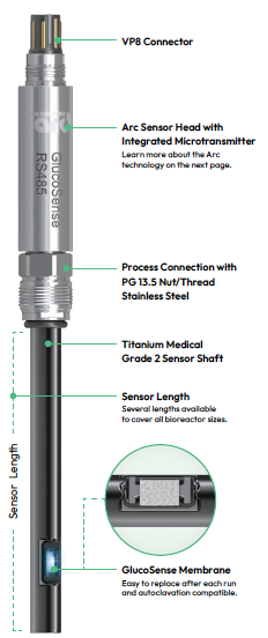 Figure 1. The GlucoSense optical glucose sensor.
GlucoSense performs glucose quantification using mid-infrared absorption spectroscopy based on ATR (attenuated total reflectance), a well-established technique for measuring analytes in aqueous solutions. Unlike Raman or NIR platforms, it does not require lasers, external spectrometers, or fiber-optic cables. Its titanium Grade 2 body withstands repeated autoclave, clean-in-place (CIP), and steam-in-place (SIP) cycles, and because it is fiberoptic-free, it avoids the degradation issues that limit the lifetime of other optical technologies under thermal stress.
The sensor is purpose-built for cell culture. GlucoSense addresses these challenges through a combination of technological features drawn directly from Hamilton’s nine-year development program:
A diamond ATR sensing element protected by a single-use semi-permeable membrane. This membrane forms a small measurement chamber: glucose and other small molecules diffuse freely, while cells remain outside, preventing spectral interference and helping maintain baseline stability across the full run. The membrane must be replaced before each new bioprocess run.
Detectors tuned to glucose-specific absorption features. The detectors chosen isolate the wavelengths most sensitive to glucose while minimizing overlap from lactate, amino acids, and other media components, eliminating the need for complex chemometric modeling or repeated calibration runs.
Each GlucoSense probe arrives factory-calibrated, and only a single in situ product calibration step is required to account for media background. No continual referencing or multivariate retraining is needed, enabling rapid setup at any scale.
GlucoSense also incorporates Hamilton’s Arc intelligent sensor architecture. A microtransmitter embedded within the sensor head stores calibration constants, diagnostic parameters, and performance indicators directly on the device. This approach simplifies data management, supports predictive maintenance, and ensures traceability. The sensor continuously assesses the quality of each measurement, allowing operators to see not only the glucose value but the reliability of that value in real time.
Process data are delivered directly to the control system via Modbus or 4–20 mA, and full integration with Hamilton’s ArcAir software enables automated control, streamlined verification, and GMP-compliant documentation. Wireless configuration is available through the Arc Wi Adapter, and GMP-ready verification kits support fast, reproducible sensor qualification.
What Makes GlucoSense Different — And Why It Matters
The GlucoSense sensor brings together real-time, in situ measurement, high reliability, and simple integration, addressing the limitations of current glucose monitoring tools. By measuring directly in the medium, it eliminates delays associated with off-line sampling, reduces manual workload, and provides continuous data that operators and automated systems can act on immediately. Unlike enzymatic assays, it does not suffer from drift caused by reagent degradation or biofouling, and unlike Raman or NIR systems, it requires no chemometric modeling, fiber optics, or external spectrometers.
Factory characterization against known interferents, combined with the sensor’s internal algorithm for cell culture media, ensures accurate performance without repeated recalibration. Only a single in situ product calibration is needed to establish a baseline for the specific medium being used. All calibration constants, quality indicators, and diagnostic information are stored in the sensor head via Hamilton’s Arc microtransmitter, removing the dependency on external transmitters and supporting predictive maintenance and GMP-compliant data handling.
A key advantage is GlucoSense’s cell-blocking membrane. This single-use, semi-permeable barrier prevents cells from reaching the diamond ATR sensing element, avoiding fouling, optical scattering, and the drift that typically affects optical systems when cells accumulate on the measurement surface. The membrane creates a small, well-controlled measurement chamber that allows small molecules like glucose to diffuse freely, ensuring measurement stability throughout the entire run.
This robustness extends across scales: GlucoSense is PG13.5-compatible and available in multiple lengths, enabling seamless use from development reactors through pilot and production-scale vessels. The titanium Grade 2 sensor shaft withstands repeated autoclave, CIP, and SIP cycles, and no consumable reagents are required, lowering operational costs relative to wet-chemistry and enzymatic technologies.
Together, these features create a practical, low-maintenance solution for real-time glucose monitoring that supports more consistent process control, more efficient automation, and reduced analytical burden across the entire bioprocess life cycle.
Demonstrated Performance in Fed-Batch and Perfusion CHO Systems
The GlucoSense sensor has undergone extensive evaluation through Hamilton’s internal development program as well as beta-testing at three external bioprocessing organizations. Representative performance data are summarized below for both fed-batch and perfusion CHO processes.
In a standard lab-scale fed-batch run, a single in situ product calibration was performed at inoculation. The sensor then operated continuously for roughly 125 hours (four to five days) with no detectable signal drift and no need for recalibration. Real-time glucose measurements remained closely aligned with offline reference values obtained using Nova Flex analyzers. When two sensors were run in parallel in the same bioreactor, both GlucoSense probes generated nearly identical glucose profiles, capturing expected nutrient consumption between feed intervals and the increases following feed additions at approximately 50 and 125 hours (Figure 2). The agreement among the two probes and the offline data demonstrates the high accuracy, repeatability, and temporal resolution of the ATR-based optical system.
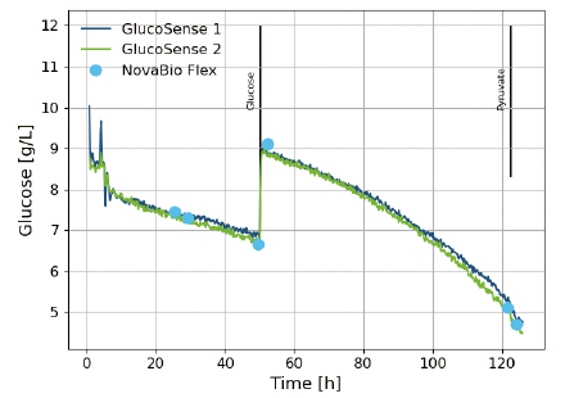 Figure 2. Continuous glucose monitoring during a fed-batch CHO process using two GlucoSense probes. Real-time profiles are consistent with offline PerkinElmer and Nova Flex measurements, confirming stability and accuracy over 125 hours. Data collected in collaboration with the Biotechnology group of the University of Applied Sciences Northwestern Switzerland (Fachhochschule Nordwestschweiz)
These results validate the sensor’s stability in an R&D-relevant fed-batch environment and show that a calibration-light optical probe can be readily integrated into conventional development workflows. Continuous glucose insight also shortens the process-development feedback loop, enabling earlier detection of metabolic shifts and accelerated optimization of feed strategies.
Strong performance was similarly observed in a three-week CHO perfusion process operated at high cell densities of up to 50 million cells/mL. The run was conducted in parallel with two GlucoSense probes (Figure 3). A permittivity probe was used simultaneously to track viable biomass. Throughout the full culture duration, both GlucoSense sensors delivered consistent glucose readings within a narrow range, even as biomass and metabolic activity increased substantially. Weekly product calibrations were performed to account for media background; no additional tuning was required.
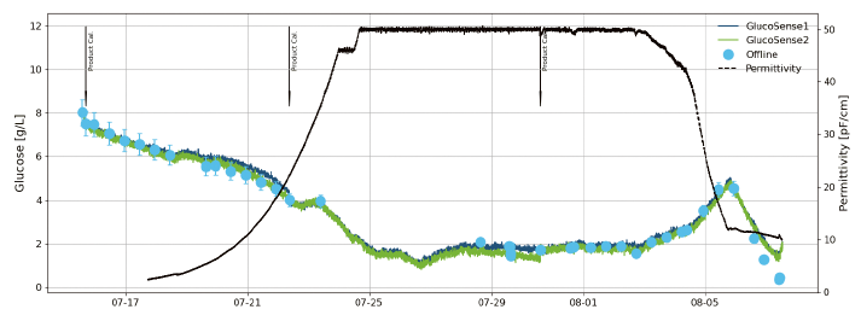 Figure 3. Continuous glucose and permittivity monitoring during a three-week CHO perfusion process with weekly product calibration. GlucoSense profiles remain stable and aligned with biomass growth (up to ~30 million cells/mL during the comparison window), confirming robust nutrient control across the entire run. Data collected in collaboration with FHNW.
No measurable drift was observed between the initial calibration and the final verification points, demonstrating the sensor’s resistance to fouling and its stability in dense, protein-rich media, conditions that commonly degrade enzymatic, electrochemical, and traditional optical approaches. The results confirm that GlucoSense technology can be transferred directly from R&D to manufacturing without modification, recalibration cycles, or additional model maintenance. Continuous real-time visibility into glucose helped prevent undetected fluctuations that often lead to lactate accumulation, and in combination with other PAT signals, supports feed-on-demand strategies and QbD-driven predictive and adaptive process control.
Enabling the Next Generation of Real-Time Glucose Control
Accurate and timely glucose measurement is fundamental to achieving robust, cost-effective control of mammalian cell culture processes. While current offline and in-line/online methods provide valuable information, each carries limitations that restrict real-time control and complicate scale-up. The GlucoSense optical sensor offers a practical path forward: a simple, durable, and cost-efficient tool that enables continuous glucose monitoring in fed-batch and perfusion systems from benchtop development through commercial-scale manufacturing.
With GlucoSense, real-time and largely maintenance-free glucose sensing becomes both feasible and scalable. Continuous in situ measurement transforms glucose from a periodic analytical checkpoint into an active source of process intelligence. This shift supports proactive control strategies, more consistent product quality, and the increased automation essential to modern bioprocessing. Reliable, high-frequency data also simplifies the implementation of adaptive feeding strategies, accelerates digital-twin development, and strengthens the foundation for continuous manufacturing.
Hamilton launched the first version of GlucoSense — designed for benchtop bioreactors — on November 26, 2025. This initial model supports R&D, process development, and technology validation. A second version of the single-use membrane, engineered to withstand full SIP/CIP cycles, will follow in late 2026, enabling deployment of GlucoSense directly in GMP environments without workflow modification.
Customers have also expressed interest in extending this sensing capability beyond mammalian cell culture. Hamilton is evaluating adaptation of the GlucoSense platform for fermentation processes, where real-time glucose control is equally crucial. The underlying optical design may also lend itself to measurement of additional critical nutrients and metabolites, such as lactate, and these opportunities are under active exploration.