
Key Takeaways
CHO remains the dominant platform for commercial biopharmaceutical protein production because it combines scalability, regulatory familiarity, and near-human glycosylation with low levels of problematic non-human epitopes.
HEK293 is widely favored for transient expression and viral vector manufacturing because it is highly transfectable, fast, and adaptable to suspension culture.
The idea that HEK293 is inherently “more human-like” in output can be misleading; glycosylation differences between HEK and CHO are real and must be assessed on a molecule-by-molecule basis.
HEK293 can outperform CHO for some difficult-to-express proteins, which makes it a valuable strategic alternative rather than just a research convenience.
The best platform choice depends on the product class, the development stage, the required speed, and the critical quality attributes that matter most for the final molecule.
Why This Comparison Matters Now
For many biologics developers, the choice of expression host is not a technical footnote; it is one of the earliest platform decisions that will shape product quality, manufacturability, cost, speed, and regulatory strategy. In mammalian expression, that decision most often comes down to two workhorse systems: Chinese hamster ovary (CHO) cells and human embryonic kidney 293 (HEK293) cells. CHO remains the dominant host for therapeutic recombinant proteins, especially monoclonal antibodies, while HEK293 is widely used for transient expression, research-grade protein production, and viral vector manufacturing because of its high transfectability and adaptability to suspension culture.
To the question of which platform is superior (CHO vs. HEK293), the right answer is rarely that one platform is universally better. More often, the better system is the one that best matches the molecule, the development stage, the required speed, and the intended commercial path.
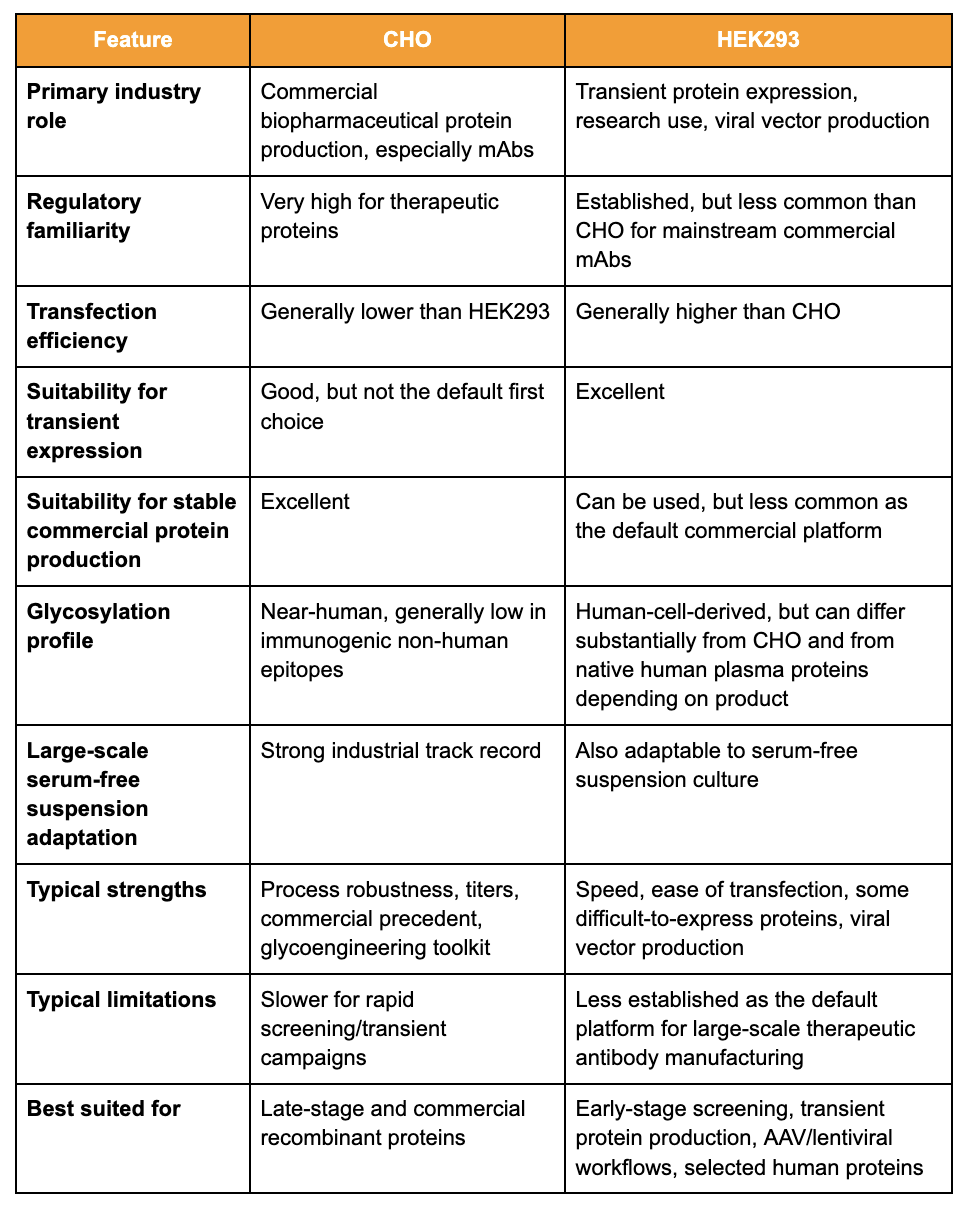 At a high level, the industry’s default division of labor is clear: CHO is usually the production platform of choice for mainstream commercial biologics, while HEK293 is often the faster and more flexible platform for transient expression and vector-related applications.
Mechanistic Differences
The “CHO vs. HEK293” decision is really a comparison between two different hosT cell philosophies. CHO is a non-human mammalian platform that has been industrialized over decades for high-yield, stable production of therapeutic proteins. Its success is tied not only to productivity and adaptability to large-scale serum-free suspension culture, but also to its ability to generate glycoproteins with near-human, generally non-immunogenic glycosylation patterns. CHO cells, for example, are favored in part because they do not meaningfully express some of the glycoforms that have historically raised immunogenicity concerns in other non-human hosts.
HEK293, by contrast, is a human-cell-derived platform valued for high transfectability, rapid growth, and operational convenience in transient workflows. Those characteristics make it especially attractive when speed matters, when multiple constructs must be screened quickly, or when the product class already sits close to HEK293’s established strengths, as in viral vector manufacturing.
Importantly, “human-derived” does not automatically mean “more native” in every product-quality dimension. Comparative glycosylation studies have shown that recombinant proteins expressed in HEK and CHO can differ substantially, and in at least one detailed comparison of factor VII, the HEK293-produced material showed markedly different N-glycan profiles from both CHO-derived material and plasma-derived protein. In other words, host origin matters, but it does not eliminate the need for molecule-specific analytical characterization.
Manufacturing and Operational Considerations
From a manufacturing standpoint, CHO’s biggest advantage is not just that it works but that it has been optimized at industrial scale for a very long time. CHO systems are widely used in industry, adapt well to large-scale serum-free suspension processes, and have been pushed to very high monoclonal antibody titers through advances in media, cell-line engineering, and fed-batch and perfusion processes. Review literature notes that mAb titers in CHO can exceed 10 g/L under optimized fed-batch and perfusion conditions, underscoring why CHO remains the commercial default for many antibody programs.
HEK293’s operational advantage is usually speed and flexibility rather than mature large-scale industrialization. HEK293 cells are easy to transfect and maintain, with high reproducibility in transient expression settings, making them especially useful for early discovery, analytical reagent production, and rapid protein generation. Suspension-adapted HEK293 derivatives such as 293F, 293-6E, and Expi293F have also made production-scale transient workflows more practical than older adherent approaches.
That said, HEK293 should not be dismissed as purely a research system. Reviews and process papers show clear industrial relevance, particularly for viral vectors. HEK293 is traditionally used for lentiviral vector production because it is easily transfectable and adaptable to different culture strategies, and it is also the preferred platform for many recombinant adeno-associated virus (rAAV) production workflows, owing in part to its integrated adenoviral helper functions.
Product Quality and Glycosylation Implications
For therapeutic proteins, the most important quality question is not which cell line is more fashionable, but which one produces the right molecule. CHO’s long-standing dominance rests heavily on product-quality consistency and a glycosylation profile that is close enough to human biology to support broad regulatory and commercial acceptance, while remaining amenable to extensive glycoengineering. That combination has made CHO especially attractive for antibodies and other glycoproteins where glycan pattern affects efficacy, half-life, and immunogenicity.
HEK293, however, can offer real advantages for selected proteins, particularly some human proteins that prove difficult to express or secrete in CHO. In one comparative study of 24 recombinant proteins, eight consistently expressed better in HEK293 than in CHO across both semi-stable and transient setups, while only one favored CHO in both configurations. That does not make HEK293 the better universal host, but it does make a strong case for evaluating it when a candidate is secretion-limited, heavily post-translationally modified, or otherwise “difficult to express.”
At the same time, HEK293 should not be assumed to yield a more clinically “native” glycoform profile simply because it is human-derived. Comparative studies have shown significant glycosylation differences between HEK and CHO products across multiple proteins, and those differences can materially affect product characterization and comparability planning.
Regulatory and Clinical Implications
Regulatory strategy often follows platform familiarity. For mainstream therapeutic proteins, especially monoclonal antibodies, CHO benefits from the strongest precedent base. That does not mean regulators will reject HEK293-derived proteins; rather, it means CHO typically starts with fewer platform-level questions because its use in biopharmaceutical manufacturing is so well established.
HEK293 is on firmer ground in areas where it is already widely entrenched, particularly viral vectors. For lentiviral and many rAAV workflows, HEK293 is not a niche alternative but a standard production platform. In those settings, the regulatory discussion is less about whether HEK293 is acceptable in principle and more about the usual issues of process control, impurity clearance, characterization, and consistency.
For recombinant therapeutic proteins, though, HEK293 may prompt more molecule-specific scrutiny around glycosylation and product heterogeneity, especially if the product is intended to compete with or resemble a CHO-derived or plasma-derived benchmark. That is not a barrier so much as a reminder that analytical comparability has to lead the platform decision.
Best Fit by Use Case
CHO is generally the better fit when the goal is a stable, scalable, commercially robust manufacturing process for a recombinant therapeutic protein, particularly monoclonal antibodies and other well-understood glycoproteins. It is also the stronger default when the program values industrial precedent, process robustness, large-scale suspension culture performance, and access to a mature cell-line engineering and glycoengineering toolkit.
HEK293 is often the better fit when the priority is speed, transient expression efficiency, viral vector production, or rescue of proteins that behave poorly in CHO. It is especially attractive in discovery and early development, where fast construct screening and rapid material generation can matter more than long-term manufacturing economics. It is also a logical first-choice platform for many lentiviral and rAAV production workflows.
A practical decision rule emerges from the literature: if you are developing a mainstream therapeutic protein for late-stage or commercial manufacture, start by assuming CHO unless the molecule gives you a compelling reason not to. If you are prioritizing transient speed, vector production, or a challenging human protein, HEK293 deserves serious consideration much earlier in the evaluation process.
Verdict: Which Should You Choose?
For most commercial recombinant protein programs, CHO remains the safer default choice because of its deep industrial track record, scalability, regulatory familiarity, and generally favorable product-quality profile.
For transient expression, rapid screening, viral vector manufacturing, and selected difficult-to-express human proteins, HEK293 is often the more practical and sometimes the more effective platform.
So the short verdict is this: CHO is usually better for commercial therapeutic protein manufacturing; HEK293 is often better for speed, flexibility, vector production, and specific protein-expression problems. The real decision is not which cell line is better in the abstract, but which one is better for the molecule and stage in front of you.