
Key Takeaways
Fed-batch is currently the dominant manufacturing approach for monoclonal antibody production.
Continuous bioprocessing offers significantly higher productivity and improved facility utilization but requires more advanced process control.
Batch processing remains useful for early development and small-scale production.
Future manufacturing strategies are likely to combine elements of fed-batch and continuous processing.
Why This Comparison Matters Now
Biopharmaceutical manufacturing has historically relied on batch and fed-batch processes, particularly in monoclonal antibody (mAb) production. However, increasing pressure to improve productivity, reduce cost of goods, and accelerate development timelines has renewed interest in continuous bioprocessing approaches, including perfusion cell culture and integrated downstream processing.
These strategies represent fundamentally different philosophies in how biologics are produced: batch emphasizes discrete production cycles, fed-batch extends productivity through controlled nutrient feeding, and continuous processes aim to maintain cells in a steady-state production environment for extended periods. The decision among these approaches increasingly depends on the product modality, facility design, and desired manufacturing flexibility.
 Mechanistic Differences
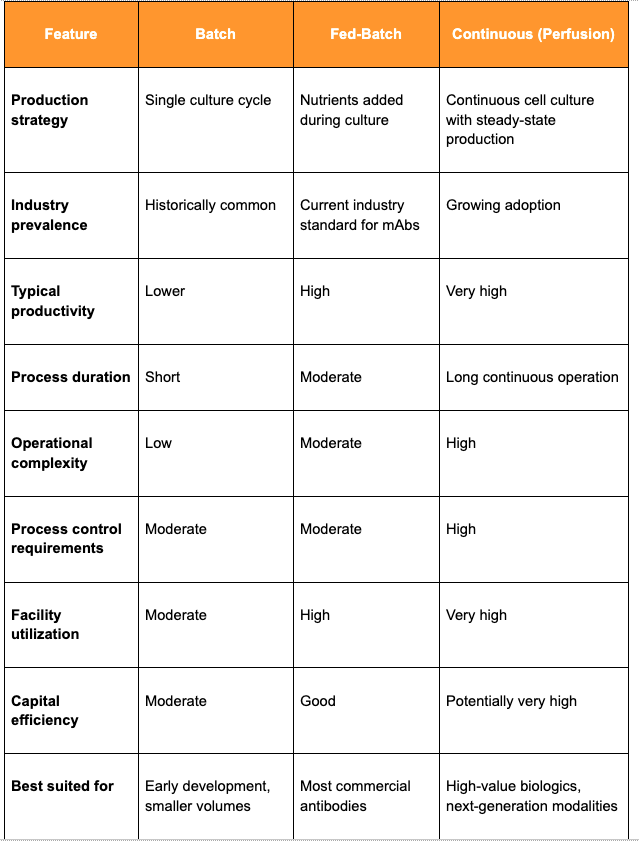
Batch processing represents the simplest production model: cells are inoculated into a bioreactor containing culture medium and allowed to grow and produce protein until nutrients are depleted or inhibitory byproducts accumulate. At that point, the culture is harvested and the reactor is cleaned before the next run.
Fed-batch improves on this model by adding nutrients during the culture to prolong cell viability and productivity. This approach enables significantly higher cell densities and protein titers compared with simple batch processes, which is why it has become the dominant method for large-scale monoclonal antibody production.
Continuous bioprocessing, particularly perfusion culture, maintains cells in an active growth state by continuously removing spent media while replenishing nutrients. This allows cultures to operate for extended periods while sustaining very high viable cell densities and productivity.
Manufacturing and Operational Considerations
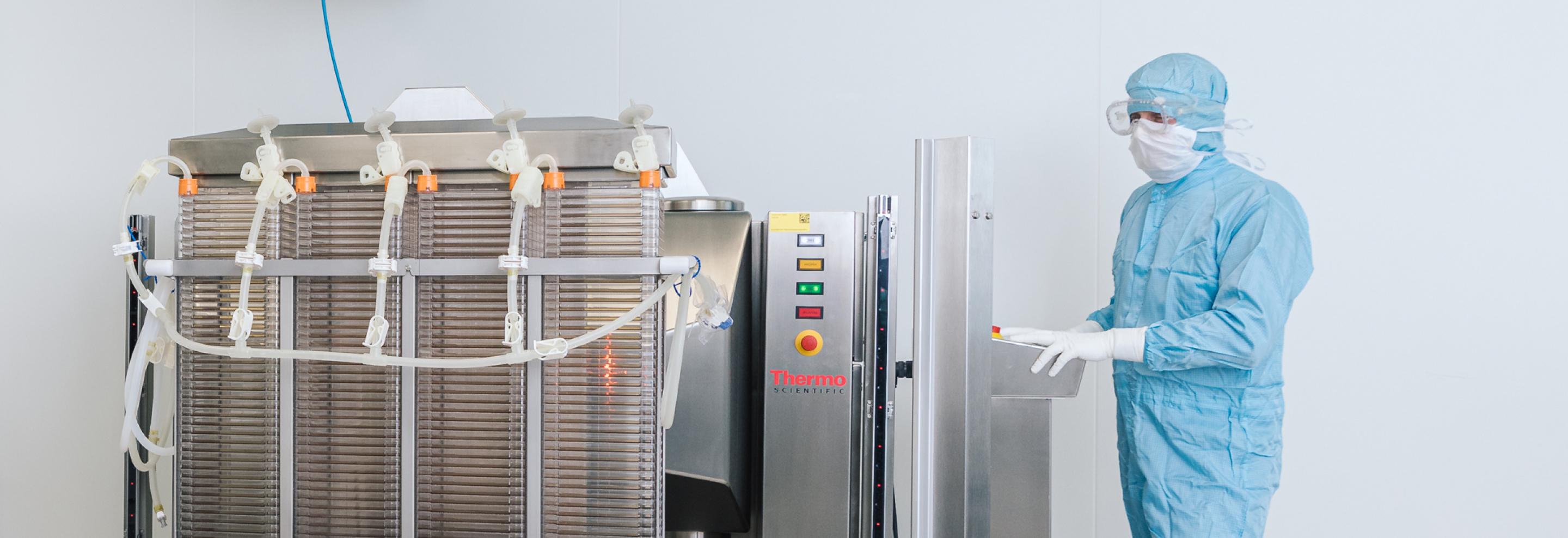
From a manufacturing standpoint, fed-batch remains the most widely adopted model because it strikes a balance between productivity, operational familiarity, and regulatory comfort. It can achieve very high titers without the infrastructure complexity associated with continuous systems.
Continuous bioprocessing, however, offers several compelling advantages. By maintaining steady-state operation, perfusion systems can achieve much higher volumetric productivity and improved facility utilization. Continuous processes may also enable smaller facilities to produce equivalent output compared with large fed-batch plants.
The trade-off is operational complexity. Continuous systems require more advanced monitoring, automation, and process control infrastructure, as well as careful integration with downstream purification operations.
Regulatory and Development Implications
Regulatory agencies have historically evaluated biologics produced using batch and fed-batch processes because these methods dominate the industry. However, regulators have increasingly encouraged innovation in manufacturing technologies, including continuous processing, provided that process control and product consistency can be demonstrated.
Continuous manufacturing approaches also introduce new considerations for validation, batch definition, and process monitoring, which require clear regulatory strategies during development.
Best Fit by Use Case
Batch processing is generally best suited for early development programs or small-scale production where process simplicity and flexibility are priorities.
Fed-batch remains the most common choice for commercial mAb manufacturing because it balances high productivity with operational familiarity.
Continuous bioprocessing is increasingly attractive for next-generation biologics, high-value therapies, and facilities designed around modular or flexible manufacturing strategies.
Verdict: Which Should You Choose?
For most commercial biologics today, fed-batch remains the most practical and widely implemented manufacturing strategy.
However, continuous bioprocessing is gaining momentum as companies pursue higher productivity, improved facility efficiency, and more flexible manufacturing models.
Batch processes continue to play a role in early development and niche applications where simplicity is advantageous.