
Key Takeaways
Asia is no longer a single biopharmaceutical manufacturing market, as each country offers a different combination of operating capacity, modality expertise, regulatory infrastructure, and CDMO maturity.
South Korea has established substantial large-scale mammalian biologics capacity, while China is combining an MAH-enabled outsourcing framework with commercial biologics drug-product and bioconjugation capabilities.
India is building on its global pharmaceutical and vaccine scale by expanding biologics drug-substance, fill–finish, biosimilar, and advanced-biomanufacturing infrastructure.
Singapore and Japan are differentiating themselves through high-value manufacturing models, with Singapore serving as a multinational platform and Japan emphasizing cell and gene therapies, regenerative medicine, and vaccine resilience.
Thailand, Indonesia, Vietnam, and Malaysia are emerging along different paths, ranging from pilot-scale biologics and established vaccine production to planned fill–finish capacity and selected captive biologics manufacturing.
There Is No Longer One Asian Manufacturing Proposition
Asia’s role in biopharmaceutical manufacturing can no longer be described through a single regional proposition. China, India, South Korea, Singapore, and Japan have developed markedly different combinations of manufacturing scale, modality expertise, regulatory infrastructure, domestic industrial policy, and access to global supply networks. Thailand, Indonesia, Vietnam, and Malaysia are also building capabilities, but their progress ranges from established vaccine or insulin production to pilot infrastructure, technology transfer programs, and facilities that remain under construction.
These distinctions matter because biopharmaceutical capacity is not fungible. A 15,000-liter mammalian bioreactor, a high-throughput vaccine facility, an aseptic vial-filling line, an antibody–drug conjugate (ADC) suite, and a cell therapy manufacturing operation address different technical and commercial requirements. A country may be highly developed in one of these areas without offering comparable depth in the others.
The maturity of the capacity matters just as much as its scale or modality. Samsung Biologics’ fifth plant is operating in South Korea, while major additions planned by WuXi Biologics in Singapore and VNVC in Vietnam remain under development. Government strategies, groundbreaking ceremonies, and announced investments can reveal the direction of an ecosystem, but they do not establish that capacity is available to sponsors today.1–3
It is also necessary to distinguish between captive manufacturing and third-party contract development and manufacturing organization (CDMO) services. A multinational manufacturer may operate a sophisticated plant in a country without creating a broad outsourcing market around it. Conversely, a country with a growing CDMO sector may still depend on a limited number of companies or geographic clusters.
Regulatory indicators add another layer. Participation in the Pharmaceutical Inspection Co-operation Scheme (PIC/S) and maturity assessments conducted under the World Health Organization’s (WHO’s) benchmarking framework can demonstrate the development of national regulatory and inspection systems. However, they do not replace product- and facility-level due diligence or establish that manufacturing quality is uniform across a country.4–7
The resulting map is neither a simple hierarchy nor a contest to identify the most attractive Asian destination. It is a portfolio of manufacturing ecosystems that are becoming more differentiated as biopharmaceutical products become more complex and sponsors place greater emphasis on capacity availability, modality fit, network resilience, and the ability to support products from development through commercial supply.
China: Connecting Contract Manufacturing with the Wider Value Chain
China’s biopharmaceutical manufacturing strategy combines a formal structure for outsourced production with broader efforts to connect research, product approval, manufacturing, distribution, procurement, and clinical use.
The country’s marketing authorization holder (MAH) system separates ownership of a drug authorization from the requirement to manufacture the product internally. An MAH may entrust production to a qualified manufacturer, but it retains responsibility for the drug’s safety, efficacy, and quality throughout development, production, distribution, and use. The MAH is also responsible for auditing the contract manufacturer’s quality system and establishing agreements that define quality obligations. More recent contract-manufacturing rules have reinforced the allocation of responsibilities between product holders and manufacturing partners.8,9
This framework provides a regulatory foundation for outsourcing, but China’s strategy extends beyond the relationship between an individual sponsor and CDMO. A biopharmaceutical development plan for the Jiangsu pilot free trade zone covers research and development capacity, approval services, production, distribution, procurement, and product use. It also identifies macromolecular biologics and cell and gene therapies among the fields targeted for further cluster development. The plan illustrates an effort to integrate multiple stages of the product lifecycle within a regional industrial system rather than treating manufacturing as an isolated activity.10
Commercial capabilities within China also extend beyond conventional monoclonal antibody (mAb) production. At Wuxi, dedicated bioconjugate infrastructure supports drug substance production at scales up to 2,000 liters and drug-product output of up to five million vials. Separate facilities provide aseptic clinical- and commercial-stage manufacturing for liquid and lyophilized biologic drug products, with stated capacity of up to six million doses annually. These examples demonstrate operating capability in specialized bioconjugates, including products relevant to the ADC sector, as well as conventional biologics fill–finish.11,12
China’s current differentiation therefore lies partly in the relationship between regulation and industrial structure. The MAH framework accommodates outsourced manufacturing, while regional strategies seek to connect that manufacturing with development, approval, and market functions. Chinese CDMOs are participating in technically demanding areas, such as bioconjugation and aseptic commercial drug product.
India: Building on Scale While Moving into Greater Complexity
India enters the biopharmaceutical manufacturing transition with an industrial base that differs substantially from those of its regional peers. It is the world’s third-largest pharmaceutical industry by volume, supplies approximately 20% of global demand for generic medicines, and exported pharmaceuticals to 191 countries in fiscal year 2025. It is also a major producer of widely used vaccines, including diphtheria, pertussis, and tetanus, Bacillus Calmette–Guérin, and measles vaccines.13
This established base gives India considerable manufacturing breadth, but it has also shaped a persistent perception of the country as principally a source of generics, active pharmaceutical ingredients (APIs), and high-volume vaccines. Current policy and investment are intended to expand that identity toward biosimilars, complex biologics, and higher-value development and manufacturing services.
India’s production-linked incentive programs have supported new greenfield locations capable of manufacturing formulations that include vaccines and biosimilars, as well as active ingredients and excipients. As of June 2025, fresh capacity had been created at 28 greenfield manufacturing sites through the pharmaceutical incentive scheme. These investments sit within a broader policy effort to increase domestic production of strategically important and higher-value products.14
India’s BioE3 Policy adds a translational and pre-commercial layer. Eleven shared biomanufacturing platforms have been established to support pilot- and pre-commercial-scale development across multiple biomanufacturing fields. The health-related areas include mAbs, mRNA therapeutics, and cell and gene therapies. Not all of these platforms are dedicated to pharmaceuticals, but their inclusion of precision biotherapeutics reflects an effort to create shared infrastructure for modalities that require more specialized process development, analytical systems, and scale-up capabilities than conventional small-molecule manufacturing.15
Operating company infrastructure provides evidence that this transition is not limited to policy. In Bengaluru, an additional 20,000 liters of biologics drug substance capacity became operational during fiscal year 2024–2025, alongside a commercial-scale fill–finish unit, at Syngene. Clinical drug-substance suites use single-use bioreactors ranging from 50 to 500 liters, while two high-speed filling lines can process vial volumes from 1 to 100 milliliters and have stated capacity of up to one million vials per day. This combination supports a pathway from clinical production into commercial drug substance and drug product.16,17
India’s vaccine base remains a distinct advantage. A major facility in Pune has stated annual capacity of four billion doses and supports vaccine supply across more than 170 countries. The scale of this infrastructure allows India to participate both in established public-health vaccine markets and in manufacturing partnerships for newer products.18
The country’s vaccine regulatory system was reassessed at WHO Maturity Level 3 in 2024, indicating a stable and functioning system for vaccine oversight. That designation applies specifically to regulatory performance and should not be interpreted as a national rating of every pharmaceutical or biologics facility.5
India’s manufacturing proposition is becoming broader rather than being replaced. High-volume pharmaceuticals and vaccines remain central, but they increasingly coexist with commercial biologics drug substance, high-speed fill–finish, biosimilar expansion, and shared infrastructure for emerging therapeutic platforms. The central question is no longer whether India can manufacture at scale,but how consistently it can extend that scale into more complex development and production models.
South Korea: Concentrated Mammalian Scale and Expansion into ADCs
South Korea has the clearest concentration of operating large-scale mammalian biologics capacity in the region. That concentration is centered in Songdo, where Samsung Biologics and Celltrion operate extensive manufacturing campuses.
Samsung Biologics opened its fifth plant in April 2025, adding 180,000 liters and bringing its manufacturing capacity in South Korea to 784,000 liters. Celltrion operates three Songdo plants with capacities of 100,000, 90,000, and 60,000 liters, for a combined 250,000 liters. These totals should be presented separately rather than folded into a broader cluster estimate that has not been fully confirmed as operational.1,19
The significance of the Korean model is not simply the total number of liters. Samsung Biologics’ drug substance operations include bioreactors ranging from 1,000 to 15,000 liters and use both stainless-steel and single-use systems. The facilities support mid- to late-stage clinical programs and commercial production. Celltrion similarly describes its manufacturing system as capable of supporting high-volume commercial supply and smaller batches for clinical programs.19,20
This flexibility matters because large-scale capacity can create commercial value only when it can be matched to different process requirements and program stages. A sponsor preparing for global launch may need high-volume stainless-steel capacity, while another may require smaller single-use runs during late clinical development or early commercial introduction. South Korea’s leading facilities combine substantial aggregate scale with a range of operating configurations.
The sector is also expanding beyond conventional mAbs. Samsung Biologics has established a dedicated bioconjugation facility with single-use and stainless-steel systems supporting scales up to 500 liters. In the first quarter of 2026, the company completed a commercial-scale ADC engineering run. The milestone demonstrates that the facility is operationally preparing for commercial-scale work, although it does not by itself establish routine commercial manufacture of an approved ADC.21,22
Korea’s cluster strategy also extends beyond manufacturing plants. Songdo serves as the major production center, while Osong concentrates regulatory, public health, and research institutions, including the Ministry of Food and Drug Safety and the Korea Disease Control and Prevention Agency. This separation of manufacturing and institutional functions reflects a network of specialized clusters rather than a single all-purpose location. South Korea’s participation in PIC/S provides additional context for the development of its pharmaceutical inspection system.4,23
Korean manufacturing is also becoming less geographically confined. Samsung Biologics’ acquisition of a 60,000-liter drug substance facility in Rockville, Maryland, established its first manufacturing presence in the United States. The site does not increase South Korea’s domestic capacity, but it shows how a Korean-headquartered CDMO can use its home-country scale as the center of a wider international network.24
South Korea’s position is therefore built on concentrated operating capacity, flexible mammalian production, and increasing specialization in areas such as ADCs. Its next phase may be defined as much by the geographic reach and modality breadth of Korean companies as by further additions to Songdo’s bioreactor volume.
Singapore: A Multinational Platform for High-Value Manufacturing
Singapore’s biopharmaceutical ecosystem is structured differently from South Korea’s. Its position is not anchored by one dominant domestic manufacturer or by the region’s largest aggregate mammalian capacity. Instead, Singapore has built a compact multinational manufacturing base supported by industrial infrastructure, regulatory maturity, workforce development, and continued investment in complex products.
The country hosts more than 60 biomedical manufacturing facilities, including operations run by seven of the world’s ten largest biopharmaceutical companies. Existing production spans active pharmaceutical ingredients, biologics, vaccines, and cell therapies. The breadth of this portfolio allows Singapore to function as a regional platform for several manufacturing models rather than a center devoted primarily to one modality.25,26
Industrial infrastructure forms part of that proposition. Singapore’s manufacturing estates provide shared access to power, water, waste management, logistics, and high-speed connectivity. Government programs also support high-value manufacturing investment, research, capability development, and improvements in resource efficiency.27
The biopharmaceutical manufacturing workforce has been reported at approximately 9,500 professionals, representing 55% growth over a decade. Training and workforce programs are intended to support the technical requirements of biologics, cell therapies, and other advanced manufacturing operations.28
Singapore’s regulatory system provides another differentiating feature. Its medical-products regulator reached WHO Maturity Level 4 in 2022, the highest classification under the benchmarking framework. The designation supports the characterization of Singapore as a mature regulatory environment, although it does not establish that every facility or process in the country performs at the same level.6
The expansion of the local manufacturing base remains a work in progress. WuXi Biologics broke ground on an integrated contract research, development, and manufacturing organization hub intended to add 120,000 liters of capacity and provide both drug-substance and drug-product services. The project incorporates single-use processing, digital tools, and a stated dual-sourcing rationale. Its current status is more limited than the original announcement might imply. The drug-product facility completed modular topping-out in June 2026 and is expected to begin operations in 2027, while the drug-substance facility remained in design. Planned drug-product infrastructure includes three prefilled-syringe lines and two vial lines for liquid and lyophilized products, with projected annual output of approximately 100 million units.2,29
The project illustrates both Singapore’s direction and the importance of distinguishing future capacity from operating supply. It also reflects the country’s role as a location where non-Singaporean companies can establish additional manufacturing nodes within wider global networks.
Singapore is best understood as an enabling ecosystem for high-value multinational manufacturing. Its strengths lie in modality breadth, infrastructure, regulatory development, and its ability to attract investments intended to connect development, manufacturing, and regional supply.
Japan: Advanced-Therapy Specialization and Strategic Capacity Building
Japan combines an advanced life-sciences sector with a continuing need to strengthen domestic biopharmaceutical production. Approximately 90% of antibody drugs sold in the country are manufactured overseas, reflecting limitations in domestic manufacturing capacity, process-development personnel, and the number of biologics developed locally.30
This dependence has helped make manufacturing capacity a strategic policy issue. Japan’s vaccine development and production strategy supports dual-use facilities that can manufacture biopharmaceuticals during routine operations and shift toward vaccine production during public-health emergencies. The model emphasizes resilience and flexibility rather than simply maximizing idle vaccine capacity between emergencies.31
Japan’s more distinctive manufacturing opportunity lies in regenerative medicine and other advanced therapies. In 2025, the government published a list of 26 domestic CDMOs with facilities or experience involving cells, ex vivo gene therapy, viral vectors, plasmids, or messenger RNA.32
Government subsidies are also supporting domestic manufacturing sites and workforce development for regenerative medicine, cell therapy, and gene therapy. These programs recognize that advanced therapy capacity requires not only specialized facilities but also personnel who can develop, transfer, control, and execute complex manufacturing processes.33
Operating activity is visible in Yokohama, where cell-therapy process-development and clinical-manufacturing services began in July 2025. The available technologies include induced pluripotent stem cells, mesenchymal stem cells, hematopoietic stem cells, and chimeric antigen receptor T cells. A larger facility planned for 2027 is intended to add capabilities spanning mammalian protein biologics, cell therapies, and messenger RNA, but those future services should remain distinct from the work available today. 34
Japan’s manufacturing position therefore rests less on dominant bulk biologics capacity than on advanced-therapy specialization, targeted policy support, and efforts to reduce strategic dependence on overseas production. Its ecosystem may be particularly relevant to products requiring specialized cell-processing, gene-therapy, or regenerative-medicine expertise.
Thailand: Connecting Research with GMP Manufacturing
Thailand’s emerging biopharmaceutical role is centered on translational and pilot-scale infrastructure. The National Biopharmaceutical Facility includes upstream and downstream development capabilities and prototype production capacity of up to 2,000 liters. Its platforms include mAb, plasmid DNA, and recombinant proteins.35
A Thailand–Australia partnership has extended this work through the development of antibody-producing cell lines, optimization of upstream processes, pilot-scale bioreactor production, and analytical quality-control systems. The program is intended to prepare processes for transfer into good manufacturing practice (GMP) production.36
Thailand’s participation in PIC/S provides regulatory-system context, but the available manufacturing evidence remains concentrated at the pilot and technology-transfer stages. The country should therefore be presented as building a bridge between domestic research and GMP execution, not as an established large-scale commercial antibody hub.4
Indonesia: Expanding from an Established Vaccine Base
Indonesia has stronger verified evidence in vaccine manufacturing than in broader commercial biologics production. The domestically produced IndoVac COVID-19 vaccine was launched at Bio Farma’s Bandung facility in 2022. Bio Farma also manufactured a novel oral polio vaccine type 2 that received WHO emergency-use listing, providing product-level evidence of Indonesia’s ability to manufacture vaccines for international public-health use.37–39
The country is attempting to use that base to adopt additional platforms. A collaboration involving Bio Farma and the Coalition for Epidemic Preparedness Innovations was intended to transfer viral-vector and messenger RNA vaccine technologies and establish laboratory and GMP capacity for clinical-trial and limited commercial production. No later official source has yet confirmed that these facilities are operational.40
Indonesia’s participation in PIC/S and its record of WHO-listed vaccine products provide distinct indicators of regulatory and manufacturing development. Its near-term differentiation remains vaccine production, while its broader advanced-platform ambitions depend on successful technology transfer and facility execution.4
Vietnam: A Future-Facing Vaccine and Fill–Finish Strategy
Vietnam’s emerging position is driven primarily by tech transfer goals and planned infrastructure. Its national pharmaceutical strategy includes a target to transfer production technology for at least 100 branded medicines, vaccines, biological products, and other products not then manufactured domestically by 2030. This remains a policy objective rather than an achieved manufacturing outcome.41
The most significant new project is VNVC’s planned vaccine and biological-products facility. Its proposed technologies include vial, prefilled-syringe, and pen-injector filling using isolators, alongside research and clinical-trial infrastructure. Operations are expected to begin at the end of 2027, with vaccine manufacturing planned for 2028 and next-generation vaccine commercialization targeted for 2029. The developer has projected annual capacity of approximately 100 million doses.3,42
Vietnam’s vaccine regulatory system reached WHO Maturity Level 3 in 2021. That designation provides evidence of regulatory development, but it does not establish the readiness of facilities that have not yet entered operation.7
Vietnam should therefore be viewed as a developing future hub whose strongest evidence lies in coordinated policy, regulatory development, and planned modern vaccine and fill–finish capacity.
Malaysia: Biologics Manufacturing Without a Broad CDMO Base
Malaysia demonstrates why operating biopharmaceutical manufacturing should not automatically be equated with a mature outsourcing ecosystem. Biocon Biologics operates a 562,000-ft2 integrated insulin-manufacturing facility in the country, confirming meaningful production of a complex biological product.43
At the same time, Malaysia’s investment agency stated in February 2024 that the country did not yet have domestic CDMO operations and identified development of the sector as an ecosystem priority. There has yet to be evidence that a broad third-party biopharmaceutical CDMO base has since emerged.44
Malaysia’s regulator participates in PIC/S and can accept qualifying GMP certificates and inspection reports from other participating or recognized authorities. This regulatory framework supports international manufacturing activity, but it is separate from the question of whether sponsors have access to a diverse local outsourcing market.4,45
Five Manufacturing Models Are Taking Shape
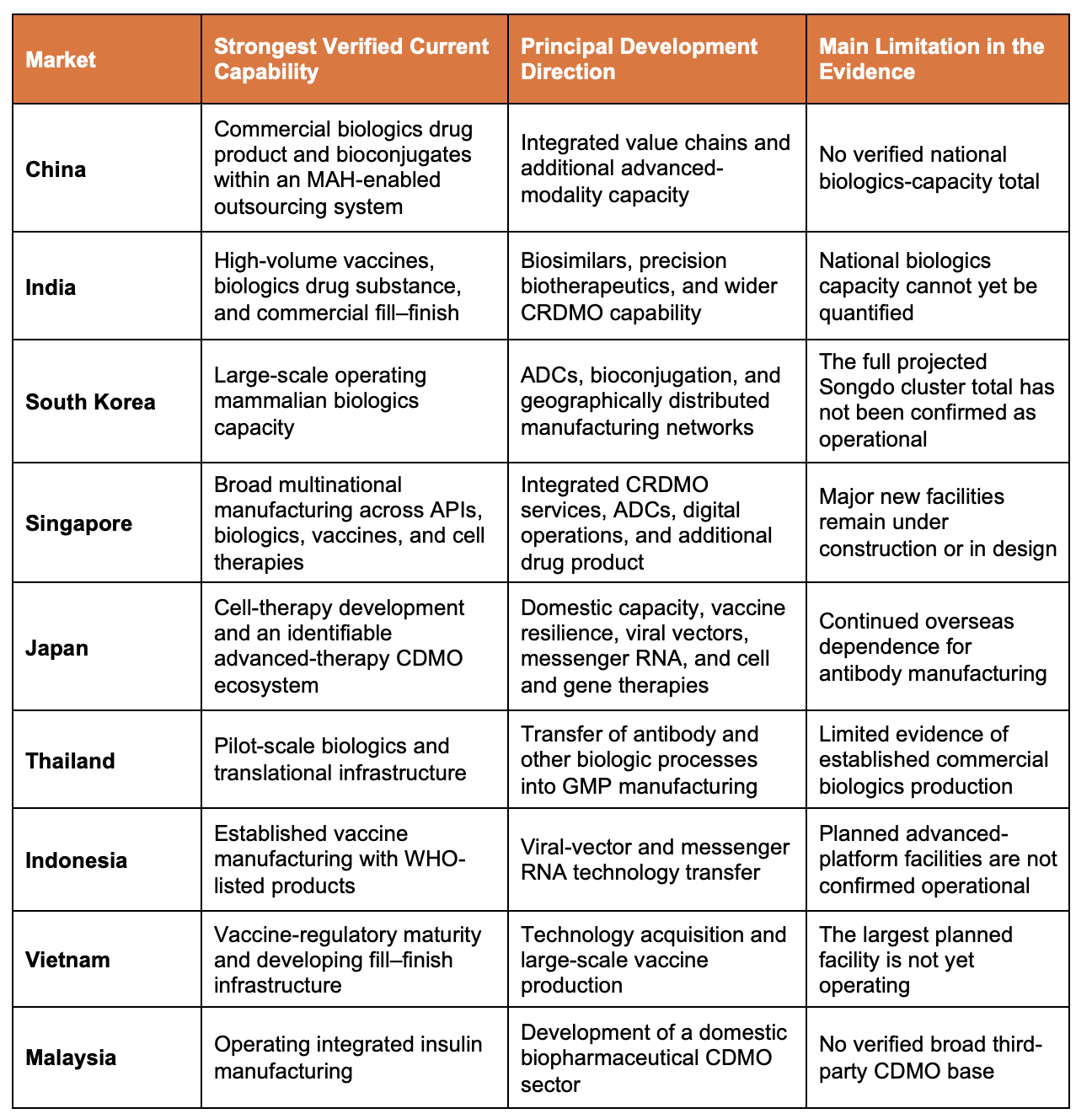
The country profiles reveal several distinct manufacturing models. South Korea represents concentrated, operating mammalian-biologics scale, with additional investment in ADCs and international network expansion. India combines established pharmaceutical and vaccine volume with growing biologics drug-substance, fill–finish, and translational capacity. China links an MAH-enabled outsourcing framework with integrated industrial-chain policies and specialized commercial manufacturing.
Singapore offers a different model: a multinational platform supported by infrastructure, workforce programs, regulatory maturity, and investment across multiple modalities. Japan is developing an advanced therapy–centered ecosystem while seeking to reduce dependence on overseas biologics production.
The emerging Southeast Asian markets occupy different positions along the development curve. Thailand is building pilot and technology-transfer infrastructure. Indonesia is extending an established vaccine base toward new platforms. Vietnam is preparing major future vaccine and fill–finish capacity. Malaysia has demonstrated biologics manufacturing but lacks a verified broad domestic CDMO sector.
These models are summarized in Table 1. The table is not a ranking of national quality or attractiveness. It distinguishes the strongest capabilities supported by the current evidence from each market’s principal development direction and remaining limitations.
Table 1. Differentiation Across Asian Biopharmaceutical Manufacturing Markets
 What the New Map Means for Sponsors
The expanding number of Asian manufacturing options creates more choice, but it also requires more precise evaluation. Country selection should begin with the product and process rather than with a general regional preference.
Modality is the first differentiator. A sponsor seeking high-volume mammalian drug substance may place greater emphasis on South Korea’s operating capacity. An ADC developer may examine bioconjugation capabilities in China or South Korea, while a cell therapy company may find Japan’s specialist ecosystem more relevant. Vaccine developers may place greater weight on India’s scale, Indonesia’s established production base, or the future capacity planned in Vietnam.
Development stage is equally important. Thailand’s pilot infrastructure may support process translation and early scale-up, but it does not answer the same need as an operating commercial plant. India’s combination of clinical single-use suites, commercial drug substance, and high-speed filling offers a different development-to-commercial pathway. Singapore’s planned integrated facilities may eventually add further options, but sponsors evaluating near-term capacity must distinguish projected operating dates from current availability.
The ownership model of the capacity also requires attention. Biocon’s Malaysian insulin plant demonstrates that sophisticated biologics manufacturing can operate in a country that does not yet have a broad domestic CDMO market. Multinational manufacturing sites may strengthen a national ecosystem without being available for general third-party outsourcing.
Sponsors should also examine how much a market’s capability depends on a small number of companies. South Korea’s scale is concentrated heavily in major Songdo manufacturers. China’s strongest verified examples in this analysis come from selected Wuxi facilities. Concentration can support deep expertise and large investments, but it may also limit the number of genuinely comparable partners.
Regulatory maturity provides useful context, although it cannot substitute for site-level assessment. WHO maturity classifications and PIC/S participation indicate that national authorities have developed important regulatory and inspection functions. A sponsor still needs to evaluate the specific facility’s inspection history, quality system, process experience, analytical capabilities, technology-transfer approach, and ability to support the intended markets.
Network design is becoming another consideration. Samsung’s expansion into the United States and WuXi’s planned Singapore hub show Asian CDMOs developing geographically distributed systems. The resulting decision may concern the configuration of a global network rather than the selection of a single country. One site may provide primary drug substance, another may support drug product or regional supply, and a second geography may offer redundancy.
The difference between announced and operational capacity remains fundamental throughout that evaluation. Construction milestones, policy programs, and projected output can identify the direction of travel, but they should not be treated as available supply until facilities are commissioned and operating.
A Multipolar Manufacturing Region
Asia’s biopharmaceutical manufacturing landscape is becoming more capable, more specialized, and more internally differentiated. China is connecting outsourcing regulation with integrated industrial development. India is extending pharmaceutical and vaccine scale into more complex biologics. South Korea has established concentrated mammalian capacity and is broadening into ADCs. Singapore provides a multinational platform for high-value manufacturing, while Japan is developing advanced-therapy specialization and strategic domestic capacity.
Thailand, Indonesia, Vietnam, and Malaysia are not interchangeable emerging alternatives. Each combines operating capabilities, infrastructure development, and future ambition in a different proportion.
The new manufacturing map is therefore best understood as a set of complementary ecosystems. The relevant question is not which country will dominate Asian biopharmaceutical manufacturing as a whole, but which market, facility, and network best match the modality, development stage, scale, and supply strategy of a particular product.
References
1. “Plant 5: Re-Shaping Biopharma Operations.” Samsung Biologics. 16 May 2025.
2. “WuXi Biologics Singapore CRDMO Hub Completes Modular Topping-Out of Drug Product Facility.” WuXi Biologics. 5 Jun. 2026.
3. Thy, Trúc. “Vietnam to Begin Manufacturing High Technology Vaccines at the VNVC Vaccine and Biological Manufacturing Plant as Early as 2028.” VNVC. 10 Jul. 2026.
4. “Members.” Pharmaceutical Inspection Co-operation Scheme. Accessed 23 Jul. 2026.
5. “India Meets WHO Global Standards for Vaccine Regulation.” World Health Organization. 15 Oct. 2024.
6. “Singapore Medicines Regulator World’s First to Achieve Highest Maturity Level in WHO Classification.” World Health Organization. 27 Feb. 2022.
7. “Viet Nam’s Vaccine Regulatory System Reaches WHO’s Second-Highest Level.” World Health Organization. 12 Apr. 2021.
8. Standing Committee of the National People’s Congress. “Drug Administration Law of the People’s Republic of China.” National Medical Products Administration. 26 Sep. 2019.
9. “Announcement of the National Medical Products Administration on Strengthening Supervision and Administration of Contract Manufacturing of Drugs (No. 134, 2025).” National Medical Products Administration. 14 Apr. 2026.
10. “China Approves Biopharma Innovation Plan for Jiangsu Free Trade Zone.” State Council of the People’s Republic of China. 27 Aug. 2025.
11. “WuXi XDC Named Best CDMO Winner at 2023 World ADC Awards.” WuXi XDC/WuXi Biologics. 20 Oct. 2023.
12. “Commercial Drug Product Manufacturing Service.” WuXi Biologics. Accessed 23 Jul. 2026.
13. “Economic Survey 2025–26 Highlights India’s Shift Toward High-Value Pharma and Innovation.” Press Information Bureau, Government of India, Department of Pharmaceuticals. 30 Jan. 2026.
14. “Strengthening Pharmaceutical Self-Reliance.” Press Information Bureau, Government of India, Ministry of Chemicals and Fertilizers. 19 Aug. 2025.
15. “Parliament Question: BioE3 Policy.” Press Information Bureau, Government of India, Ministry of Science and Technology. Accessed 23 Jul. 2026.
16. “India as a Global CRDMO Powerhouse: Debunking Quality Myths.” Syngene International. Accessed 23 Jul. 2026.
17. “Biologics Contract Research, Development & Manufacturing Organization Services.” Syngene International. Accessed 23 Jul. 2026.
18. “Bavarian Nordic and Serum Institute of India Expand Strategic Partnership with Chikungunya Vaccine Manufacturing Agreement.” Bavarian Nordic and Serum Institute of India. 11 Mar. 2026.
19. “Celltrion’s Commitment to Biopharmaceutical Excellence.” Celltrion. 14 May 2025.
20. “Drug Substance Manufacturing Services.” Samsung Biologics. Accessed 23 Jul. 2026.
21. “End-to-End Bioconjugation Development & Manufacturing.” Samsung Biologics. Accessed 23 Jul. 2026.
22. “Samsung Biologics Reports First Quarter 2026 Financial Results.” Samsung Biologics. 22 Apr. 2026.
23. “Korea’s Bio Clusters Leap Toward a Global Bio Hub: The Convergence of Global Manufacturing Capabilities and an Innovation Ecosystem.” Invest KOREA. Accessed 23 Jul. 2026.
24. “Samsung Biologics Completes Acquisition of GSK’s Manufacturing Facility in Rockville, Maryland.” Samsung Biologics. 31 Mar. 2026.
25. “Singapore Biomed Production Breaks Out of Slump, EDB Says at Least 1,000 New Jobs in Pipeline.” Singapore Economic Development Board. Accessed 23 Jul. 2026.
26. Gan, Kim Yong. “Speech by DPM and Minister for Trade and Industry Gan Kim Yong at AstraZeneca’s Antibody Drug Conjugate (ADC) Manufacturing Facility Groundbreaking Ceremony.” Ministry of Trade and Industry, Singapore. 7 Nov. 2024.
27. “Advanced Manufacturing in Singapore: Built for What’s Next.” Singapore Economic Development Board. Accessed 23 Jul. 2026.
28. “Biotechnology & Pharmaceuticals in Singapore.” Singapore Economic Development Board. Updated 21 Apr. 2026.
29. “WuXi Biologics Breaks Ground on CRDMO Center in Singapore.” WuXi Biologics and Singapore Economic Development Board. 19 Mar. 2024.
30. “Attractive Markets: Life Science.” Japan External Trade Organization. Accessed 23 Jul. 2026.
31. “The Strategy for Strengthening the Vaccine Development and Production System.” Ministry of Economy, Trade and Industry, Japan. Updated 20 Mar. 2023.
32. “METI Published a List of CDMO Companies for Regenerative Medical Products.” Ministry of Economy, Trade and Industry, Japan. 1 Apr. 2025.
33. “Call for an Administrative Organization for the FY2024 Supplementary Subsidy Supporting Investment in Regenerative, Cellular, and Gene-Therapy Manufacturing Facilities.” Ministry of Economy, Trade and Industry, Japan. 6 Jan. 2025.
34. “AGC Biologics Expands Cell Therapy Development Operations to Asia to Serve Growing Market Need.” AGC Biologics. 25 Jun. 2025.
35. “The National Biopharmaceutical Facility (NBF) Extends Research Efforts Towards Commercial Production.” Thailand.go.th. 28 Aug. 2023.
36. “Thailand–Australia Partnership Advances Biomanufacturing for Health Security and Equitable Access to Medicines.” National Center for Genetic Engineering and Biotechnology. 31 Mar. 2026.
37. “President Jokowi Launches IndoVac Vaccine.” Cabinet Secretariat of the Republic of Indonesia. 13 Oct. 2022.
38. “First Ever Vaccine Listed Under WHO Emergency Use.” World Health Organization. 13 Nov. 2020.
39. “WHO Prequalifies an Additional Novel Oral Polio Vaccine, Strengthening Global Outbreak Response.” World Health Organization. 13 Feb. 2026.
40. “Indonesia Establishes Global Cooperation to Accelerate Vaccine Production.” Indonesian Ministry of Health. 3 Oct. 2023.
41. Dung, Thuy. “Gov’t Approves National Strategy for Pharmaceutical Industry Development Through 2030.” Viet Nam Government News. 10 Oct. 2023.
42. Dung, Thuy. “Viet Nam to Build First International Standard Vaccine Plant.” Viet Nam Government News. 16 Jan. 2025.
43. “Global Scale Manufacturing.” Biocon Biologics. Accessed 23 Jul. 2026.
44. “CDMO—Completing Malaysia’s Biopharmaceutical Ecosystem.” Malaysian Investment Development Authority. 20 Feb. 2024.
45. “Basic Regulation.” National Pharmaceutical Regulatory Agency, Ministry of Health Malaysia. Accessed 23 Jul. 2026.