
Key Takeaways
Platform process development uses established unit operations, process parameters, analytical strategies, and prior knowledge as a starting point for multiple molecules within a related product class.
Molecule-specific development builds or substantially adapts the process around the individual molecule rather than assuming that a standard platform will provide the optimal manufacturing solution.
Platform approaches can reduce development time, experimentation, technology-transfer complexity, and risk by avoiding unnecessary reinvention.
Molecule-specific optimization becomes important when a candidate exhibits unusual expression, stability, impurity, aggregation, purification, or product-quality behavior.
The most effective strategy is often platform-first rather than platform-only: standardize operations that behave predictably across molecules, while preserving the flexibility to customize the steps that materially affect product quality or process performance.
Why This Comparison Matters Now
Biologics process development has traditionally involved extensive experimentation to identify appropriate upstream and downstream conditions for each new therapeutic molecule. As companies and CDMOs accumulated experience producing monoclonal antibodies and other increasingly standardized product classes, however, many began converting that knowledge into platform processes that could provide a common starting point for successive programs.
The logic is compelling. If dozens of antibodies can be expressed using related CHO cell culture systems, purified using similar protein A capture and polishing sequences, and formulated using established development frameworks, rebuilding the entire process from first principles for every candidate can consume time and resources without necessarily producing a better process.
Platform approaches therefore seek to distinguish between what is genuinely molecule specific and what is repeatable. Cell line development workflows, media and feeds, chromatography sequences, viral clearance strategies, analytical methods, process-control approaches, and even ranges for key operating parameters may be informed by experience with previous products. Developers can begin with this prior knowledge and focus experimentation on areas where the new molecule behaves differently.
But biologics are not interchangeable. Differences in molecular structure can affect expression level, aggregation propensity, charge variants, glycosylation, stability, host-cell protein clearance, chromatography behavior, and other critical quality attributes. Bispecific antibodies, fusion proteins, antibody fragments, and increasingly complex recombinant proteins may deviate substantially from the behavior established using conventional monoclonal antibodies.
This creates an important development question: how much of the manufacturing process should be standardized, and when should the molecule be allowed to dictate a different process?
As development timelines compress and pipelines become more diverse, the answer increasingly lies between the extremes. Platform development can provide a fast, de-risked starting point, but molecule-specific process understanding remains necessary to demonstrate that the platform is appropriate for the product being manufactured.
 Mechanistic Differences
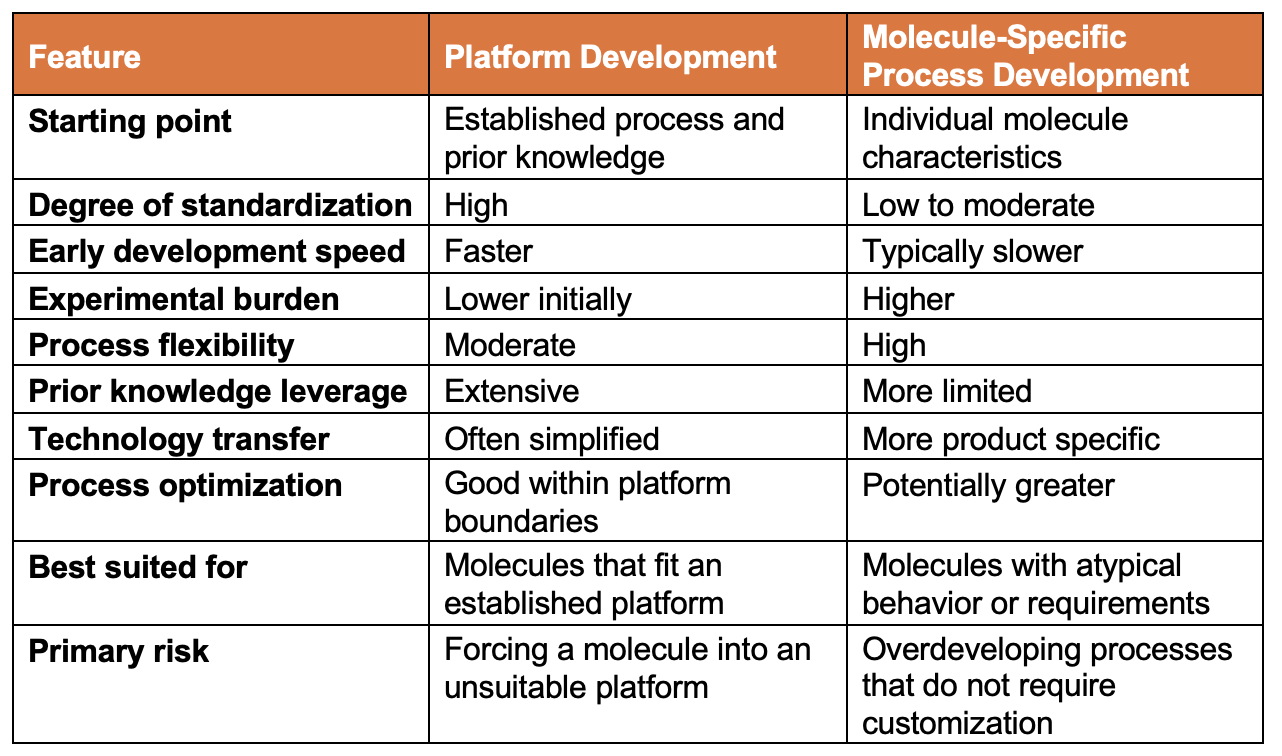
Platform development begins with the assumption that certain manufacturing behaviors are sufficiently consistent across a product class to support reuse of prior knowledge. Rather than asking what process should be built from scratch for a new molecule, developers first ask whether that molecule can be manufactured within an existing process framework.
For a conventional monoclonal antibody, for example, an organization may already have an established host cell line, upstream production strategy, media and feeding platform, protein A capture step, polishing chromatography sequence, viral clearance approach, and formulation-screening workflow. Historical process and product data can establish expected ranges for yield, impurity clearance, product quality, and process performance.
The new molecule is then evaluated against those expectations. Development work becomes focused on confirming platform fit and identifying exceptions rather than independently optimizing every operation.
Molecule-specific development reverses that emphasis. The molecular properties and observed process behavior of the candidate determine the development path. Developers may screen broader ranges of culture conditions, resins, buffers, chromatography modes, purification sequences, or formulation conditions to identify a process tailored to that specific product.
The distinction is therefore less about whether experiments are performed and more about where development begins and what must be proven. A platform process starts with accumulated knowledge and challenges the new molecule to reveal where customization is needed. A molecule-specific approach starts with the individual product and builds the process outward from its observed behavior.
Manufacturing and Operational Considerations
Speed is one of the strongest advantages of platform development. Reusing established process knowledge can reduce the number of screening experiments needed during early development and allow teams to move more rapidly from candidate selection toward material generation and clinical manufacturing.
Standardization can also simplify operations beyond process development. Common equipment, raw materials, resins, buffers, single-use assemblies, analytical methods, and manufacturing workflows can reduce supply-chain complexity and make technology transfer more predictable. For organizations running multiple programs through the same facilities, these efficiencies can compound across the portfolio.
Platforms can additionally improve organizational learning. Each molecule manufactured using the platform generates additional process knowledge that can refine acceptable ranges, identify recurring failure modes, and strengthen understanding of which parameters truly matter. A mature platform therefore becomes more than a standard process; it becomes a body of prior knowledge that can inform risk assessment and development decisions for subsequent products.
The danger arises when standardization becomes a constraint rather than an advantage. A molecule with poor expression may require different upstream conditions. An unusual impurity profile may not respond adequately to the standard downstream sequence. A protein prone to aggregation may require changes in buffers, hold times, processing temperatures, or formulation conditions. A purification step that performs well for conventional antibodies may have very different selectivity for a bispecific or other engineered format.
Attempting to preserve the platform in those situations can create false efficiency: development may initially move faster, only for difficulties to emerge during scale-up, characterization, validation, or commercial manufacturing.
Molecule-specific development provides greater freedom to solve those problems early, but excessive customization carries its own cost. Every novel unit operation, material, or operating condition introduces additional development, characterization, validation, sourcing, and technology-transfer requirements. Customization that does not provide a meaningful improvement can therefore add complexity without adding value.
Regulatory and Quality Implications
Platform development does not eliminate the requirement to understand and control the manufacturing process for the individual product. Regulators ultimately evaluate whether the process consistently produces a drug substance or drug product meeting its predefined quality requirements.
Prior knowledge can nevertheless be valuable. Experience with related products, manufacturing operations, analytical methods, and control strategies can help developers identify likely critical process parameters, understand sources of variability, establish development ranges, and construct more focused risk assessments.
Regulatory frameworks around quality by design similarly recognize that product and process understanding can be built using both prior knowledge and product-specific studies. The key is demonstrating that knowledge derived from the platform is relevant to the new molecule rather than simply assuming that previous experience transfers automatically.
For novel molecules or formats, the burden of product-specific understanding may consequently increase. If an engineered protein behaves differently from the molecules used to establish the platform, developers need sufficient data to characterize those differences and determine whether changes to the manufacturing process or control strategy are necessary.
A mature platform should therefore support regulatory development by generating useful prior knowledge, not by eliminating product-specific evidence.
Best Fit by Use Case
Platform development is typically preferred when:
the molecule belongs to a well-characterized product class, such as a conventional monoclonal antibody
the organization has extensive prior experience using the same expression and purification platform
accelerated development timelines are important
established operations can achieve the required yield, purity, and product-quality profile
multiple pipeline products are expected to use common manufacturing infrastructure
streamlined technology transfer and supply-chain standardization provide meaningful operational advantages
Molecule-specific process development is typically preferred when:
the molecule exhibits unusual expression, stability, aggregation, or purification behavior
the product has an atypical impurity or product-quality profile
novel molecular formats such as bispecifics, fusion proteins, or engineered constructs challenge established platform assumptions
standard unit operations cannot reliably achieve the required quality attributes
maximizing yield or product quality justifies additional development effort
the molecule’s clinical or commercial requirements make optimization particularly valuable
Verdict
Platform development offers one of the most powerful ways to accelerate biologics development because it converts accumulated manufacturing experience into a reusable starting point. For molecules that behave within an established platform’s boundaries, rebuilding every unit operation from scratch provides little benefit and can unnecessarily consume development time, material, and resources.
Molecule-specific development remains essential, however, because the product — not the platform — ultimately defines the required quality profile. Biological molecules can differ in ways that materially affect expression, purification, stability, and manufacturability, and those differences become increasingly important as pipelines expand beyond conventional monoclonal antibodies into more complex protein formats.
The strongest development strategy is therefore usually neither complete standardization nor complete customization. It is platform-first, molecule-responsive development: use prior knowledge and standardized operations wherever they remain scientifically justified, identify deviations quickly, and focus molecule-specific experimentation on the parameters and unit operations where customization can meaningfully improve process performance or product quality.
In that model, the platform serves as a starting point rather than a constraint. Developers standardize what they can and customize what they must — capturing the speed and accumulated knowledge of platform development without sacrificing the process understanding required for the individual molecule.