Key Takeaways
Spray drying has become the dominant manufacturing route for amorphous solid dispersions, reflecting its central role in enabling oral delivery of poorly soluble small-molecule drugs.
Rising molecular complexity is driving sustained demand for advanced particle engineering, as more development programs rely on ASDs to achieve bioavailability and therapeutic performance.
Commercial spray-drying capacity is increasingly constrained, with long lead times for equipment, facilities, and operational expertise creating a bottleneck for late-stage programs.
Formulation decisions now shape manufacturing strategy, requiring sponsors to consider scalability, solvent systems, and polymer selection much earlier in development.
Spray drying is evolving into pharmaceutical infrastructure, differentiating companies that can reliably manufacture complex formulations at commercial scale from those that cannot.
Spray Drying as a Core Enabler of Modern Oral Drug Development
Spray drying is now firmly established as a core manufacturing route for enabling oral delivery of poorly soluble small molecule drugs. As molecular complexity increases across development pipelines, bioavailability enhancement has become a routine requirement rather than an occasional formulation challenge.
Amorphous solid dispersions (ASDs) are widely used to address these constraints, and spray drying has emerged as the dominant commercial manufacturing pathway for producing them. Regulatory precedent, expanding clinical adoption, and continued pipeline complexity have positioned spray drying as a standard element of modern oral solid dose (OSD) development. Over the past decade, ASD manufacturing has moved firmly into the commercial mainstream: 80 ASD drug products were approved by the U.S. Food and Drug Administration between 2012 and 2023.1 Commercial ASD manufacturing is concentrated primarily in spray drying and hot-melt extrusion, with spray drying widely adopted for its ability to control particle properties, accommodate thermally sensitive materials, and support scalable production.
As more programs rely on ASD-based formulations, demand for commercial-scale spray-drying capacity continues to grow. Market analyses project sustained expansion in pharmaceutical spray drying, with the global market expected to grow at approximately a 7% compound annual growth rate between 2026 and 2031.2 The ability to translate laboratory success into reliable large-scale production has therefore become a defining operational consideration. Spray drying sits not only at the center of formulation science but increasingly at the center of manufacturing strategy, functioning as a foundational capability for modern oral drug development.
From Formulation Technique to Manufacturing System
Spray drying is often discussed in terms of formulation performance, but commercial supply depends on far more than the spray dryer itself. The drying unit operation is only one component of a tightly integrated manufacturing environment that must support solvent handling, containment, recovery, process control, safety systems, and validated material flows across upstream and downstream operations. Reliable commercial production requires this entire ecosystem to function as a coordinated whole.
Commercial-scale solvent-based spray drying introduces infrastructure requirements that extend well beyond standard OSD manufacturing. Facilities must incorporate explosion protection, closed-loop solvent recovery, environmental controls, industrial-scale utilities, and specialized waste management. These systems must operate continuously, meet regulatory expectations for pharmaceutical manufacturing, and remain stable across large commercial campaigns. Building and qualifying this environment requires significant capital expenditure and complex engineering, best served by purpose-designed facilities rather than retrofitted production space.
Organizational and quality systems capable of supporting routine commercial supply are equally critical. Spray-dried ASD manufacturing requires validated processes, reproducible scale-up, established deviation management practices, and teams with the expertise and experience to ensure that consistent performance and product attributes are maintained across batches and campaigns. Long-term operational reliability depends not only on technical knowledge of spray drying, but also on accumulated manufacturing experience, including the ability to run campaigns repeatedly, manage variability, and sustain performance over time.
Because the spray dryer itself is only a fraction of the required infrastructure, establishing internal commercial spray-drying capability is not a one-off equipment investment. It requires integrated facility design, specialized workforce expertise, and mature quality and operational systems built specifically around solvent-based particle engineering. These requirements create substantial barriers to entry and long implementation timelines.
For many drug developers, outsourcing commercial spray drying is therefore not simply a matter of convenience but of structural efficiency. Dedicated manufacturing organizations that operate large-scale spray-drying facilities are designed around the infrastructure, regulatory framework, and operational discipline required for sustained commercial production. Their facilities, quality systems, and technical teams are already aligned with the demands of high-volume solvent-based manufacturing.
This distinction also separates contract development and manufacturing organizations (CDMOs) with established commercial spray-drying operations from those historically focused on early development. Development-scale spray drying emphasizes flexibility and rapid iteration, while commercial manufacturing depends on infrastructure robustness, validated processes, and long-term operational continuity. Transitioning from development services to reliable commercial supply requires an organizational model built around sustained manufacturing performance.
With spray drying becoming increasingly integral to modern drug development, commercial production is increasingly concentrated in facilities designed specifically for large-scale operation. The primary constraint is no longer the technology itself but access to integrated manufacturing infrastructure capable of supporting consistent commercial supply.
The Capacity Funnel: Why Scaling Is Harder Than It Looks
As spray drying has advanced from a niche formulation tool into a core manufacturing capability, a structural imbalance has emerged between demand and available capacity. At early development scale, access to spray drying is widely available. Small systems can support feasibility studies and early clinical supply relatively inexpensively and without placing heavy strain on infrastructure. However, this changes as programs advance toward commercial volumes. Larger solvent-based spray-drying systems are fewer in number, and the technical and regulatory requirements to operate them narrow the field of viable manufacturing sites.
This creates a capacity funnel. Many projects can enter at the top, but only a limited number can pass through to sustained commercial production. Bringing new large-scale spray-drying assets online is not a short-term exercise. Equipment procurement alone can take years, and facilities must be designed and built for efficient material flows, solvent handling, containment, and safety systems before qualification and routine operation can begin. These timelines mean that capacity decisions are often made well in advance of clinical or commercial inflection points.
Compounding the challenge is the way demand concentrates. Large, high-volume programs tend to secure capacity early and for long durations, which can crowd out smaller or later-arriving projects. In practice, capacity is frequently committed before equipment is fully operational, and schedules can shift when a major program requires priority access. This dynamic introduces uncertainty for sponsors who assume that manufacturing slots will remain available when they reach late-stage development.
This requires a shift in how we view capacity. What was once treated as a downstream operational concern has become a strategic variable in development planning. Formulation success alone no longer guarantees manufacturability at scale; sponsors must now consider whether the infrastructure needed to support their chosen approach will exist when it is needed and whether it can be secured without disrupting timelines. The constraint, in other words, is not the viability of spray drying but the difficulty of executing it reliably and repeatedly at commercial scale.
Implications for Developers: Planning Beyond the Formulation Problem
The growing reliance on spray drying and ASD manufacturing changes what it means to make an early formulation decision. Choices that appear technical in phase I, such as solvent systems, polymer selection, and target particle attributes, can shape manufacturability years later. A formulation that performs well in the laboratory may encounter obstacles when translated into large-scale production if its underlying design does not account for solvent recovery, throughput limitations, or operational robustness. As such, formulation strategy and manufacturing strategy are no longer separable.
This places greater emphasis on anticipating commercial realities during development. Solvent choice is not only a question of solubility and stability but also of safety systems, regulatory expectations, and long-term sustainability. Polymer systems that perform well in small batches must also be compatible with high-volume processing and consistent downstream tableting. Process design must balance flexibility with repeatability so that scale-up does not require fundamental reengineering. This requires a shift in focus from solving today’s bioavailability problem to designing tomorrow’s supply chain.
Risk management also begins earlier. As commercial-scale spray-drying capacity becomes more constrained, reliance on a single manufacturing pathway carries greater exposure. Second-source strategies and life cycle planning are increasingly part of development discussions rather than contingencies to be addressed after approval. Drug developers must evaluate not only whether a formulation can be made, but where it can be made, how reliably, and under what timeline assumptions. Capacity diversification, formerly considered to be an optimization step, is becoming a structural requirement for programs built on advanced particle engineering.
Successful programs are those that treat spray drying not as a corrective measure for poor solubility but as a platform that must be supported by aligned scientific, engineering, and operational decisions. The implication for sponsors is straightforward but demanding: formulation choices now carry manufacturing consequences that extend across the product life cycle, and those consequences must be addressed deliberately rather than discovered late in development.
Codis: A Dedicated Commercial Manufacturing Partner for Large-Scale Spray Drying
As commercial spray drying becomes increasingly concentrated in specialized facilities, the defining differentiator among manufacturing partners is their ability to operate reliably at commercial scale. Only a relatively small number of facilities globally operate commercial-scale, solvent-based spray-drying systems qualified for sustained pharmaceutical production, and even fewer are designed specifically for routine commercial supply. Long equipment lead times, complex facility requirements, and the need for experienced operating teams make new capacity slow to develop. As a result, access to established commercial spray-drying infrastructure is constrained, particularly for programs transitioning into late-stage development or preparing for market launch. Codis is structured specifically around this requirement, with an operating model built to support sustained commercial supply rather than early-stage formulation development.
The company’s foundation is long-term commercial manufacturing experience. Decades of production across complex spray-dried products have shaped mature quality systems, established operational practices= and organizational structures designed for consistency, repeatability, and regulatory compliance. This experience extends beyond technical process knowledge to the practical realities of commercial supply: managing campaigns at scale, maintaining and improving validated processes over time, and delivering predictable product quality across batches and markets.
Codis’ facilities reflect this commercial focus. Large-scale spray drying is supported by extensive infrastructure for solvent handling, containment, recovery, and environmental control, along with the utilities, safety systems, and process integration required for routine pharmaceutical manufacturing. These supporting systems, which are typically the most difficult and time-consuming elements to establish, are embedded within the manufacturing environment.
Technical transfer and scale-up are central to this model. Transitioning spray-dried products from early development or pilot scale into commercial production requires process understanding, engineering alignment, and structured transfer protocols that preserve particle characteristics and product performance at scale. Codis’ manufacturing organization is designed to support this transition, providing established pathways for transferring processes into validated commercial operation while maintaining continuity of product quality and supply.
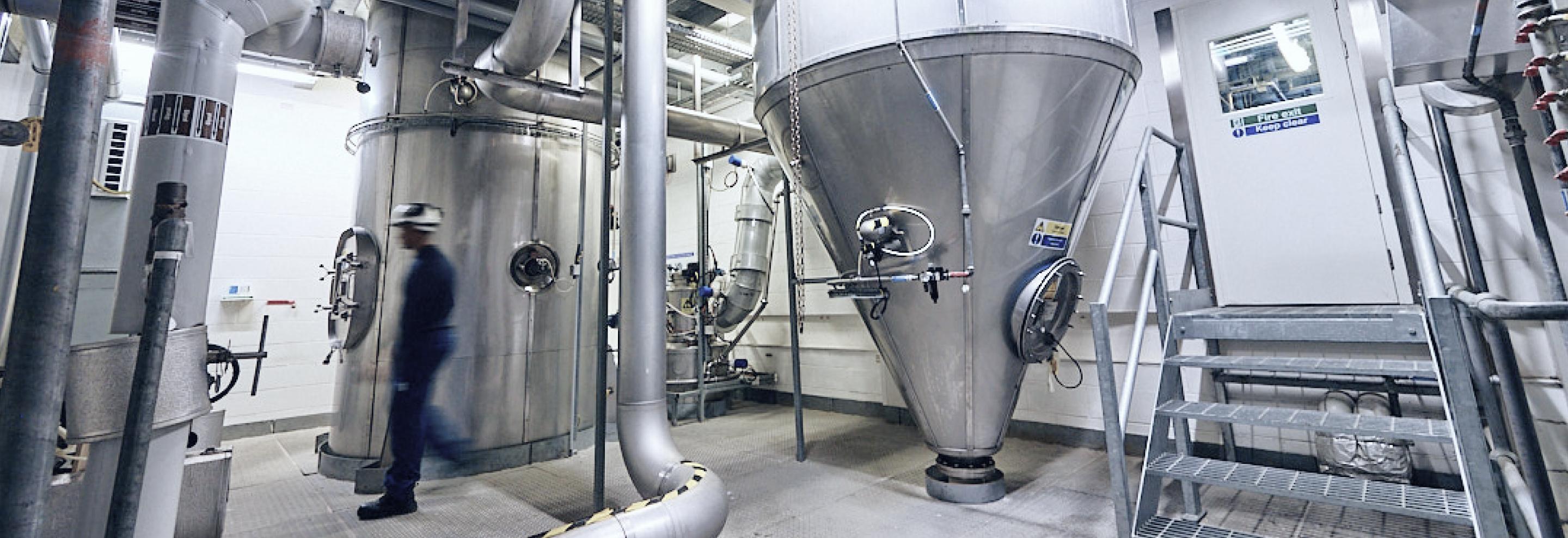
Within the spectrum of commercial spray-drying capacity, systems such as Codis’ PSD2 production spray dryer operate between development-scale equipment and larger high-throughput commercial units. The platform supports intermediate commercial batch volumes while maintaining flexibility across solvent systems and process conditions commonly required for ASD manufacturing. This operating range allows manufacturers to produce material at scales suitable for late-stage clinical supply, product launch, and lower-volume commercial products without requiring immediate transition to the largest commercial installations. The result is greater scale flexibility and more efficient alignment between production capacity and program demand.
This positioning allows the PSD2 to function as a practical bridge between late-stage development and early commercial supply. Programs can transition from pilot or clinical manufacturing into sustained production without an immediate shift to the largest commercial platforms. Facilities operating at this scale can support repeated manufacturing campaigns, production of launch inventory, and supply for early market demand while maintaining process continuity established during scale-up. This reduces the operational disruption and technical risk often associated with large step-changes in manufacturing scale.
A key element of this commercial platform is the company’s large-scale production spray dryers, including the PSD4 system. Currently under construction, and purpose-built for commercial manufacturing, the PSD4 incorporates advanced process control, containment, and safety capabilities designed to support highly potent compounds, including operation at OEB4 containment levels. The system reflects current engineering standards for large-scale solvent-based spray drying, enabling consistent production of complex ASDs under tightly controlled operating conditions.
Codis is purpose-built for commercial manufacturing, with infrastructure, operational systems, and technical expertise aligned specifically around reliable large-scale spray-dried production. By concentrating resources on sustained commercial supply rather than early-stage development, the company maintains facilities, quality systems, and organizational capabilities designed for consistent execution over time. Combined with extensive manufacturing experience and established scale-up and technical transfer pathways, this specialization positions Codis as a dedicated commercial supplier for spray-dried pharmaceuticals. In an environment where commercial spray-drying capacity is limited and scale transitions can introduce significant operational risk, this model provides a manufacturing platform designed to reduce program risk by supporting regulatory readiness, operational stability, and long-term supply continuity.
Conclusion: Spray Drying as Strategic Infrastructure
The trajectory of ASD-based products suggests that spray drying will remain a central and growing feature of pharmaceutical development rather than a transitional solution. Regulatory approvals over the past decade show a steady presence of ASD formulations across therapeutic areas, reflecting their role as a standardized response to solubility and bioavailability challenges in modern small-molecule pipelines. Market projections reinforce this pattern, pointing to continued growth in pharmaceutical spray drying as advanced particle engineering becomes more deeply embedded in development strategies.
However, the expansion of manufacturing capability does not move at the same pace as scientific adoption. Commercial spray-drying systems require significant investments, long lead times for equipment procurement, facility readiness, and operational qualification. Expertise accumulates through repeated execution rather than rapid scaling, creating a persistent gap between rising demand and available capacity. This imbalance is likely to persist even as new investments come online, making manufacturing readiness a defining constraint rather than a secondary consideration.
As a result, spray drying is becoming a differentiator in the commercialization of complex small-molecule therapies. The competitive divide is shifting away from who can design sophisticated formulations toward who can manufacture them reliably and consistently at scale. Particle engineering decisions increasingly shape not only bioavailability but also supply continuity, scalability, and life cycle management.
More broadly, the evolution of spray drying signals a structural change in how the industry approaches complex molecules. What began as a technical solution has become part of pharmaceutical infrastructure, requiring sponsors to treat advanced formulation not as a development fix but as a manufacturing strategy integral to long-term product success. Codis exemplifies the specialized commercial manufacturing model required to deliver reliable large-scale spray-dried production in an increasingly infrastructure-constrained environment.
References
1. Moseson, Dana E, et al. “Trends in amorphous solid dispersion drug products approved by the U.S. Food and Drug Administration between 2012 and 2023.” Int. J. Pharm. X. 3:7:100259 (2024).
2. Pharmaceutical Spray Drying Market Size & Share Analysis – Growth Trends and Forecast (2026 – 2031). Mordor Intelligence. 2025.