
State of the Industry 2026
Inside the CDMO
Landscape
Economic and geopolitical uncertainty is redefining biopharma sponsor-CDMO strategy. This Nice Insight Report draws on expert panels and proprietary analysis to examine the partnerships and market forces shaping the global CDMO landscape.
State of the Industry 2026
Inside the CDMO Landscape
Economic and geopolitical uncertainty is redefining biopharma sponsor-CDMO strategy. This Nice Insight Report draws on expert panels and proprietary analysis to examine the partnerships and market forces shaping the global CDMO landscape.
The Factors Shaping Biopharma Manufacturing
The Factors Shaping Biopharma Manufacturing
The biopharma industry is adapting to its new reality of continued economic and geopolitical uncertainty, which is reshaping sponsor-CDMO relationships; forging partnerships founded on discipline and financial constraint. This Nice Insight Report, informed by our own insights and a series of panel discussions with industry experts, explores the shifting trends, market dynamics and ongoing innovation that will shape the global CDMO landscape in 2026 and beyond.
The CDMO Landscape in Numbers

500+
CDMOs tracked globally across all modalities
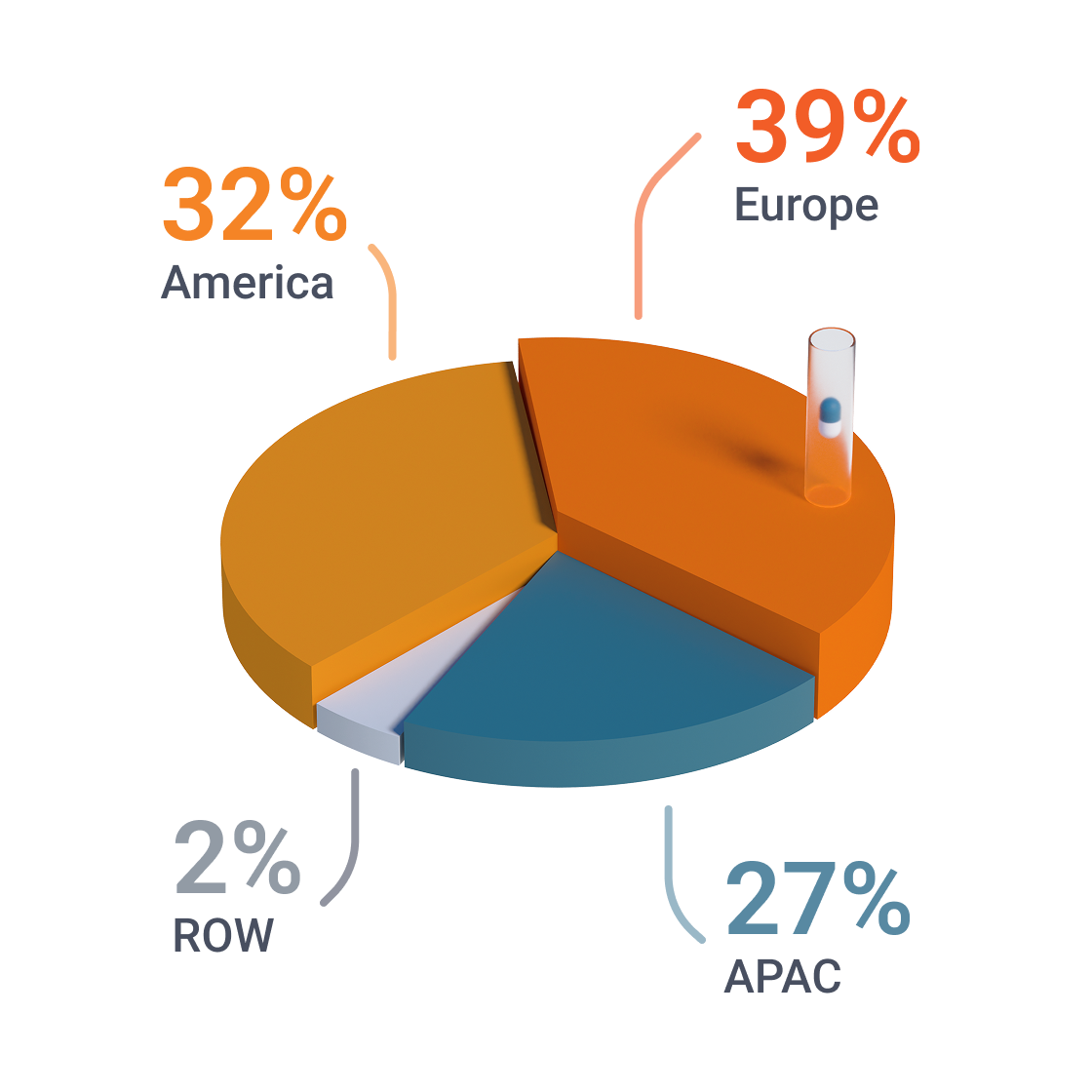
1,934
manufacturing sites (32% Americas, 39% Europe, 27% APAC, 2% ROW)

43
FDA Therapeutic Approvals by October 2025, maintaining the 7 year average

2
antibody-drug conjugates (ADCs) approved in 2025; the first since 2022

113
CDMOs offering dedicated fill/finish capabilities (74% of which are in North America)

99
CDMOs offering ADC conjugation; double the number identified in 2024

45-50%
drop in pricing for clinical batch scales (sub 2000L) of mammalian proteins since 2022-23 peak

10%
annual increase in fill/finish process since GLP-1 agonists entered the market

7%
drop in CDMOs with a single specialised focus in RNA from 2025

Operations, Serán
Bioscience
We’ve seen large pharma in particular consolidate their outsourcing strategies this year, often trying to keep more of their supply in the U.S. They are increasingly open to strategic models... That said, once you’re in the relationship, pharma can quickly revert to transactional behavior.”
The Global Therapeutic Pipeline Remains Strong
The global therapeutic pipeline remained strong during 2025, with 43 new drugs approved by the U.S. Food and Drug Administration (FDA) by the end of Q3. New modalities are experiencing accelerated growth, evidenced by the fact that 8 of the 10 best-selling biopharma products in 2025 are new modality drugs (Source: BCG).


50% of 2025 FDA
approvals were for
small molecules

11 monoclonal
antibodies approved
by end of Q3 2025,
including 1 bispecific and 2 ADCs.

8 new advanced
therapies approvals
1 viral vector–based gene therapy, 2 gene-modified cell therapies, and 5 RNA-based therapies
The Global CDMO Landscape
During 2025, Nice Insight actively tracked over 500 CDMOs globally, an increase from the 400 CDMOs tracked in 2024. This increased CDMO coverage is the result of a focused landscape analysis to better map the small molecule active pharmaceutical ingredient (API), oral solid dose (OSD), and sterile fill/finish CDMO sectors.


Small Molecules APIs
- Demand outpaced capacity for highly potent APIs (HPAPIs) and those with complex specialized chemistry requirements
- 30% of global CDMOs can manufacture small molecules
- Europe and APAC dominate the API manufacturing landscape
- Efforts to reshore or onshore API manufacture continues to gain momentum
Sterile Manufacturing
- 113 CDMOs offer dedicated sterile fill/finish capabilities, across 212 sites
- 74% of aseptic manufacturing sites are in North America (31%) or Europe (43%)
- Investment is focused on bringing new isolator-based, multiproduct and flexible capacity online

mAbs and ADCs
- 19% of 500+ global CDMOs manufacture mAbs
- 99 CDMOs can perform ADC conjugation; double the number from last year
- 5 CDMOs globally can offer mammalian production, API synthesis, conjugation capability and HPAPI fill

Director, Nice Insight
The political agenda in the U.S. for reshoring of API manufacturing presents both significant opportunities and challenges for U.S.-based CDMOs. The various capital investments promised in 2025 by large pharma will take several years to be fully realized, so in the short-term the reshoring policy is likely to drive demand for domestic manufacturing services to already established and operational CDMOs.”
2025 appears to have marked an inflection point where talent became a little-discussed but clear determinant of competitiveness.
Every panel, regardless of modality, returned to a single recurring constraint: even when funding is available and infrastructure exists, the work can only move as fast as qualified people allow it to.
The industry’s talent shortage is no longer a short-term aftershock of the pandemic or the “great resignation.”
It has evolved into a structural limitation that threatens to slow regionalization and stall innovation. Rapid facility expansion across the United States and Europe — spurred by tariffs, onshoring incentives, and diversification away from China — has outpaced the available labor pool.


Leaders
You can add bioreactors faster than you can train operators. Projects are increasingly constrained by the availability of people rather than equipment or capital. The most acute pain points are in high-skill areas, such as aseptic manufacturing, analytical development, and viral-vector processing, where hands-on expertise cannot be quickly replaced by automation.”
CDMO Pricing Dynamics
As budgets and timelines shrink, CDMOs have had to step up to become true strategic partners to their customers, functioning as extensions of their clients’ internal R&D and manufacturing departments. This has resulted in a shift in pricing strategy and dynamics in the outsourcing market. Understanding the nuances of CDMO pricing is critical for clients, investors and competitors seeking a competitive edge in 2026 and beyond.

HPAPIs
- Pricing for HPAPI manufacture surged in 2025
- This reflects equipment and safety premiums, as well as the scarcity of trained staff

Advanced Therapies
- In response to demand from early-stage clinical clients, CDMOs have introduced feasibility and manufacturing batches, priced between $50,000 and $190,000 depending on scale
- There’s no geographic variability in pricing for advanced therapies manufacture.
- Overall, GMP batch list pricing has remained relatively stable over 2024 – 2025

Biologics
- Clinical batches of 2,000L or lower have dropped between 45 – 50% from a 2022-23 peak
- Commercial projects have not seen the same fluctuations
- In 2024, the cost of a 1,000L single-use bioreactor batch was 50% lower in China than in North America

Sterile
- Capacity constraints have created strong upward pressure on manufacturing service fees; rising over 10% annually since the introduction of GLP-1 agonists to the market
- Clinical sterile prices have increased 20% since 2023
- CDMOs may charge smaller developers price premiums of 20% - 30% above listed prices

Director, Nice Insight
2025’s pricing dynamics reveal a global recalibration: sponsors seek flexibility, CDMOs seek strategic partnerships, and patients wait for affordability to catch up with discovery. The tension between innovation and access sharpens, but it also inspires new models, shared risk, performance-based contracts, and global supply harmonization. As we enter 2026, pricing power now stems from scarcity of expertise, specialized infrastructure, and regulatory mastery, not from scale alone.”
The Ups and Downs of Advanced Therapies
The Ups and Downs of Advanced Therapies
In 2025, CDMOs that specialize in early clinical-phase development and manufacturing of mRNA-based products faced significant headwinds that are expected to remain throughout 2026. Many mRNA-focused CDMOs were competing for a very limited number of clients, resulting in the need to restructure resources and operations or shut down completely during 2025.

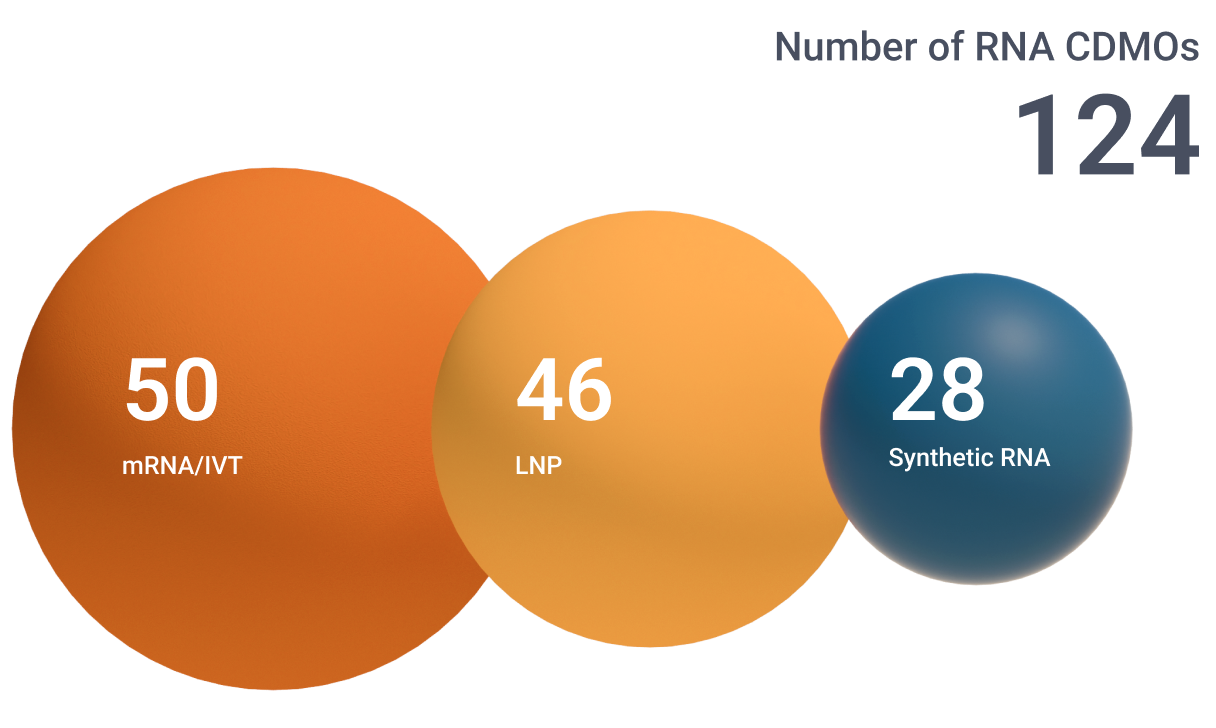
There are 124 CDMOs offering RNA based services; this represents an expansion from 79 companies in 2024, but a reduction in single focus specialization (from 37% in 2024 to 25% in 2025)
There are 124 CDMOs offering RNA based services; this represents an expansion from 79 companies in 2024, but a reduction in single focus specialization (from 37% in 2024 to 25% in 2025)
CDMOs offering synthetic RNA services are proving slightly more resilient due to different cost structures involved in running synthetic vs IVT approaches.

Almanac
2025 has been a bleak year for mRNA CDMOs. The funding landscape hit emerging mRNA therapeutic developers particularly hard in 2024, and in 2025 a dwindling preclinical pipeline shrunk even further. Add to that the U.S. government termination of vaccine research programs, and larger-scale mRNA projects also came under threat.”
The CDMO landscape for viral vector manufacture divides between those vector types more suited to in vivo gene therapy and those employed mainly for ex vivo cellular modification.
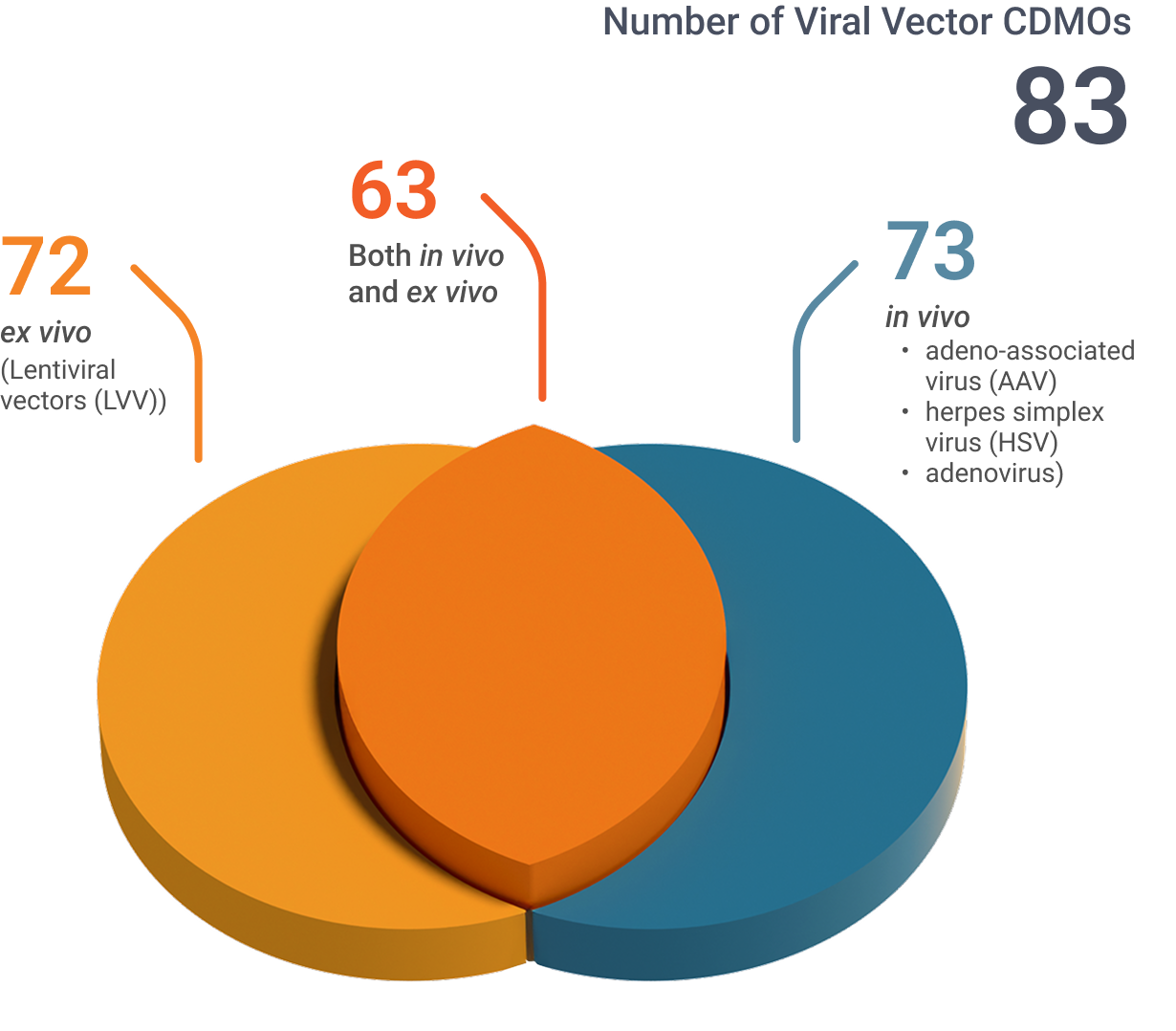
- There are 83 CDMOs offering viral vector based capabilities from 148 manufacturing facilities
- 73 of these CDMOs offer vector production for in vivo use, while 72 offer Lentiviral vector (LVV) manufacturing for ex vivo modification. 63 offer both vector types
- 62 CDMOs across 117 sites offer cell therapy manufacturing
Almanac
The maxim of AAV for in vivo and LVV for in vitro is set to be challenged over the next couple of years, as limitations in the size of payload that can be packaged into an AAV become more problematic, while molecular design of LVV moves towards optimization for in vivo use. CDMOs who want to get ahead of this trend should start thinking about efficient scale-up for LVV manufacture, as required batch sizes increase for in vivo use.”
Looking ahead to 2026

Overall, 2025 has emerged as a year of pragmatic execution under persistant constraint. The anticipated investment rebound never materialized; instead, sponsors and CDMOs alike accepted that they could no longer wait for more favorable capital conditions.

2026 is expected to bring a gradual consolidation around resilience and specialization. Sponsors are increasingly drawn to CDMOs that demonstrate depth rather than breadth and can offer measurable expertise in HPAPI containment, ADC payload–linker conjugation, complex sterile/device integration, or vector-specific CGT manufacturing.

The “one-stop shop” narrative is giving way to “best-in-class within a network,” where interoperability across trusted specialists replaces vertical integration.
However, even the most grounded predictions come with caveats. The global CDMO market remains sensitive to policy swings and technological inflection points that could rapidly alter today’s equilibrium.

Director, Nice Insight
In 2026, the global CDMO market will pivot on three critical axes: technological sophistication, capacity resilience, and transformative challenges. Success will favour CDMOs that marry technological agility with operational robustness and strategic foresight.”

Nice Insight is the market research division of That's Nice LLC, A Science Agency.
Visit our website at niceinsight.com
© Nice Insight 2025
New York | Chicago | Bristol | Raleigh | Oklahoma City | San Diego | Houston | London | Manchester | Frankfurt | Hangzhou