

While innovation in pharmaceutical therapies is accelerating, a significant population — older adults in long-term care (LTC) — remains underserved. New research from PointClickCare Life Sciences reveals stark disparities in the adoption of new medications for common chronic conditions within LTC facilities. Here, we explore the multifactorial barriers that prevent equitable access, including systemic biases, operational hurdles, and prescriber behavior — probably based in provider education. Drawing on insights from real-world data and a medication access initiative, we examine why treatment gaps persist — and how payers, providers, and policymakers can close them. With aging populations on the rise, improving access to innovation in LTC isn’t just a clinical necessity — it’s a moral imperative.
Introduction: A Hidden Crisis in Innovation Access
Pharmaceutical innovation has never moved faster. In the past decade alone, transformative new treatments for chronic conditions like diabetes, heart failure, and neurodegenerative diseases have reached the market, driven by groundbreaking science, accelerated regulatory pathways, and record invest-ment in life sciences. Yet while the healthcare system celebrates these advances, one population remains consistently left behind: older adults living in long-term care (LTC) facilities. This paradox — unprecedented therapeutic progress alongside stagnant real-world adoption in LTC settings — is more than a technical gap. It’s a public health failure hiding in plain sight. LTC residents are among the highest utilizers of medications in the U.S. healthcare system. Most residents live with multiple chronic conditions, and many face functional limitations that make treatment optimization critical not just for themselves but for caregivers as well. However, these patients are rarely included in clinical trials and often face steep barriers to accessing the very therapies that could improve their quality of life, reduce com- plications, and avoid costly hospitalizations.
PointClickCare Life Sciences launched its Access to New Medications Research Initiative to examine this persistent access gap. Leveraging PointClickCare’s longitudinal data from over 70% of U.S. LTC facilities — including electronic health records (EHRs), claims, and pharmacy data — this initiative aims to quantify disparities in treatment, uncover underlying causes, and identify actionable paths forward. Preliminary findings from a retrospective analysis of LTC residents reveal sharp variation in treatment access across common chronic conditions.1 In some cases, eligible patients remain untreated with newer, guideline-recommended medications.
Addressing this challenge is no longer optional. As the U.S. population continues to age and chronic disease rates rise, ensuring equitable access to innovation in LTC is essential, not just for improving individual outcomes but for the long-term sustainability of the health-care system. If the benefits of medical progress are not reaching those who need them most, then progress itself must be redefined.
The Reality on the Ground: What Early Research Reveals
Initial findings from PointClickCare Life Sciences’ Access to New Medications Research Initiative — presented in six abstracts accepted to the 2025 American Society of Consultant Pharmacists (ASCP) Annual Meeting — offer the most comprehensive real-world view to date of pharmacologic treatment patterns for older adults LTC. Drawing on 1.6 million resident records from January to April 2025, these analyses show that while many residents receive at least one guideline-concordant therapy, treatment gaps, inequities, and inertia remain widespread.
Multichronicity: The Hidden Driver of Treatment Patterns
Across the five most common chronic condi-tions in LTC — hypertension, hyperlipidemia, diabetes, depression, and Alzheimer’s disease and related dementias (ADRD) — treatment rates ranged from 60% to 90% depending on the presence of multiple conditions. For example, residents with depression were less likely to receive ADRD-related therapy if they also carried a dementia diagnosis, while those receiving treatment for diabetes or hypertension were more likely to also receive lipid-lowering drugs. These findings suggest prescribing is not determined by single diseases alone but by the interplay of comorbidities, underscoring the need for more nuanced, individualized guidelines.
Hypertension: A Common Yet Under-Treated Condition
Among nearly 994,000 residents with hypertension, 81% received pharmacologic treatment, meaning almost one in five were untreated. Beta blockers, calcium channel blockers, and ARBs were most common, while renin inhibitors and aldosterone antagonists were almost never used. Untreated residents were disproportionately those with diabetes, Lewy body dementia, and hyperlipidemia.
Hyperlipidemia: Heavy Reliance on Statins, Underuse of New Agents
Of the 792,000 residents with hyperlipidemia, only 74% were treated. Statins accounted for the majority of prescriptions (70%), while newer classes, such as PCSK9 inhibitors, were prescribed to less than 1% of residents. Female residents and residents with diabetes or Lewy body dementia were less likely to receive therapy.
Diabetes: Widespread Treatment, but Limited Uptake of Innovation
Among 540,000 residents with diabetes, 73% were prescribed at least one therapy. Insulin (46%) and biguanides (30%) dominated use, while newer classes, such as SGLT2 inhibitors (16%) and dual GIP/GLP-1 receptor agonists (< 2%) were prescribed far less often. Untreated residents tended to be older, and more often resided in the Midwestern or Southern United States, echoing regional disparities observed across other conditions.
Depression: High Treatment Rates, but Missed Opportunities
Of 396,000 residents with depression, 82% received at least one antidepressant. SSRIs (49%), atypical antidepressants (34%), and SNRIs (18%) were most common, while tricyclics, MAOIs, and serotonin modulators were rarely used. Even for such a prevalent mental health condition, nearly one in five residents remained untreated. Black or African American residents had the lowest odds of receiving depression medication. These findings point to the need for increased trust and access to depression medications for those where stigma and systemic barriers may prevent care.
Alzheimer’s Disease and Related Dementias: Behavioral Management Prevails
In the 435,000 residents diagnosed with ADRD, 73% received treatment, but prescribing was heavily weighted toward behavioral management (60%) rather than cognitive enhancers (36%) or disease-modifying agents (<1%). More than one in four residents received no pharmacologic therapy at all. Un-treated residents were predominantly older, taking diabetes medication, and in the Western United States. These findings underscore the difficulty of aligning ADRD care with emerging guidelines and highlight the slow uptake of newer anti-amyloid therapies. Taken together, these early findings rein-force the importance of real-world data in exposing treatment gaps and guiding interventions. They also highlight the critical role of consultant pharmacists and interdisciplinary teams in ensuring that older adults in LTC receive equitable, evidence-based, and up-to-date pharmacologic care. Across conditions, the analyses reveal a consistent story:
Most residents receive some treatment, but gaps remain (18–27% untreated across conditions).
Prescribing is shaped by comorbidities, sometimes leading to under-treatment.
Newer therapies are rarely adopted, even when included in guidelines.
Geographic and demographic variation cuts across conditions, pointing to systemic inequities.
Understanding the Barriers
The data alone make a compelling case: many LTC residents are not receiving older, well-accepted medications, and even fewer receive the latest evidence-based treatments for chronic conditions. To address this access gap, we must first understand the layered, interdependent barriers that keep it in place. These include systemic age-related biases, the complexity of clinical practice in LTC, economic fragility within the pharmacy ecosystem, and behavioral inertia in prescribing habits (Figure 1).
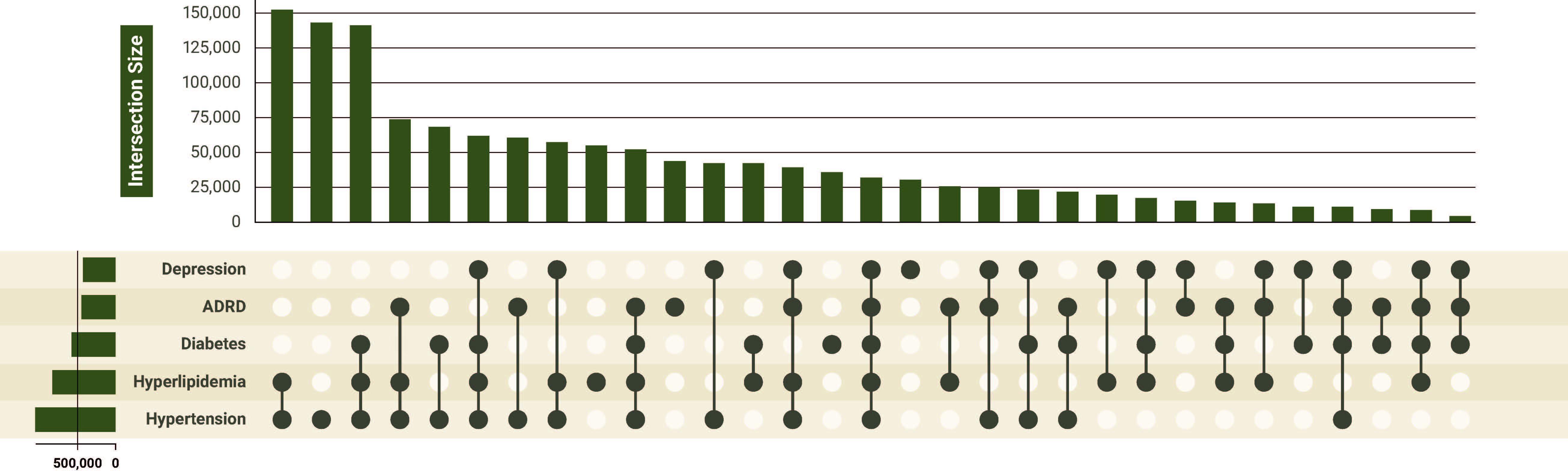 Figure 1. Upset plot showing the intersection sizes of five chronic conditions: depression, ADRD, diabetes, hyperlipidemia, and hypertension. Each bar represents the number of residents with a specific combination of conditions, as indicated by the filled circles in the matrix below the bars. The largest intersection includes residents with both hyperlipidemia and hypertension.
The most prevalent combination of chronic conditions observed includes residents with both hyperlipidemia and hypertension, totaling approximately 150,000 residents. The second most common intersection was residents with just hypertension. Diabetes, hyperlipidemia, and hypertension comprise the third most common intersection among residents. Other notable combinations include those with ADRD, hyperlipidemia, and hypertension, as well as diabetes and hypertension. A small subset of residents with all five conditions concurrently totals just over 25,000. These findings highlight the frequent co-occurrence of hypertension and hyperlipidemia with other chronic conditions and underscore the complexity of multimorbidity patterns in LTC.
Systemic and Structural Factors
At the foundation of the access gap is a persistent form of ageism that is subtle but deeply ingrained. Clinical trial protocols routinely exclude older adults with multiple comorbidities, resulting in a weak evidence base to guide prescribing in LTC settings. Ruscica et al. (2018) further emphasized that most randomized controlled trials (RCTs) on statin efficacy historically excluded individuals over 75 years of age, resulting in a lack of robust evidence for this population.2 Medlinskiene et al. (2021) highlight that the average time for evidence-based interventions, including pharmacologic therapies, to become standard practice is approximately 17 years.3 This delay is especially concerning in LTC environments, where residents often have complex chronic conditions that could benefit from timely access to newer, more effective treatments. This exclusion has real consequences: without clear evidence tailored to this population, clinicians are often reluctant to initiate newer therapies, even when guidelines support them. Numerous studies have documented the “treatment–risk paradox,” in which older adults, despite being at higher absolute risk for cardiovascular events, are less likely to receive statin therapy.4,5 This paradox is particularly evident in the prescribing of statins and antihypertensive medications.
Polypharmacy — common among LTC residents — adds another layer of complexity. Clinicians managing patients with five or more concurrent medications must weigh the risk of interactions and side effects, often erring on the side of caution.6 This caution can also result in undertreatment or the continuation of outdated regimens, even when newer, safer options are available.
Operational and Economic Challenges
The structure of medication procurement and delivery in LTC introduces further barriers. Formularies can lag behind clinical guidelines, particularly in value-based purchasing programs where cost containment often takes precedence over rapid adoption. Procurement cycles and centralized medication management practices may delay or discourage the use of newer therapies, especially those not yet designated as “preferred.”
Moreover, LTC facilities face chronic staffing shortages and exist in a strict regulatory environment that limits the ability of prescribing clinicians to closely monitor new treatment regimens when shifts do occur. These barriers do more than delay adoption; they often translate directly into higher health care resource utilization, from preventable hospital transfers to costly emergency department visits, when conditions are not managed with the most effective available therapies.
Perhaps most critically, the financial ecosystem underpinning LTC pharmacy is under severe strain. According to a March 2025 Senior Care Pharmacy Coalition survey, 60% of LTC pharmacies anticipate potential closure due to proposed drug pricing reforms that jeopardize the viability of the closed-door pharmacy model.7 If realized, this would dis-mantle a core pillar of medication access for millions of residents.
Clinical Behavior and Cultural Inertia
Clinical conservatism also plays a role. Prescriber adoption of new medications is influenced by social and institutional norms as much as clinical data,8 as well as by the inherent uncertainty of practicing within a complex system. In LTC, where residents often present with multichronicity and polypharmacy, even small changes in therapy can have unpredictable downstream effects. From a complex science perspective, prescribers’ caution may be understood as an adaptive response to uncertainty. Yet without timely access to evolving evidence, this caution risks calcifying into inertia, leaving residents without potentially beneficial therapies.
Even when clinicians are motivated to change, they may lack timely access to the necessary information. Significant gaps remain in providers’ awareness of therapeutic innovations, especially those approved after the initial development of a facility’s prescribing protocols.9 While clinical caution is understandable in complex LTC populations, undertreatment can drive greater down-stream resource use, including readmissions, prolonged length of stay, and escalating care costs that could be mitigated with timely adoption of guideline-concordant therapies.
Broader Disparities
Overlaying all these challenges are dis-parities in access that align with race, income, geography, and facility resources.
Research consistently shows that residents in under-resourced or rural LTC facilities are less likely to receive guideline-concordant care. Addressing these inequities is essential to any comprehensive strategy for improving access to innovation in LTC. Barriers to care, as indicated by social determinants of health, as well as disability status and how these intersect with access to medications in long-term care, are part of ongoing analysis.
At the 2025 American Sociological Association Annual Meeting, researchers from the Medical Sociology section utilized PointClick-Care EHR data to critically examine health disparities among 1.6 million individuals in SNFs. The presentation focused on assess-ing various measures of health and well-be-ing in these settings, highlighting systemic challenges faced by disabled populations and potential overreliance on the part of clinical researchers on clinical tools like the Charlson Comorbidity Index (CCI). The study called for a more inclusive framework that incorporates psychosocial factors, such as disability status, sex, and activities of daily living (ADLs) that could impact treatment patterns and clinical outcomes — including outcomes of clinical trials. This work underscores the urgent need for data practices and care models that better reflect the lived experiences of marginalized groups in LTC.10
The access gap is not a result of a single failure — it is the product of many small frictions, biases, and constraints that collectively inhibit progress. Overcoming these barriers will require more than education or policy reform; it will demand a reengineering of the systems and incentives that shape care delivery for older adults.
Understanding where and why treatment gaps exist in LTC requires more than traditional research methods or randomized trials. It demands insight into how care is delivered — day to day, resident by resident, across thousands of facilities. That’s where real-world data (RWD) becomes indispensable.
PointClickCare Life Sciences operates one of the largest and most comprehensive RWD ecosystems in the United States, derived from over 70% of EHR and pharmacy claims data from LTC facilities nationwide. This data set offers a continuous, longitudinal view of clinical care. It captures diagnoses and demographics, as well as real-time medication use patterns: which drugs are prescribed, if and when they’re initiated or discontinued or switched, and for how long.
The Access to New Medications Research Initiative is leveraging this RWD platform to explore treatment disparities across common chronic conditions. The research team is mining medication binders and formu-lary records to map out the real-world treatment landscape, identifying not just what medications are used but how their adoption aligns (or fails to align) with evidence-based guidelines.
Two forthcoming retrospective cohort studies offer a deeper dive into condition-specific dynamics:
One will assess the use of therapies treating ADRD therapies over time, evaluating treatment initiation patterns against standard-of-care benchmarks.
The other will examine the prescribing of GLP-1 and SGLT2 inhibitors for diabetes management, comparing trends from 2017 to the present to gauge how well LTC practice is keeping up with evolving guidelines.
The value of this approach lies in its inclusivity and precision. RWD fill critical gaps left by clinical trials, which historically exclude older adults and people with multiple chronic conditions. Additionally, longitudinal track-ing uncovers trends that might otherwise go unnoticed, including chronic under-treatment, delayed initiation of new therapies, or abrupt discontinuation patterns tied to non-clinical factors.
Unlike limited claims data snippets, RWD enables a living model of the care environment — one that evolves with patient needs, policy shifts, and therapeutic innovation.
It empowers researchers, policymakers, and healthcare leaders to act on real trends in real time, making it a foundational tool for closing the medication access gap in LTC.
Research in Action: Mapping Change with Retrospective Cohorts
Closing the medication access gap in LTC requires more than high-level statistics; it de-mands condition-specific investigations that can reveal how treatment patterns evolve over time, where gaps persist, and what factors drive variation.
The ADRD cohort study seeks to determine whether residents diagnosed with dementia are receiving treatments aligned with standard-of-care expectations. Drawing from EHRs enriched with detailed payer data, the study evaluates the prescribing of cognitive enhancers and newer disease-modifying agents across the population in SNFs. It examines how treatment rates vary across certain populations — disaggregated by age, sex, race, or facility type, and specific condition type — are more or less likely to receive appropriate therapy.
This is especially urgent in dementia care, where timely initiation of therapy can help maintain cognitive function and delay institutional decline, but early data suggest significant underuse of approved treatments in LTC settings — a trend the study aims to quantify and contextualize.
The diabetes cohort study assesses pre-scribing trends for all medications recommended by the American Diabetes Association (ADA) and the European Association for the Study of Diabetes (EASD) as first-line or adjunctive therapy, including for GLP-1 recep-tor agonists and SGLT2 inhibitors — two classes of medications now widely prescribed to older adults with type 2 diabetes. By analyzing treatment data from 2025, the study will evaluate whether LTC prescribing practices have kept pace with clinical guidelines and evolving evidence, building upon earlier work from Pandya and colleagues.11
Both studies offer more than condition-specific insights. They serve as templates for future analysis across therapeutic areas. By using RWD to identify variation, track alignment with guidelines, and highlight disparities, these cohorts can help LTC systems, payers, and policymakers take targeted action to close care gaps.
Just as importantly, they demonstrate what’s possible when data are harnessed not just to describe the problem, but to drive solutions — marking a critical step forward in the pursuit of medication equity for older adults.
Conclusion: Treating Access as a Clinical Outcome
The gap in access to new medications for older adults in LTC is not a peripheral quality issue — it is central to patient outcomes. When residents with chronic diseases go untreated or remain on outdated regimens, the consequences ripple across the care continuum: avoidable hospitalizations, worsening disease trajectories, and preventable complications.
Access itself must be recognized as a measurable clinical outcome — one that, like blood pressure control or fall prevention, reflects whether residents are truly benefiting from advances in care. The difference is that while we already know how to improve blood pressure or reduce falls, the pressing challenge is ensuring that every resident has equitable access to the therapies and sup-ports that make those outcomes possible. Equitable access is not just about fairness in prescribing: it is about reducing avoidable hospitalizations, emergency visits, and other costly health care utilization that result when residents are denied the full benefits of innovation.
The good news is that we are no longer in the dark. With robust RWD from platforms like PointClickCare Life Sciences, researchers can see where the gaps are, who they affect, and what might be done to close them.
We have the insights, the tools, and the precedent. What we need now is aligned effort across providers, payers, pharmacies, policy-makers, and the life sciences industry to ensure that innovation reaches the people who need it most. We invite stakeholders to share perspectives, exchange ideas, and explore collaborations that can help close these access gaps and drive meaningful change together.
Progress in medicine means little if it stops short of the bedside. It’s time to finish the job.
References
1. Wagner, Brittin, Ph.D., and Tanishtha Arora. “Access to New Medications for Older Adults in Long-Term Care.” PointClickCare Life Sciences. Poster submitted to AMIA Annual Symposium, Atlanta, GA. Nov. 2025.
2. Ruscica, M, et al. “Appropriateness of statin prescription in the elderly.” European Journal of Internal Medicine. 50: 33–40 (2018).
3. Medlinskiene, K, et al. “Barriers and facilitators to the uptake of new medicines into clinical practice: a systematic review.” BMC Health Services Research. 21: 1198 (2021).
4. Ko, DT, M Mamdani, and DA Alter. “Lipid-lowering therapy with statins in high-risk elderly patients: The treatment-risk paradox.” JAMA. 291: 1864–1870 (2004).
5. Leya, M, and NJ Stone. “Statin prescribing in the elderly: Special considerations.” Current Atherosclerosis Reports. 19:47 (2017).
6. Hagiwara, S, et al. “Polypharmacy and potentially inappropriate medications in older adults who use long-term care services: A cross-sectional study.” BMC Geriatrics. 24: 696 (2024).
7. New SCPC Member Survey Shows More than Half of America’s LTC Pharmacies May Close Locations Without Congressional Action. Senior Care Pharmacy Coalition. 12 Mar. 2025.
8. Lubloy, Á. “Factors affecting the uptake of new medicines: A systematic literature review.” BMC Health Services Research. 14: 469 (2014).
9. Van Amber, Alan. “Long-term care (LTC) pharmacy overview: Balancing quality care with financial sustainability.” Milliman. 5 Oct. 2023.
10. Wagner, B, M Maroto, and D Pettinicchio. “Assessing Health and Wellbeing in Skilled Nursing Facilities for Individuals with Alcohol Use Disorder.” Paper presented at the Medical Sociology Section of the American Sociological Association Annual Meeting, Chicago, IL. 13 Aug 2025.
11. Pandya, Naushira, et al. “Medication Prescribing for Type 2 Diabetes in the US Long-Term Care Setting: Observational Study.” J. Am. Med. Dir. Assoc. 24: 790—797.e4 (2023).